


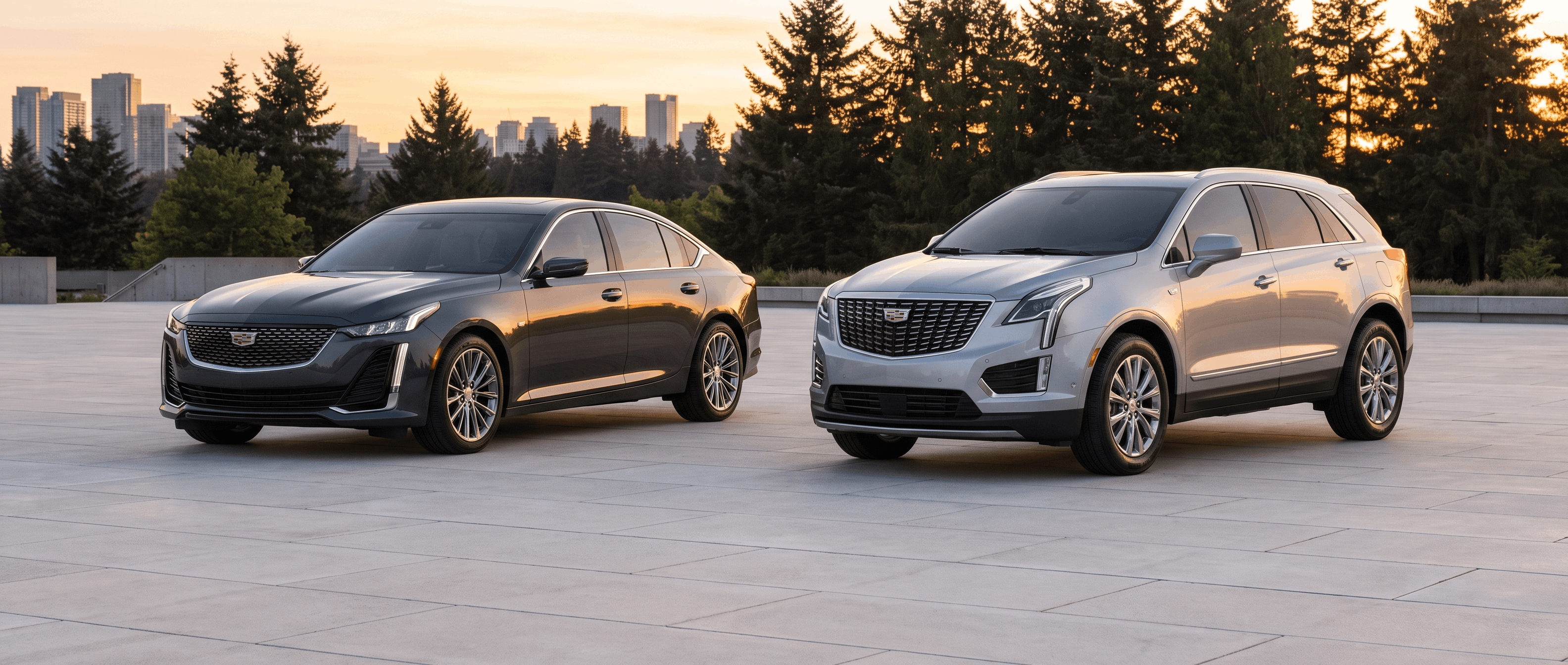
Trim level decides your tire technology before you ever reach our service drive. We'll say that plainly up front, because it's the single most useful thing to know before you walk in.
The 2026 Cadillac lineup carries three distinct tire technologies across its models. You'll find all-season self-sealing, all-season run-flat, and, on the LYRIQ and VISTIQ, self-sealing in larger low-profile configurations. Each behaves differently when Mississippi summer pavement is pushing 130 degrees, each handles a puncture its own way, and each has a different answer to "can you repair it?" Getting the right service starts with knowing which type is on your specific vehicle. Below is the framework we use.
- CT5 Sport and CT4 Sport: run-flat tires (19-in and 18-in respectively). Drivable after air loss, harder ride, generally not repairable after a puncture.
- CT5 Premium Luxury and CT4 Luxury/Premium Luxury: self-sealing tires. Ride like conventional tires, seal small punctures automatically, but require roadside assistance if the tire fully deflates.
- XT5: all-season non-sealing tires in two sizes by trim (235/65R18 on Luxury, 235/55R20 on Premium Luxury and Sport). Pressure management is the main maintenance variable in a Mississippi summer.
- LYRIQ and VISTIQ: self-sealing tires across most trims, no spare on either. Ask us specifically about the repair/replace threshold before you need to know the answer.
- Escalade and Escalade ESV: P275/50R22 all-season across all trims. Tire rotation intervals and heat-driven pressure checks matter most at this wheel size.
Schedule a service appointment with our team in Ridgeland when you're ready to talk tires in person.
What Actually Matters When You Choose or Replace a Cadillac Tire?
Four variables drive every tire decision for a Cadillac in this market, and they rank in a rough order: the tire technology itself, then the size your trim dictates, then the OEM TPC spec code, and finally the pressure discipline a Mississippi summer forces on you. Get those four straight and the rest follows.
| Option | Best For | Key Spec | Honest Tradeoff |
|---|---|---|---|
| All-season self-sealing (CT5 PL, CT4 PL/Luxury, LYRIQ, VISTIQ) | Ride comfort, daily commuting, highway touring | Seals small nail/screw punctures automatically | Not drivable if fully deflated; repair eligibility depends on puncture location |
| All-season run-flat (CT5 Sport, CT4 Sport) | Peace of mind after air loss, no spare needed | Supports driving up to 50 mph after puncture | Stiffer sidewall, noticeably harsher ride; typically replaced rather than repaired after use |
| All-season standard (XT5, most Escalade variants) | Value, ride quality, broad replacement availability | Widest repair options; easiest to source | Requires a spare or roadside assistance if punctured |
| Low-profile self-sealing (LYRIQ Signature, upper VISTIQ) | Handling response, aesthetic presence | 275/40R22 footprint, larger contact patch | More vulnerable to sidewall damage on rough pavement or parking curbs; replacement cost is higher |
Treat the table above as a starting point rather than the last word. OEM tire fit on every Cadillac is governed by a TPC (Tire Performance Criteria) specification code that Cadillac engineers to the specific suspension calibration of that model and trim. Replacing tires with the correct TPC code preserves the handling geometry the engineers intended. Swapping to a non-TPC tire isn't wrong in every case, though it's a conversation worth having with our service advisors before you decide.
Tire Technology Is Fixed at the Trim Level, and It Changes the Whole Service Question
Tire technology on your Cadillac is set the moment you pick a trim, and it reshapes every service question that follows, from whether a puncture can be plugged to whether you even have a spare to fall back on. The idea sounds complicated. In practice it's simple once you see the pattern, so let's walk the two sedans through it.
The 2026 CT5 Premium Luxury uses 18-inch self-sealing tires (245/45R18). Step up to the CT5 Sport and you're on 19-inch run-flat tires (245/40R19). Same nameplate, fundamentally different tire engineering. When a CT5 Sport owner arrives asking whether a punctured tire can be plugged, the answer is almost always no. Run-flat tires that have operated while deflated generally show internal sidewall stress that voids a repair, and Cadillac's guidance is replacement. A CT5 Premium Luxury owner with the same nail in the tread often has a repairable tire, because the self-sealing compound contained the pressure loss before any sidewall flexion damage occurred.
The 2026 CT4 follows the same logic. Luxury and Premium Luxury trims carry 17-inch and 18-inch self-sealing tires respectively, while the CT4 Sport steps up to 18-inch run-flats. The Sport trim's stiffer sidewall is part of what tightens the chassis feel, and that's the genuine tradeoff you're buying. You get sharper response, and you pay for it in ride firmness and replacement over repair.
Pros and Cons: Self-Sealing vs. Run-Flat
| Pros | Cons |
|---|---|
| Self-sealing: normal ride quality; small punctures seal automatically; repair often possible if caught early | Self-sealing: completely flat if sidewall fails or large puncture; no mobility without roadside assistance |
| Run-flat: can be driven at limited speed after air loss; no spare required; confidence on long highway runs | Run-flat: harsher ride due to reinforced sidewall; after deflation, usually replaced not repaired; higher rolling resistance |
Mississippi Summer Heat Adds a Variable the National Tire Guides Don't Address
The 2026 XT5 rides on 235/65R18 tires on the Luxury trim (rated at 35 PSI) and 235/55R20 on the Premium Luxury and Sport (rated at 36 PSI per Michelin's fitment data), and both figures are cold-inflation targets that read fine in the morning and climb hard by afternoon in this heat. "Cold" means checked before the vehicle has been driven and before the sun has been on the sidewalls for an hour.
The practical issue for this market is simple. Mississippi pavement surface temperatures regularly exceed 130 degrees Fahrenheit during July and August. Tire pressure increases approximately 1 PSI for every 10-degree rise in ambient temperature. A tire that reads correctly at 7 a.m. on a 75-degree morning can read 3 to 4 PSI higher by noon on a 95-degree afternoon. None of that calls for action; it's the physics of sealed air. The trap is checking pressure mid-day and deflating down to the cold target, which then leaves the tire underinflated once the vehicle cools overnight.
Neither the 2026 LYRIQ nor the 2026 VISTIQ carries a traditional spare. The LYRIQ runs 265/50R20 self-sealing tires across most configurations, with 275/40R22 self-sealing on Signature trims. On the VISTIQ, Luxury and Sport use 285/45R21 self-sealing, while Premium Luxury and Platinum step to 295/40R22. If a puncture falls outside the self-sealing compound's effective zone (which is the center tread area, away from the sidewall), you're dependent on roadside assistance. Know your OnStar status before you need it.
Match the Tire Maintenance to How You Actually Drive
How you drive should set your tire maintenance more than any fixed calendar does, because a highway commuter and a weekend hauler wear tires in genuinely different ways, and the right rotation and inspection rhythm follows the use pattern over a one-size interval. Two Cadillacs, two very different jobs.
A physician commuting daily between Ridgeland and the Medical District puts roughly 12,000 to 15,000 miles a year on a CT5, mostly Interstate 55 at sustained highway speeds. An Escalade ESV used primarily for school runs and weekend travel to the Gulf Coast accumulates a different wear pattern. More short trips, more stop-and-go heat buildup, more variation in load. The rotation schedule and inspection frequency are not identical for both.
Ridgeland sits along Interstate 55 in Madison County, Mississippi.
Cadillac recommends tire rotation intervals consistent with the vehicle's oil change schedule as a baseline, but that's a floor, not a ceiling. Our service advisors look at your actual tread wear pattern and adjust from there. Edge wear that's faster on one side tells us about alignment. Center wear that's accelerating tells us the pressure routine needs tightening. Those patterns read clearly in a Jackson metro summer, the heat compresses the useful life faster than the national wear estimates assume.
One question worth asking by name. What is the remaining tread depth across all four positions, front and rear? Rear tires on a rear-wheel-drive CT5 carry different stresses than the fronts, and uneven front-to-rear wear is exactly what rotation service on the sport sedans is meant to catch.
Schedule a Tire Inspection at Our Ridgeland Service Center
What to Ask Our Service Team Before You Leave the Drive
Two questions will do most of the work here, and you can bring them in no matter what put you on the service drive, because both get at whether your next set of tires will actually match what Cadillac engineered for your car. Ask them before you commit to anything.
First, what TPC code is on my current tire, and does my replacement match? Cadillac engineers each tire spec to the TPC standard for that model and trim. The code is molded into the tire sidewall and starts with "TPC Spec." A tire that's the right physical size but the wrong TPC code may not preserve the handling and TPMS calibration the vehicle expects.
Second, for LYRIQ and VISTIQ owners, what's my self-sealing repair window? Self-sealing tires can handle punctures in the center tread area up to a certain diameter. Beyond that threshold, or with any sidewall involvement, the tire requires replacement. Knowing that boundary now means you won't be making that decision from the shoulder of Interstate 220.
The honest tradeoff of the no-spare design is real. It saves weight, supports range efficiency on the electric models, and the self-sealing technology handles the large majority of everyday punctures without any intervention. What it won't cover is every scenario. Our team will walk you through the specifics for your model.
Frequently Asked Questions
Can I repair a run-flat tire on my Cadillac CT5 Sport or CT4 Sport after it's gone flat?
In most cases, no. Run-flat tires that have supported the vehicle's weight while deflated typically sustain internal sidewall stress that makes a standard plug-and-patch repair unsafe. Cadillac's guidance is to replace a run-flat tire that has been driven on while flat, even if the puncture itself appears small. The self-sealing tires on the CT5 Premium Luxury and CT4 Premium Luxury are a different case. Those may be repairable if the puncture is in the center tread zone and the tire maintained sufficient pressure. Our service team will assess the specific tire and tell you exactly what the options are.
How often should I check tire pressure on my Cadillac during a Mississippi summer?
Check cold pressure monthly at minimum, and before any trip longer than a couple of hours. "Cold" means before the vehicle has been driven or sat in direct sun for more than an hour. Tire pressure increases approximately 1 PSI for every 10-degree rise in ambient temperature, which means a tire measured correctly at 7 a.m. will read higher by midday. That's normal. The target figures for your specific trim are on the placard inside the driver's door jamb, not on the tire sidewall (the sidewall number is the maximum, not the target). Mississippi summers run long, and keeping pressure within spec is the single most effective thing you can do to protect tread life and maintain the handling your Cadillac was engineered to deliver.
What tire size should I expect on my specific Cadillac trim?
Tire size varies by model and trim level. The XT5 Luxury runs 235/65R18, while Premium Luxury and Sport trims step up to 235/55R20. The CT5 and CT4 use self-sealing tires on Luxury and Premium Luxury trims (18-inch and 17-inch respectively) but run-flats on Sport trims (19-inch and 18-inch). The LYRIQ carries 265/50R20 or 275/40R22 depending on trim, and the VISTIQ ranges from 285/45R21 to 295/40R22. The Escalade and Escalade ESV share P275/50R22 across all trims. When you're ready to replace, confirm the TPC specification code with our service team to ensure the replacement matches Cadillac's engineering spec for your vehicle.

![<script type="application/ld+json"> { "@context": "https://schema.org", "@type": "AutoDealer", "name": "Cadillac of Jackson", "url": "https://www.cadillacofjacksonms.com", "telephone": "(601) 948-5183", "address": { "@type": "PostalAddress", "streetAddress": "700 Adcock St", "addressLocality": "Ridgeland", "addressRegion": "MS", "postalCode": "39157" } } </script> <script type="application/ld+json"> { "@context": "https://schema.org", "@type": "Article", "headline": "Does the 2026 LYRIQ Lose Meaningful Range in a Mississippi Fall and Winter? Here's What to Plan For", "publisher": { "@type": "Organization", "name": "Cadillac of Jackson" }, "datePublished": "2026-10-05", "dateModified": "2026-10-05" } </script> <style> #just-private-label * { box-sizing: border-box; } #just-private-label { font-family: inherit; line-height: 1.7; color: #333333; max-width: 800px; margin: 0 auto; padding: 20px; } #just-private-label h2 { font-size: 1.5em; font-weight: 600; margin-top: 1.5em; margin-bottom: 0.75em; color: #000000; } #just-private-label h3 { font-size: 1.2em; font-weight: 600; margin-top: 1.2em; margin-bottom: 0.5em; color: #000000; } #just-private-label p { margin-bottom: 1em; font-size: 1em; } #just-private-label a { color: #000000; text-decoration: underline; } #just-private-label a:hover { text-decoration: none; } #just-private-label strong { font-weight: 600; } #just-private-label ul, #just-private-label ol { margin-bottom: 1em; padding-left: 1.5em; } #just-private-label li { margin-bottom: 0.5em; } #just-private-label .tip-box { background-color: #f9f9f9; border-left: 4px solid #333333; padding: 15px; margin: 1.5em 0; } #just-private-label .faq-section { background-color: #f5f5f5; padding: 30px; margin: 2em 0; } #just-private-label .faq-section h2 { margin-top: 0; margin-bottom: 1em; padding-bottom: 15px; border-bottom: 2px solid #333333; } #just-private-label .faq-item { margin-bottom: 1.5em; padding-bottom: 1.5em; border-bottom: 1px solid #e0e0e0; } #just-private-label .faq-item:last-child { margin-bottom: 0; padding-bottom: 0; border-bottom: none; } #just-private-label .faq-item h3 { color: #000000; margin-top: 0; margin-bottom: 0.5em; font-size: 1.1em; } #just-private-label .faq-item p { margin-bottom: 0; color: #333333; } #just-private-label .cta-section { margin-top: 2em; padding: 20px; text-align: center; } #just-private-label .cta-button { display: inline-block; padding: 12px 24px; margin: 10px; background-color: #000000; color: #ffffff !important; text-decoration: none; font-weight: 600; } #just-private-label .cta-button:hover { opacity: 0.9; text-decoration: none; } #just-private-label .dealer-footer { margin-top: 40px; padding-top: 20px; border-top: 1px solid #e0e0e0; text-align: center; font-size: 14px; color: #666666; } #just-private-label .dealer-footer p { margin: 5px 0; } @media (max-width: 600px) { #just-private-label { padding: 15px; } #just-private-label h2 { font-size: 1.3em; } #just-private-label h3 { font-size: 1.1em; } #just-private-label .cta-button { display: block; margin: 10px 0; } } </style> <div id="just-private-label"> <p>The honest answer is yes, some. You'll give up a little range, though far less than the national cold-weather headlines suggest, and with the right habits in place, most LYRIQ owners in the Ridgeland and Madison area will barely notice.</p> <p>Here's the practical picture. The <a href="https://www.cadillacofjacksonms.com/searchnew.aspx?ModelAndTrim=LYRIQ">2026 Cadillac LYRIQ</a> carries a 102 kWh Ultium battery rated by the EPA at up to 326 miles in rear-wheel-drive configuration and up to 319 miles in all-wheel drive. Those figures come from testing at moderate temperatures. When overnight lows in the Jackson metro drop into the mid-40s in November or brush the mid-30s on a January morning, you're looking at a 10-to-15 percent reduction under mild-cold conditions, based on independent EV winter-range data. That works out to roughly 28 to 49 fewer miles on a full charge, enough to notice and nowhere near the 30-percent cliff that dominates discussion about EVs in Minnesota.</p> <p>What matters more than the temperature itself is how the battery arrives at your charging session and what it does overnight. That's where the preparation pays off.</p> <h2 id="how-far-will-the-lyriq-really-go-here-when-temperatures-drop">How Far Will the LYRIQ Really Go Here When Temperatures Drop?</h2> <p>The range picture in this market is genuinely more favorable than the national narrative around EVs and cold weather, because Jackson's subtropical climate keeps sustained hard freezes uncommon. Overnight lows in November average near 48 degrees Fahrenheit and January lows average in the low-to-mid 40s, with the record low sitting at 10.4 degrees Fahrenheit, an anomaly rather than a weekly event. At 40 degrees Fahrenheit, independent EV testing data consistently shows an average range reduction of around 10 to 15 percent across modern battery platforms.</p> <p>That range reduction, when it does appear, comes from two places. First, lithium-ion battery chemistry becomes slightly less efficient below roughly 50 degrees Fahrenheit, producing higher internal resistance. Second, cabin heating draws energy directly from the pack. Unlike a gasoline vehicle that scavenges waste heat from the engine, the LYRIQ has to generate cabin warmth electrically, and a sustained cabin heating load can consume two or more kilowatts continuously. On a long highway run at 70 mph on a 38 degrees Fahrenheit morning, that load accounts for the bulk of the range reduction you'd see.</p> <div style="overflow-x: auto; margin: 1.5em 0;"><table style="width: 100%; border-collapse: collapse; font-family: inherit;"><thead><tr><th style="background-color: #f5f5f5; border: 1px solid #e0e0e0; padding: 14px 16px; text-align: left; font-weight: 600; color: #333333;">Driving scenario</th><th style="background-color: #f5f5f5; border: 1px solid #e0e0e0; padding: 14px 16px; text-align: left; font-weight: 600; color: #333333;">Conditions</th><th style="background-color: #f5f5f5; border: 1px solid #e0e0e0; padding: 14px 16px; text-align: left; font-weight: 600; color: #333333;">LYRIQ RWD starting range (EPA)</th><th style="background-color: #f5f5f5; border: 1px solid #e0e0e0; padding: 14px 16px; text-align: left; font-weight: 600; color: #333333;">Realistic cooler-weather range</th><th style="background-color: #f5f5f5; border: 1px solid #e0e0e0; padding: 14px 16px; text-align: left; font-weight: 600; color: #333333;">Range note</th></tr></thead><tbody><tr><td style="border: 1px solid #e0e0e0; padding: 14px 16px; text-align: left; color: #333333;">Metro commute, 40-55 degrees Fahrenheit morning</td><td style="border: 1px solid #e0e0e0; padding: 14px 16px; text-align: left; color: #333333;">Level 2 home charge overnight, cabin preconditioned</td><td style="border: 1px solid #e0e0e0; padding: 14px 16px; text-align: left; color: #333333;">326 mi EPA</td><td style="border: 1px solid #e0e0e0; padding: 14px 16px; text-align: left; color: #333333;">~285-300 mi</td><td style="border: 1px solid #e0e0e0; padding: 14px 16px; text-align: left; color: #333333;">Minimal impact; short trips don't fully cold-soak the pack</td></tr><tr><td style="border: 1px solid #e0e0e0; padding: 14px 16px; text-align: left; color: #333333; background-color: #fafafa;">Highway run to New Orleans (I-55 S), 38 degrees Fahrenheit start</td><td style="border: 1px solid #e0e0e0; padding: 14px 16px; text-align: left; color: #333333; background-color: #fafafa;">Battery not preconditioned, heater active at 70 mph</td><td style="border: 1px solid #e0e0e0; padding: 14px 16px; text-align: left; color: #333333; background-color: #fafafa;">326 mi EPA</td><td style="border: 1px solid #e0e0e0; padding: 14px 16px; text-align: left; color: #333333; background-color: #fafafa;">~260-275 mi</td><td style="border: 1px solid #e0e0e0; padding: 14px 16px; text-align: left; color: #333333; background-color: #fafafa;">Plan one charge stop; pack colder at departure</td></tr><tr><td style="border: 1px solid #e0e0e0; padding: 14px 16px; text-align: left; color: #333333;">Highway run, same conditions, battery preconditioned</td><td style="border: 1px solid #e0e0e0; padding: 14px 16px; text-align: left; color: #333333;">myCadillac app warm-up while still plugged in</td><td style="border: 1px solid #e0e0e0; padding: 14px 16px; text-align: left; color: #333333;">326 mi EPA</td><td style="border: 1px solid #e0e0e0; padding: 14px 16px; text-align: left; color: #333333;">~290-305 mi</td><td style="border: 1px solid #e0e0e0; padding: 14px 16px; text-align: left; color: #333333;">Preconditioning recovers 20-30 mi of that gap</td></tr><tr><td style="border: 1px solid #e0e0e0; padding: 14px 16px; text-align: left; color: #333333; background-color: #fafafa;">January morning, 35 degrees Fahrenheit overnight low</td><td style="border: 1px solid #e0e0e0; padding: 14px 16px; text-align: left; color: #333333; background-color: #fafafa;">80% charge target, battery sat cold in driveway</td><td style="border: 1px solid #e0e0e0; padding: 14px 16px; text-align: left; color: #333333; background-color: #fafafa;">261 mi (80% of 326)</td><td style="border: 1px solid #e0e0e0; padding: 14px 16px; text-align: left; color: #333333; background-color: #fafafa;">~230-245 mi</td><td style="border: 1px solid #e0e0e0; padding: 14px 16px; text-align: left; color: #333333; background-color: #fafafa;">Correct with preconditioning; not an emergency margin</td></tr><tr><td style="border: 1px solid #e0e0e0; padding: 14px 16px; text-align: left; color: #333333;">AWD in rain, 50 degrees Fahrenheit, wipers and heat running</td><td style="border: 1px solid #e0e0e0; padding: 14px 16px; text-align: left; color: #333333;">Typical November wet commute</td><td style="border: 1px solid #e0e0e0; padding: 14px 16px; text-align: left; color: #333333;">319 mi EPA</td><td style="border: 1px solid #e0e0e0; padding: 14px 16px; text-align: left; color: #333333;">~275-290 mi</td><td style="border: 1px solid #e0e0e0; padding: 14px 16px; text-align: left; color: #333333;">AWD adds modest efficiency cost; heating load is the bigger factor</td></tr></tbody></table></div> <p>These figures use the EPA's 326-mile RWD and 319-mile AWD estimates as the baseline and apply independent EV cold-weather testing ranges. Treat them as planning estimates rather than guarantees. Actual results vary with speed, wheel size, and individual driving habits.</p> <h2 id="where-do-you-charge-in-and-around-the-jackson-metro">Where Do You Charge in and Around the Jackson Metro?</h2> <p>The public charging picture here has improved steadily, and for a vehicle with the LYRIQ's 326-mile range it matters most for longer runs rather than daily life. Charging at home overnight is the foundation, and arriving the next morning with a full or near-full battery is the normal rhythm for a LYRIQ. That's still the right base to build on.</p> <p>For public sessions, the I-55 corridor running through Ridgeland and into Jackson is the spine of the local network. Entergy Mississippi operates a DC fast charging station at Renaissance at Colony Park in Ridgeland, situated directly off I-55, which provides access to CCS1 DC fast charging for northbound and southbound travelers. The downtown Jackson network expanded in 2025 with Level 2 installations at Union Station and the Mississippi Museum of Art, among other civic locations, through the city's agreement with Adopt A Charger.</p> <p>On a public DC fast charger the LYRIQ charges at up to 190 kW, which Cadillac rates at up to 86 miles of range added in approximately 10 minutes under optimal conditions. In cooler weather, that speed is what preconditioning is designed to protect. A battery that arrives cold at a fast charger throttles its acceptance rate right away, and a battery that arrives warmed will hit its peak charging rate from the first minute of the session. On a practical basis, that distinction can mean the difference between a 40-minute stop and a 65-minute one.</p> <p>Grounded in what the specs actually show, our team's take is simple. The 190 kW peak is real, but it's a brief peak. Real-world DC fast sessions from 10 to 80 percent take closer to 40 to 45 minutes under good conditions, because the charging rate tapers as the battery fills. Plan around that real window, not the 10-minute marketing figure.</p> <p><a href="https://www.cadillacofjacksonms.com/serviceappmt.aspx">Schedule a service visit</a> if you'd like our team to walk through your home charging setup and confirm the onboard charger configuration on your specific LYRIQ.</p> <div class="tip-box"><strong>Tip:</strong> The LYRIQ's standard onboard charger is 11.5 kW, which adds up to 31 miles of range per hour on a Level 2 home charger. The available 19.2 kW upgrade brings that to roughly 51 miles per hour. If you drive more than 150 miles on a routine day, the 19.2 kW option changes your morning margin meaningfully, and cooler weather makes that margin count more.</div> <p><strong>Print-and-go cooler-weather charging checklist</strong></p> <p>Use this each morning from November through February:</p> <ul><li>[ ] Set the myCadillac app departure time the night before so the battery and cabin warm while still plugged in</li><li>[ ] Charge to 80 percent for daily use; increase to 90 percent on days you have a long drive planned</li><li>[ ] Confirm public charging connector type before leaving: LYRIQ uses CCS1 (not CHAdeMO)</li><li>[ ] On highway runs over 150 miles, identify your mid-route charging stop before departure and note the network name</li><li>[ ] Reduce cabin temperature by 2-3 degrees and rely on heated seats and steering wheel first; they draw far less energy than full HVAC at temperature</li><li>[ ] If parking outside overnight in sub-40 degree Fahrenheit conditions, plug in even when the battery is near-full so the thermal management system can maintain pack temperature on grid power</li><li>[ ] After a DC fast charging session on a cold morning, allow 5-10 minutes of driving before expecting peak range accuracy on the display</li></ul> <p><a href="https://www.cadillacofjacksonms.com/serviceappmt.aspx" class="cta-button">Schedule a Charging System Check</a></p> <h2 id="plan-it-this-way-the-ridgeland-lyriq-owner-s-fall-and-winter-routine">Plan It This Way: The Ridgeland LYRIQ Owner's Fall and Winter Routine</h2> <p>The north metro's cooler season is, if we're candid, a fairly kind environment for an EV, because the LYRIQ's 102 kWh pack was engineered to handle temperature ranges well beyond what a Mississippi winter reliably delivers. Your planning effort boils down to three habits, and once they're routine they take almost no active thought.</p> <p><strong>Precondition before every departure.</strong> This is the single most effective tool, and it costs nothing in range because it runs on grid power while the vehicle's still plugged in. Set a departure time in the myCadillac app the night before, and the system warms the cabin and the battery pack to an optimal operating temperature before you disconnect. On a 38-degree morning in the driveway, the first few minutes of a drive run the heater hardest, and that's exactly the window preconditioning covers. You leave with a warm battery, full range, and a comfortable cabin on the coldest morning the Jackson metro typically offers.</p> <p><strong>Treat the 80-percent target as flexible, not fixed.</strong> On most days, charging to 80 percent protects long-term battery health, as Cadillac recommends. On days when you know you're running to Brandon or making a longer run toward Hattiesburg or New Orleans on I-55 South, charge to 90 percent. The extra buffer is there for exactly these situations. If you do charge to 100 percent on an occasional basis for a long trip, the Ultium chemistry is designed to tolerate that; just don't leave it sitting at 100 percent for days at a time.</p> <p><strong>Know your corridor before you go.</strong> The CCS1 public network along I-55 covers the metro's primary travel spine. For trips beyond roughly 200 miles, identify one charging stop, confirm the network, and note whether it's a ChargePoint, Electrify America, or Tesla Supercharger location. The LYRIQ accepts Tesla Superchargers with the available NACS adapter from Cadillac, which expands the accessible network considerably on longer routes. Mississippi's charging infrastructure has grown, and it keeps growing, though it rewards a driver who checks a route rather than one who improvises.</p> <p>We'll name the tradeoff straight out. The LYRIQ's 190 kW DC fast charging peak is competitive, yet it's not the 800-volt architecture some European and Korean platforms offer, which can charge more consistently at high speeds across the session. For metro Ridgeland daily life, that distinction is irrelevant. For a 400-mile round trip to the Gulf Coast, you'll want the second habit and the third firmly in place.</p> <p><a href="https://www.cadillacofjacksonms.com/finance.aspx">Explore financing options</a> if you're still in the evaluation stage, or <a href="https://www.cadillacofjacksonms.com/searchnew.aspx">view current LYRIQ inventory</a> to see what's on our lot.</p> <div class="faq-section"><h2>Frequently Asked Questions</h2><script type="application/ld+json">{ "@context": "https://schema.org", "@type": "FAQPage", "mainEntity": [ { "@type": "Question", "name": "Does the LYRIQ lose a lot of range in Mississippi winters?", "acceptedAnswer": { "@type": "Answer", "text": "In the Jackson metro's typical cooler weather, no. Overnight lows in November average near 48 degrees Fahrenheit and January lows average in the low-to-mid 40s. At those temperatures, independent EV range-loss data shows roughly 10 to 15 percent reduction from the EPA estimate, which translates to approximately 28 to 49 fewer miles on a full charge for a RWD LYRIQ. That's a manageable figure, particularly when preconditioning is part of the daily routine. Sustained hard freezes that drive 25 to 30 percent range loss are uncommon in this climate." } }, { "@type": "Question", "name": "How does preconditioning work on the LYRIQ, and does it actually help?", "acceptedAnswer": { "@type": "Answer", "text": "Preconditioning uses the myCadillac app to warm the vehicle's battery pack and cabin while the vehicle is still connected to a home charger. Because it draws from the grid rather than the battery, it preserves your full charge at departure. The practical benefit is twofold: the cabin is already at temperature before you disconnect, so the heater draws less energy during the first part of your drive, and the battery pack is warm enough to accept DC fast-charge power at or near its 190 kW rated peak from the first minute of a charging session. A cold battery throttles that rate steeply." } }, { "@type": "Question", "name": "Should I change my charging target in winter?", "acceptedAnswer": { "@type": "Answer", "text": "For most local driving, Cadillac recommends an 80-percent daily charge limit to protect long-term battery chemistry. In cooler weather, if you have a longer drive planned, raising that target to 90 percent is a reasonable adjustment and doesn't meaningfully stress the Ultium pack on an occasional basis. Reserve 100 percent for long trips only, and avoid leaving the battery at 100 percent for extended periods. For metro-area commutes in the 30-to-50-mile daily range, 80 percent remains appropriate even in January." } } ] }</script><div class="faq-item"><h3>Does the LYRIQ lose a lot of range in Mississippi winters?</h3><p>In the Jackson metro's typical cooler weather, no. Overnight lows in November average near 48 degrees Fahrenheit and January lows average in the low-to-mid 40s. At those temperatures, independent EV range-loss data shows roughly 10 to 15 percent reduction from the EPA estimate, which translates to approximately 28 to 49 fewer miles on a full charge for a RWD LYRIQ. That's a manageable figure, particularly when preconditioning is part of the daily routine. Sustained hard freezes that drive 25 to 30 percent range loss are uncommon in this climate.</p></div><div class="faq-item"><h3>How does preconditioning work on the LYRIQ, and does it actually help?</h3><p>Preconditioning uses the myCadillac app to warm the vehicle's battery pack and cabin while the vehicle is still connected to a home charger. Because it draws from the grid rather than the battery, it preserves your full charge at departure. The practical benefit is twofold: the cabin is already at temperature before you disconnect, so the heater draws less energy during the first part of your drive, and the battery pack is warm enough to accept DC fast-charge power at or near its 190 kW rated peak from the first minute of a charging session. A cold battery throttles that rate steeply.</p></div><div class="faq-item"><h3>Should I change my charging target in winter?</h3><p>For most local driving, Cadillac recommends an 80-percent daily charge limit to protect long-term battery chemistry. In cooler weather, if you have a longer drive planned, raising that target to 90 percent is a reasonable adjustment and doesn't meaningfully stress the Ultium pack on an occasional basis. Reserve 100 percent for long trips only, and avoid leaving the battery at 100 percent for extended periods. For metro-area commutes in the 30-to-50-mile daily range, 80 percent remains appropriate even in January.</p></div></div> <div class="cta-section"><a href="https://www.cadillacofjacksonms.com/finance.aspx" class="cta-button">Start Your LYRIQ Financing Application</a></div> <footer class="dealer-footer"><p><strong>Cadillac of Jackson</strong></p><p>700 Adcock St, Ridgeland, MS 39157</p><p>(601) 948-5183</p></footer> </div>](/static/dealer-27124/hf_20261005_191338_fab69b8c-9277-460e-a3e9-c87bc2c7db0a.png)