
Blog

All Cadillac Model Info
2026 Cadillac Escalade on the Natchez Trace Parkway in Mississippi during autumn travel

Cadillac Battery Testing Before Cooler-Weather Travel | Ridgeland

In this article What's Actually Going On With Your Battery? The Mississippi Heat Mechanism: Why Summer Builds the Problem The EV Lineup Has Its Own 12V Battery Story DIY Checks vs. What the Service Team Does A certain symptom turns up around this time every year. The vehicle ran fine through September and October. Then a cold front drops overnight lows into the mid-30s, and the morning hands you either a sluggish crank, a cluster of warning lights you've never seen, or, in an EV, a "Reducing Features" alert that wasn't there a week ago. The cause is almost never the temperature itself. Cold is just the moment of reckoning. What actually happened was July. A Jackson metro summer runs three solid months of afternoons above 90 degrees F, with humidity that holds heat under the hood long after sundown. That sustained thermal stress speeds up plate corrosion and electrolyte degradation inside an AGM battery, quietly trimming its capacity. The battery keeps starting the car through the warm months because warm months ask less of it. Then November arrives, the electrochemical reactions slow, and a battery sitting at 70% of its original capacity turns out to have needed more. Our service team at Cadillac of Jackson can run a full battery load test before that moment finds you, and before Thanksgiving travel or a business run to Nashville puts a marginal battery under real stress. What's Actually Going On With Your Battery? Symptom Likely Cause What to Do Sluggish or slow crank, especially on the first cold morning AGM battery below serviceable CCA threshold; cold reduced available current Load test immediately; a single cold-failure event often precedes rapid decline Random warning lights (traction control, parking assist, infotainment resets) Voltage sag during starting drops below 9.6V, triggering module brownouts Load test and charging-system check; ghost codes that clear themselves are a battery signal "Reducing Features" or "Propulsion Power Reduced" on LYRIQ, ESCALADE IQ, OPTIQ, VISTIQ 12V auxiliary battery low or parasitic draw keeping it from topping off Have the 12V checked separately from the high-voltage pack; it's a different system Battery that tested fine last spring now struggling Summer heat accelerated internal degradation between tests Test again now; heat damage accumulates silently and shows up in cold Visible corrosion on terminals, or battery case that looks swollen Advanced deterioration; heat buckled the case or vented the electrolyte Replace promptly; a compromised case is not a borderline call The Mississippi Heat Mechanism: Why Summer Builds the Problem The XT5 and the full ICE lineup carry factory-spec AGM batteries, which handle both heat and cold better than conventional flooded batteries, and that resilience is genuine. That resilience has limits, though, and heat is the AGM's tougher adversary, not cold. Inside any lead-acid AGM battery, current comes from an electrochemical reaction between lead plates and a glass-mat electrolyte. High ambient temperatures push that reaction past its design pace, gradually corroding the plate surfaces and shrinking the battery's usable surface area. By the time the battery is two or three years old, after three Jackson summers, the heat-driven degradation can leave it well below its rated cold cranking amp output, even while it still rests at a reasonable open-circuit voltage. Our service team sees a specific pattern. A battery that reads 12.5 or 12.6 volts at rest looks plausible on a quick check. Only under load, when the starter pulls a surge of current and system voltage has to stay above 9.6 volts, does the hidden capacity loss turn into a failure. A battery testing at 65% of its rated CCA on a 50-degree November morning is marginal. At 35 degrees, it's a problem. Important: A cold battery can produce a falsely low CCA reading in testing. Per GM's published service guidance, an AGM battery should be warmed to above 40 degrees F (4 degrees C) before any load test is conducted. A battery tested in a cold garage may appear to fail when it would actually pass at room temperature. This matters if you're trying to decide whether to replace or not. The EV Lineup Has Its Own 12V Battery Story Every Cadillac EV carries two batteries, and the smaller of the two is where the surprises hide, because the LYRIQ, the ESCALADE IQ, the OPTIQ, and the VISTIQ all run a separate 12-volt AGM auxiliary battery alongside the high-voltage Ultium pack, a system most online guides skip entirely. They're two entirely different systems, and the distinction matters more than it sounds. The high-voltage Ultium battery powers the drive motors and handles range. The 12V auxiliary battery powers the locks, the infotainment system, the instrument cluster, the charging control modules, and the systems that let the vehicle boot up at all. Drop the 12V below threshold and the high-voltage system can't wake. The car won't start. The range on the display doesn't matter. A Cadillac EV has no alternator. The 12V battery is maintained by a DC-to-DC converter that draws from the main high-voltage pack and recharges the 12V at set intervals as the car sits unused. Let the vehicle sit for long stretches without a charge, or let a module keep the system from going fully to sleep, and the 12V can drain. That particular issue (a parasitic draw from an infotainment or gateway module that doesn't fully sleep) has been documented on LYRIQ models and addressed by GM through software updates. For owners, the takeaway is simple. The 12V auxiliary battery in a Cadillac EV deserves its own inspection, and you shouldn't assume the high-voltage pack's health covers everything. Next step: If your Cadillac EV has shown a "Reducing Features" alert, a "Propulsion Power Reduced" message, or unusual warning clusters after a cold night, contact our service team before your next long trip. Those symptoms often resolve once the 12V is addressed, but they don't resolve on their own. Schedule a Pre-Travel Battery Inspection DIY Checks vs. What the Service Team Does You can run a sensible first check at home with a digital multimeter, and it's worth doing, but a multimeter only tells you part of the story, and the part it leaves out, the battery's behavior under real starting load, is exactly the part that strands you on a cold morning. A healthy, fully charged 12V AGM battery at rest reads approximately 12.6 to 12.8 volts. A reading below 12.4 volts at rest, after the vehicle has sat for several hours, suggests the battery isn't holding a full charge and warrants a proper load test. Treat that as an early warning and nothing more. A home multimeter can't measure true cold cranking amp delivery under load, can't assess the alternator's charging output on gas models or the DC-to-DC converter health on EVs, can't detect parasitic draws quietly draining the system, and can't catch a battery that holds voltage at rest but collapses under the starting load. That last scenario, a battery with strong resting voltage and severely reduced CCA output, is exactly the failure pattern that surprises drivers who thought they'd already checked. A professional load test applies a controlled current draw and measures voltage stability at the same time, so it tells you whether the battery can actually sustain the surge the starter demands, charge level aside. Pair that test with an alternator output check on ICE models, or a DC-to-DC converter voltage check on the EV lineup, and you can see the charging system as a whole instead of guessing from one component. Skip the temptation to read a battery's health from its age alone. A battery under four years old that passes a load test confidently probably just needed a full charge cycle. Past five years and testing at 70% of rated CCA or below, replacement before winter travel is the straightforward call. AGM batteries in modern vehicles typically serve four to seven years, and a marginal one at the edge of that range doesn't get better by waiting. Frequently Asked Questions Does cold weather actually damage my Cadillac's battery, or just slow it down temporarily? Cold doesn't damage a healthy AGM battery. What it does is reveal damage that heat already caused. At 32 degrees F, a battery delivers roughly 65% of its rated capacity. At 0 degrees F, that figure drops to around 50%. If the battery's internal structure was already compromised by Mississippi's summer heat, those cold-weather reductions push it past the starting threshold. A battery with strong capacity comes through the first cold front without issue. A marginal one doesn't, and the cold gets the blame for a problem that formed in July and August. Why is my Cadillac showing warning lights and infotainment resets in cooler weather, even though it starts? A weak AGM battery can allow system voltage to sag below 9.6 volts during the cranking surge, which is enough to trigger a brief brownout in the vehicle's electronic modules. Those modules may reboot or log fault codes, producing warning lights on the instrument cluster, infotainment restarts, or error messages from the driver assist systems. The vehicle starts because the battery still has just enough capacity to turn the engine over, but the voltage drop during that effort disturbs the sensitive electronics. Load-testing the battery and checking the charging system will typically identify the cause. These are not random software glitches; they're a battery signal. Book Your Battery Check Cadillac of Jackson 700 Adcock St, Ridgeland, MS 39157 (601) 948-5183

Read More
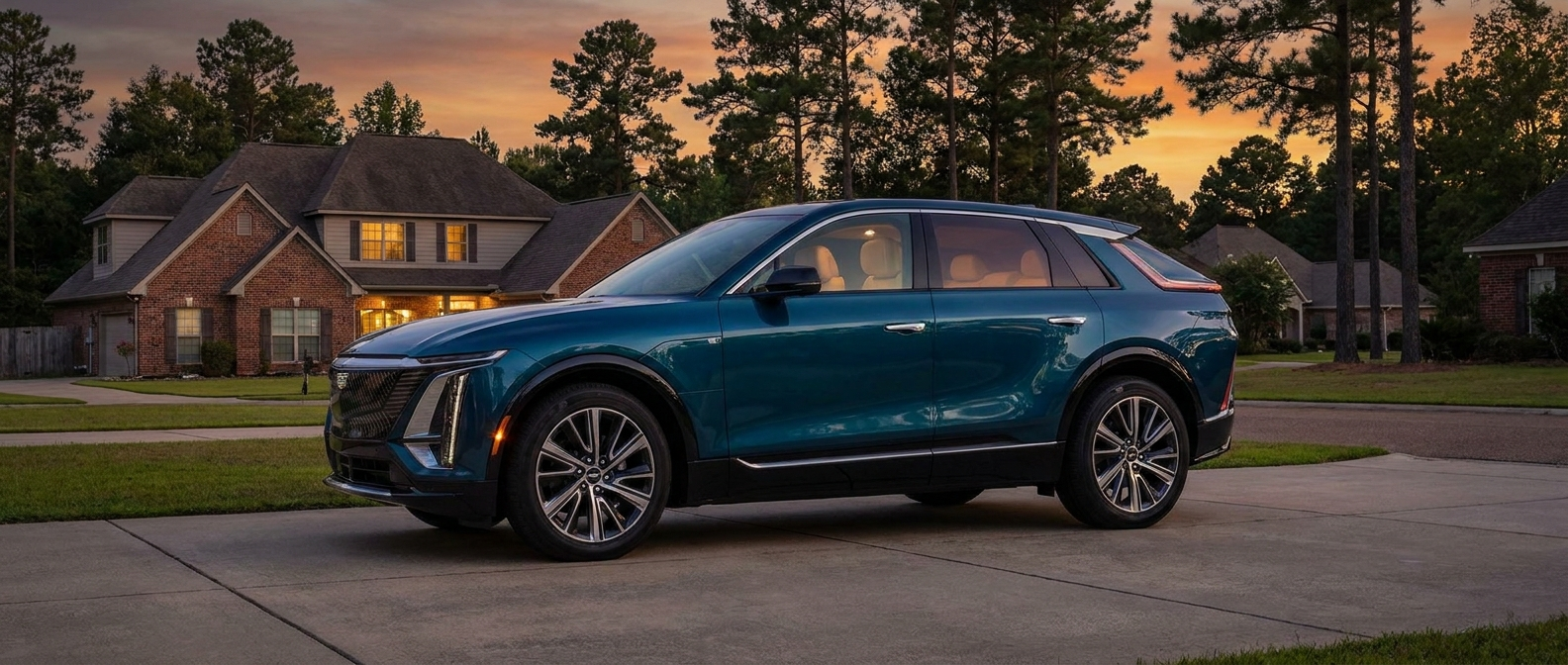
2026 Cadillac VISTIQ parked in Brandon Mississippi suburban driveway at dusk

3 Cadillac SUVs Compared for Brandon-Area Families | Cadillac of Jackson

In this article How Do These Three Cadillac SUVs Actually Compare? Which Model Does the Third Row Change Everything For? Does the VISTIQ's Electric Range Actually Work for Brandon Families? How Do You Match the Right Cadillac to Your Family's Actual Week? Which Cadillac SUV fits our family? The answer isn't the same for every household in Brandon. It depends on two rows versus three, a daily electric commute versus a boat-trailer weekend, and whether the rear seats need to hold adults or just fold flat for Costco runs now and then. We work through all three models on our lot, and the thing that separates them is rarely brand or prestige. It comes down to size, configuration, and whether the family charges at home. Below is how the 2026 Cadillac XT5, the 2026 Cadillac VISTIQ, and the Escalade family actually compare when you measure them against what Brandon households need. The short version XT5: The choice for established couples or small families who want two refined rows, 63 cubic feet of cargo flat, and a cabin that makes the I-20 run to Ridgeland feel like nothing. VISTIQ: The choice for a family that needs a genuine, adult-usable third row, wants to do most of its driving on a single charge, and is ready to plug in at home each night. Escalade / Escalade ESV: The choice when the third row gets used every trip, a trailer is in the picture, or the household simply needs the most presence and interior space Cadillac builds. The tradeoff: The XT5 gives up the third row. The VISTIQ's cargo behind that third row is tight. The Escalade ESV solves both but asks for more garage. How Do These Three Cadillac SUVs Actually Compare? These three sort cleanly by size and powertrain, with the XT5 covering five seats, the VISTIQ and Escalade covering seven, and the Escalade ESV adding a tow hook plus roughly fifteen more feet of vehicle, so once you lay the matrix flat the choice gets a lot more practical. The spread is wide. The Escalade ESV stands alone on cargo and towing; the VISTIQ is the only electric three-row in the lineup; and the XT5 is the one you choose when two rows and a quieter footprint are exactly right. Spec 2026 XT5 2026 VISTIQ 2026 Escalade 2026 Escalade ESV Rows / Seating 2 rows / 5 3 rows / 7 3 rows / 7 3 rows / 7-8 Cargo behind 3rd row n/a 15.2 cu ft 25.5 cu ft 41.5 cu ft Cargo behind 2nd row 30 cu ft 43 cu ft 72.9 cu ft 94.1 cu ft Max cargo (all rows flat) 63 cu ft 80.2 cu ft 120.5 cu ft 142.2 cu ft Powertrain 2.0T / 3.6L V6 (gas) Dual-motor EV 6.2L V8 (gas) 6.2L V8 (gas) Power output 235-310 hp 615 hp 420 hp 420 hp Towing capacity Up to 3,500 lbs Towing not recommended for range Up to 8,100 lbs Up to 8,000 lbs EPA estimate 24 mpg combined (FWD 2.0T) 305 miles / 86 MPGe combined Varies by config Varies by config Overall length 189.6 in 205.6 in 211.9 in 226.9 in Best for Couples, small families, commuters Families needing 3 rows + EV range Large families, towers Maximum cargo + adult 3rd row Which Model Does the Third Row Change Everything For? Among Brandon and Rankin County families, the third row is the single spec that reorders this whole lineup, and the XT5 settles its own case immediately by not having one, which stays a deliberate engineering choice that keeps the cabin proportions tight and the driving character intact rather than any kind of flaw. If your household runs two adults and maybe one child in the second row, the XT5's 30 cubic feet behind that seat (and 63 flat) swallows school gear, weekend luggage, and a Costco trip without asking anything of you. The gap opens once a third row becomes genuinely necessary. Cadillac rates the VISTIQ third-row legroom on a 122-inch wheelbase, and independently published road tests confirm adults can ride back there without folding their knees into the seatback. The Escalade does the same for seven, and the Escalade ESV extends that third-row comfort by an additional 1.8 inches of legroom (36.7 inches versus 34.9 in the standard wheelbase, per Cadillac specifications). The XT5 is the right call for five. If a sixth or seventh seat is a real need, not a hypothetical one, the VISTIQ and Escalade are where the conversation starts. For families with three kids in school, or households that routinely move a full complement of adults, the jump from the XT5 to the three-row options reads less like a trim upgrade and more like a different vehicle class entirely. Explore Financing Options Does the VISTIQ's Electric Range Actually Work for Brandon Families? It works for most Brandon families, and the math behind that is specific, since the EPA estimates 305 miles of range for the 2026 VISTIQ on the standard 11.5-kW charger configuration, and Brandon sits roughly 25 miles east of Ridgeland on I-20 and Highway 80, so a round trip to our showroom and back adds about 50 miles to a charge. Add school runs, the occasional trip up to the reservoir, and a typical day of Rankin County driving, and the VISTIQ's daily range clears that routine without ever needing a public charge, reservoir mornings included. The genuine tradeoff for the VISTIQ sits at the cargo wall behind that third row, where you get 15.2 cubic feet with all seven seats occupied. A weekend bag each is about the limit. Pack a hockey tournament's worth of gear with a full load of passengers, and you'll run out of room fast. The VISTIQ's maximum cargo space of 80.2 cubic feet (second and third rows down) is competitive for a midsize SUV, and 43 cubic feet behind the second row is generous. But if the family needs all seven seats in use and substantial cargo at the same time, the Escalade ESV's 41.5 cubic feet behind its third row makes that easier. The VISTIQ pairs dual-motor all-wheel drive with 615 horsepower as standard. Its EPA combined efficiency estimate lands at 86 MPGe. For a household that charges nightly at home, the VISTIQ replaces a fuel stop entirely on most weekdays. VISTIQ Escalade ESV Pros EPA-estimated 305 mi range; 615 hp; EV running costs; 7 seats 41.5 cu ft behind 3rd row; tows up to 8,000 lbs; adult-usable 3rd row; 142.2 cu ft max cargo Cons 15.2 cu ft behind 3rd row (seats up); no meaningful tow capacity Fuel cost of a 6.2L V8; 226.9 inches long; not for households that want EV running costs The Ross Barnett Reservoir makes a natural reference point here. A family heading out on a Saturday morning, boat in tow, needs either the Escalade or the Escalade ESV, and none of that is a knock on the VISTIQ. Physics does the deciding. Trailer loads cut sharply into an EV's range, and the VISTIQ isn't rated for meaningful towing, so if the trailer comes out often, the 6.2-liter V8 in the Escalade (rated to tow up to 8,100 pounds properly equipped, per Cadillac specifications) is the straight answer. How Do You Match the Right Cadillac to Your Family's Actual Week? Matching the right Cadillac to your week starts with a sharper question than seat count, because what settles the decision is which seats you actually fill and how often, and three household profiles sort that out almost automatically once you picture a normal week. Most families recognize themselves inside a sentence or two. The five-passenger household with highway commutes. Both adults commute, the rear seat holds one or two children, and the weekend trip is luggage plus cargo, not a trailer or a full third row. The XT5 fits this household precisely. Its 2.0-liter turbocharged four-cylinder earns an EPA estimate of 22 city / 29 highway / 24 combined (FWD configuration), which matters on the I-20 corridor where daily mileage adds up. At 189.6 inches overall, it also garages cleanly in the standard two-car setups common in Brandon neighborhoods. The seven-seat family that commutes daily and charges at home. This household fills all three rows on a regular basis, has a Level 2 charger in the garage (or plans to install one), and doesn't pull a trailer. The VISTIQ is built for exactly that profile. Its 305-mile EPA estimate clears a full week of Rankin County driving on a single charge cycle with margin to spare. The cabin carries the same technology suite and material standard as the rest of Cadillac's electric lineup. The household that needs everything. Full three-row seating, real cargo behind that third row, towing capacity for a boat or trailer, and enough interior space for a long drive to the Gulf Coast or beyond. The Escalade ESV is the answer. Its 41.5 cubic feet behind the third row (versus 25.5 in the standard Escalade) and 142.2-cubic-foot maximum cargo capacity aren't close to anything else in the lineup. At 226.9 inches, it's a vehicle that asks for a larger garage bay or a driveway with room to spare. Our team's honest observation: When Brandon families come in uncertain between the VISTIQ and the Escalade ESV, the question that resolves it most cleanly is trailer frequency. If a trailer comes out more than a handful of times per year, the Escalade wins on capability without debate. If the trailer's rare and the EV running cost appeals, the VISTIQ earns that household's daily miles in a way a V8 simply can't match. Frequently Asked Questions Does the Cadillac XT5 have a third row? No. The 2026 XT5 is a two-row, five-passenger SUV. Cadillac built it to prioritize second-row comfort and cargo versatility over raw passenger count, giving the rear seat 39.0 inches of legroom and the cargo area 30 cubic feet behind it, expanding to 63 cubic feet with the seats folded. If a third row's a genuine requirement, the VISTIQ and the Escalade family are where you start. How far can the 2026 Cadillac VISTIQ travel on a full charge? The EPA estimates 305 miles of range for the 2026 VISTIQ in standard 11.5-kW charger configuration. That figure covers round-trip Brandon-to-Ridgeland commutes and routine Rankin County driving with meaningful charge remaining. Towing or carrying a maximum load reduces the available range, as it does on any EV, so households that regularly pull a trailer should look at the Escalade's 6.2-liter V8 platform instead. Get a Trade-In Estimate Cadillac of Jackson 700 Adcock St, Ridgeland, MS 39157 (601) 948-5183

2026 Cadillac Escalade at a dealership service drive in Ridgeland, MS before holiday travel season

What to Ask About Cadillac Service Before the Holiday Rush | Ridgeland

Before the Thanksgiving and Christmas travel season stacks up on the I-55 corridor, the right service conversation starts with one question your advisor needs you to answer first. Is your Cadillac a gas model or an electric one? The answer reshapes every item on the checklist. Schedule that conversation now so your Cadillac is ready before the bays fill up. Gas models follow the Oil Life Monitor; electric models run on a completely different set of intervals. Know which category you're in, and the rest of the conversation gets straightforward. What Does My Gas Cadillac Actually Need Right Now? Your gas Cadillac leans on the Oil Life Monitor as its starting point, and that system isn't a simple odometer counter; Cadillac's on-board logic tracks engine temperature, trip length, and driving style to calculate remaining oil life as a percentage, with cadillac.com listing 7,500 miles or 12 months as the standard rhythm for oil and filter service. Ask your advisor this directly. "What does my Oil Life Monitor show, and is it worth combining service with a tire rotation before Thanksgiving?" Pairing both at one visit is efficient, and that 7,500-mile rhythm covers the rotation anyway. If your monitor sits above 40 percent, you may not need oil service yet. If it's closer to 15 percent, you'll want it done before a long run up I-55. Ask specifically. Don't just book because a few months have passed. Gas models in the lineup (the CT5, the XT5, the Escalade) also run on dexos1-certified full synthetic oil. That spec matters for the turbocharger bearings on the XT5's 2.0-liter turbocharged engine in particular. Ask whether dexos1 synthetic is what goes in. A yes is the answer you want. Question to Ask What a Good Answer Sounds Like What is my current Oil Life Monitor percentage? A specific number, not "probably fine" Should I combine oil service with a tire rotation? Yes, if the monitor is below roughly 30-40 percent Does my engine take dexos1 full synthetic oil? Yes, for all current gas Cadillac models Is there anything flagged on the multi-point inspection? A specific list of any noted items, not a blanket clearance What's the earliest appointment before Thanksgiving week? A date, not "we'll call you back" The multi-point inspection is worth asking about on its own. Cadillac Certified Service includes one with every scheduled visit. Ask your advisor to walk you through any flagged items in writing before you approve additional work. What's Different About Electric Cadillac Service, and What Questions Should I Ask? Electric Cadillac service catches owners of the LYRIQ, VISTIQ, OPTIQ, ESCALADE IQ, and ESCALADE IQL off guard, because no engine oil exists, which really does strip one visit's worth of work off the calendar, and yet skipping oil doesn't mean skipping service. The questions that matter just shift. Cadillac's EV maintenance schedule centers on a few specific items. Tire rotations still land every 7,500 miles (electric models carry more weight from the high-voltage battery pack, so tires wear differently than on a gas vehicle). Cabin air filters come up around 22,500 miles or two years. Brake fluid replacement runs on a time-based interval, every five years, regardless of how the fluid looks. And every Cadillac EV still carries a 12-volt auxiliary battery for accessories and vehicle systems, separate from the high-voltage drive battery. That 12-volt unit needs periodic inspection. The questions to ask your advisor before a holiday run: "Is my tire rotation due, and has tread depth been measured recently?" "What is the condition of my brake fluid, and when is my fluid replacement interval?" "Has the 12-volt auxiliary battery been checked recently?" "Are there any pending over-the-air software updates my vehicle hasn't received?" "Is the high-voltage battery cooling system due for any service?" That last one is a longer-interval item (coolant service on the EV thermal management circuit generally comes at very high mileage), but it's worth asking. An advisor who can answer it specifically knows your vehicle. One who can't is your signal to push a bit further. For electric Cadillac owners: the five questions above cover the full pre-holiday service conversation. No oil change is needed. Tires, brake fluid, the 12-volt battery, software updates, and the cooling system are the real checklist. A note we share with new electric Cadillac owners on our lot: the regenerative braking system in these vehicles uses the electric motor to slow the car and return energy to the battery, so the physical brake pads wear substantially more slowly than on a gas vehicle. True enough. None of that lets the brake fluid off the hook. The fluid absorbs moisture over time, independent of how much the pads get used, and Cadillac documents a 5-year replacement interval for exactly that reason. Schedule Your Pre-Holiday Service Appointment Is My New Cadillac's Complimentary First Service Visit Still Available? If you've bought a new Cadillac recently, ask about your complimentary first service visit before anything else, because Cadillac's program (documented on cadillac.com) covers an oil and filter change, a four-tire rotation, and a multi-point inspection at a participating dealership at no charge, and it applies to new purchases across the lineup regardless of model year. Ask your advisor directly. "Is my first complimentary service visit still available, and can I use it now?" The answer should be verifiable against your purchase date. If it's available, timing it before Thanksgiving travel is the right call, and it makes for the most efficient way into a full inspection before a long highway run. One more question earns a place in that conversation. Ask your advisor to pull your VIN-specific maintenance schedule from the Cadillac Owner Center or the myCadillac app. The schedule gets built around your actual vehicle, not a generic interval chart. It reflects your powertrain, your model year, and what's actually due. You won't get a more precise version of this conversation. Visit us at Cadillac of Jackson in Ridgeland One honest tradeoff comes with booking weeks ahead. Scheduling service several weeks before the holiday rush does occasionally put you in the bay before the Oil Life Monitor actually reaches its threshold, and that's a real consideration. If your monitor still reads 60 percent and you're four months from your next interval, changing the oil early does nothing for your engine. What it does do is get you into the bay before the December scheduling crunch arrives, with tires checked, brakes inspected, and the multi-point done regardless. That pre-trip inspection earns the early appointment even if the oil doesn't need changing yet. Ask your advisor to be explicit about which items are genuinely due and which are running ahead of schedule. The conversation should take two minutes. Frequently Asked Questions What service does my Cadillac need before holiday travel? The answer depends on your powertrain. Gas models (CT5, XT5, Escalade) follow the Oil Life Monitor on a 7,500-mile or 12-month rhythm for oil and filter service, paired with a tire rotation and multi-point inspection. Electric models (LYRIQ, VISTIQ, OPTIQ, ESCALADE IQ, ESCALADE IQL) don't require oil changes but do need tire rotations every 7,500 miles, cabin air filter service around 22,500 miles, 5-year brake fluid replacement, and 12-volt auxiliary battery checks. Ask your Cadillac Certified Service advisor to pull your VIN-specific schedule from the Cadillac Owner Center for the most accurate picture. How far in advance should I book a Cadillac service appointment before Thanksgiving? Two to three weeks before Thanksgiving is a practical window. November service lanes at any Cadillac dealership tend to tighten as the holiday approaches. Early November appointments give your advisor time to complete a full multi-point inspection, order any parts that might be needed, and have your vehicle back well before the travel week. That said, don't book blindly; check your Oil Life Monitor percentage first so you know what's genuinely due before you call. Does an electric Cadillac like the LYRIQ need any service before a long highway trip? Yes, though the list is different from a gas vehicle. The LYRIQ has no engine oil to change, but Cadillac's EV maintenance schedule still includes tire rotation every 7,500 miles, brake fluid replacement on a 5-year interval, cabin air filter service around 22,500 miles, and inspection of the 12-volt auxiliary battery. Worth asking your advisor, too, whether any pending software updates are ready to install before a long trip. The service visit is shorter and simpler than a gas Cadillac's, but it's not optional. Book Your Cadillac Service Visit in Ridgeland Cadillac of Jackson 700 Adcock St, Ridgeland, MS 39157 (601) 948-5183

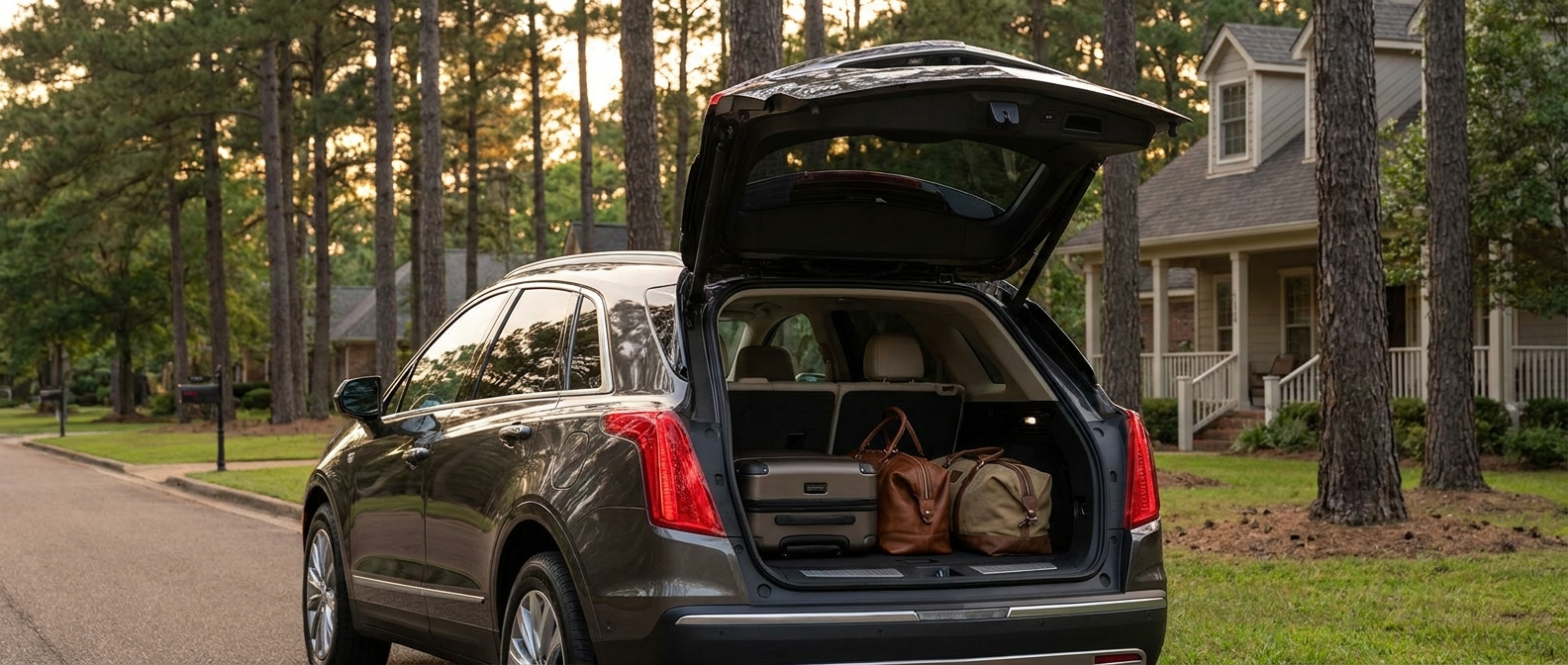
2026 Cadillac XT5 rear cargo area open with luggage loaded, Madison MS

How to Pack Your Cadillac XT5 for a Family Visit from Madison

Family arrives, and the bags multiply. The 2026 Cadillac XT5 gives you 30 cubic feet of cargo space behind the rear seats and 63 cubic feet with them folded, which sounds like plenty right up until you discover that rolling suitcases wider than 41.5 inches won't pass flat between the rear wheel-well humps. Load in the wrong order and you're rearranging luggage in an airport pickup lane. Load in the right order and everyone's bags disappear cleanly, the rear seats stay up for the ride home, and nothing slides. We'll walk the sequence precisely: what to stow before anyone shows up, what goes in first at the curb, and how the XT5's 60/40 split-folding rear seat and under-floor compartment each absorb a specific category of guest gear. The wheel wells narrow the flat cargo floor to 41.5 inches between the humps. Standard carry-on suitcases fit; large checked bags need to go in on their side or at an angle. Plan that before you reach the airport. See current XT5 inventory at Cadillac of Jackson What You Need Before the Family Arrives A quick check of dimensions and the cabin's built-in organization before the airport run saves you the scramble at the curb, and it takes all of five minutes at your own driveway. Walk the numbers once. The 2026 XT5 brings a lot to the task, and most of it is standard across the lineup. Item Spec / Detail Cargo volume (seats up) 30.0 cu. ft. Cargo volume (seats folded) 63.0 cu. ft. Rear legroom 39.0 inches Flat floor width between wheel wells 41.5 inches 60/40 split rear seat Standard on all trims Under-floor storage compartment Standard (beneath cargo floor mat) Cargo tie-down anchors and hooks Standard Cargo area power outlet (12V) Standard Engine (Luxury/Premium Luxury base) 2.0L turbo I-4, 235 hp / 258 lb-ft Engine (Premium Luxury opt. / Sport) 3.6L V6, 310 hp / 271 lb-ft One thing's worth noting before you back in at the pickup lane at Jackson-Medgar Wiley Evers International Airport. The XT5's power liftgate takes a few seconds to fully raise, and arriving passengers tend to grab it and close it before it's all the way up. Let it finish its arc. It won't hurt anything, but it does reset, and that resetting costs you time you don't have when cars are queuing up behind you. The Six-Step Loading Sequence This sequence is the spine of the whole exercise, and the geometry only works if you respect the order. Follow it and the bags fall into place. Skip a step and you're improvising at the curb while a family of four watches you. Step 1. Clear the under-floor compartment and decide what lives there permanently. Lift the cargo floor mat and open the storage well beneath it. That well is the right home for the small items that need to stay reachable throughout the visit (a compact umbrella, since November in the Jackson metro means afternoon showers can appear without ceremony, plus a reusable shopping bag and a phone charging cable for the rear seats). Stash these now and they won't be buried under luggage when someone needs them on the way back from dinner. Step 2. Measure or eyeball the guests' largest bag before you leave home. Seriously, do it. A large checked suitcase (28-inch or 30-inch shell) runs around 20 inches wide and 30 inches tall. Standing upright, it clears the 41.5-inch span between the wheel wells with room to spare, so the issue is length, not width, when bags are standing. If your family travels with oversized duffels or frame-style hiking bags, those may need to go in diagonally across the full 63-cubic-foot footprint with one rear seat section folded. Know that before you park. Step 3. At the airport, open the liftgate and set the loading zone. Our service team sees XT5 owners come in after trips with scuffed cargo liners from one habit in particular, which is sliding a wheeled suitcase straight onto the carpet before the liftgate is fully open. If you don't already have an OEM cargo liner in place, lay a moving blanket or a thick towel at the sill edge. The XT5's rear bumper fascia is painted, and rolling a hard-shell bag across it without protection leaves marks. Step 4. Load heaviest bags first, toward the rear seatbacks. A 60/40 split means you can tilt the larger 60-percent section forward without touching the other side. If you've got one adult with a large checked bag and one with carry-ons only, fold the 60-percent side for the big bag and leave the 40-percent side up for the second passenger's comfort. That configuration keeps three people in the rear seat with cargo behind them. Two large checked bags? Both sections fold flat and 63 cubic feet opens up. With the seats folded, the cargo floor is essentially flat, and that flatness matters for rolling bags. Step 5. Slide carry-on bags into the gaps alongside and atop the larger pieces. A standard carry-on (typically around 22 inches tall) stands between the wheel-well humps without issue. Soft-sided duffels compress into the remaining corners. Coats and hanging bags drape over the top of the pile. Clip anything that feels like it might shift to the tie-down anchors and hooks built into the cargo floor, because the I-55 ramp back toward Ridgeland has a way of finding loose luggage. Step 6. Confirm rear-passenger headroom before driving off. The XT5 gives rear passengers 38.4 inches of headroom. That's a generous number, though taller guests sometimes instinctively recline the seatback a touch for comfort, which shifts the lower seat cushion forward and trims legroom. With 39.0 inches of rear legroom standard, there's room to spare for most adults, so let everyone settle before you close the door. If your family visits include three rows of relatives, the Escalade is a conversation worth having with our team separately. Tip: The step most people skip is Step 2. Knowing the bag dimensions before you leave home costs nothing. Finding out at the curb that a 32-inch frame suitcase won't stand upright behind a folded seat (the cargo floor to the headliner runs around 34 inches in that position) costs you a minute of reorganizing in a no-standing zone. It's a small thing, and it's also the one thing every organized XT5 owner has figured out by the second family visit. [ ] Under-floor compartment cleared and stocked (umbrella, cable, reusable bag) [ ] Cargo liner or protective layer at the sill edge [ ] Guest bag dimensions confirmed in advance [ ] 60/40 seat decision made (which sections fold, if any) [ ] Tie-down anchors identified and ready for loose items [ ] Liftgate allowed to fully open before loading begins [ ] All rear passengers settled and comfortable before departing the airport A Print-and-Go Summary for the Airport Run The night before pickup, run through this once and you'll load clean in the morning. The 30 cubic feet behind upright rear seats handles two standard checked bags and a carry-on comfortably. Fold the seats for the 63-cubic-foot configuration and you'll absorb larger hauls or extended stays with more gear. The under-floor compartment is small, but it's exactly right for the things that need to survive the whole visit without getting buried. Madison sits three miles from our showroom at Cadillac of Jackson in Ridgeland. If you're heading to the airport via I-55, the drive from our lot to Jackson-Medgar Wiley Evers International Airport is straightforward and takes you right past the neighborhoods your guests will be visiting. The XT5's cabin makes that drive feel easy regardless of load, and the cargo planning is what makes the homecoming feel polished. One honest note. The XT5 is a two-row midsize, and it's superb for a family of four plus luggage, or a couple with generous guest bags. It is not the vehicle for five adults plus five checked bags, and that scenario is what the Escalade ESV exists for. We'd rather you know that upfront than discover it at the airport. Frequently Asked Questions Will full-size checked luggage fit in the XT5 with all rear seats up? Two standard checked bags (28 inches or smaller in height) fit behind the upright rear seats in the 30-cubic-foot cargo area. The wheel wells narrow the flat floor to 41.5 inches between them, so bags stand upright without trouble, but very long bags (over 30 inches in any dimension) may need to be loaded at an angle or with one seat section folded. Does folding the rear seats create a fully flat cargo floor? The 2026 XT5's 60/40 split-folding rear seat folds to a nearly flat surface, giving you access to 63 cubic feet. There is a slight ramp angle where the seatback meets the cargo floor, which matters for rolling items. Soft bags handle this without issue; hard-shell rollers may need to be lifted over the transition point rather than slid. Schedule a Pre-Trip Service Check Cadillac of Jackson 700 Adcock St, Ridgeland, MS 39157 (601) 948-5183
2026 Cadillac Escalade in service bay before Thanksgiving tire and brake inspection, Ridgeland, MS

Cadillac Tire and Brake Checks Before Thanksgiving | Ridgeland, MS

November in the Jackson metro means wet roads, not ice. Temperatures here run between a high around 64 degrees and a low near 47 degrees Fahrenheit, and rain falls on roughly 9 days of the month, so the Thanksgiving travel window reads as a wet-pavement problem far more than a cold-weather one. Before your Cadillac joins the I-55 corridor push toward Memphis or the run down toward the Coast, the prep comes down to two things: tire tread depth and brake system condition. Everything else is a distant second. Get those two right and you're composed on the road; get them wrong and no luxury feature makes up the difference. Our 2026 Cadillac XT5 and the full Escalade family are built to handle exactly this kind of sustained highway load, but only if the contact patch and stopping system underneath aren't already worn down. The Pre-Thanksgiving Do and Don't Table Our service team runs this same check before any significant drive, and when it's scheduled the whole thing takes less than 30 minutes. That window answers every question that matters. Check Do Don't Tread depth Verify all four tires measure 4/32" or deeper before departing Rely on the legal minimum of 2/32". Mississippi has no specific tread statute, and that depth is not a safety standard Brake Pad Life Monitor Review the percentage for both axles in your Driver Information Center before you leave Assume the monitor covers everything; listen for audible wear indicators too Tire pressure Check cold pressure the morning before departure, against the placard in the driver's door jamb Check pressure immediately after highway miles, when heat has expanded the reading Sidewall condition Inspect for bulges, cracks, or any deformation along the sidewall Skip this step because tread looks fine, the sidewall and tread fail independently Rotor feel Note whether the pedal is firm and returns cleanly to height; a pulsating pedal is a signal Dismiss minor pedal vibration as "normal"; it typically indicates disc thickness variation Brake fluid Confirm fluid is at the full mark and shows clear color Ignore dark or milky fluid, which absorbs moisture over time and raises the boiling point threshold The Number That Actually Governs Wet Stopping Distance The 4/32" tread threshold is the most consequential pre-trip check you can make before a holiday drive, and physics is the reason it's more than a polite suggestion, because wet pavement doesn't care what your tires looked like last spring. Even the difference between 4/32" and 2/32" of tread can decide whether you stop at an intersection or on the other side of it. Independent testing from 60 mph on wet pavement shows tires at 4/32" required 65 additional feet to stop compared to new tires, while tires at the barely-legal 2/32" required 71 additional feet further still. On a wet I-55 at Thanksgiving traffic speeds, with lane changes and merge events compressed by holiday volume, that extra footage isn't abstract. Mississippi has no specific tread depth statute, and that matters because there's no legal floor to lean on as a practical guide. Use 4/32" as the number. At that depth wet-road traction stays predictable and hydroplaning risk sits in a manageable range. The quarter test tells you where you stand without tools. Insert a quarter into the tread groove with Washington's head pointing down, and if the top of his head is visible, you're at or near 4/32" and approaching the replacement threshold. The penny test (Lincoln's head) confirms the legal minimum of 2/32", but that's the floor, not the target. For the Escalade and Escalade ESV, tread depth matters even more because of vehicle mass. A heavier platform needs more tread groove to channel standing water efficiently, so what's adequate on a lighter vehicle can fall short on a full-size three-row. Our team's observation: The Cadillac Brake Pad Life Monitor on 2026 models uses thickness sensors embedded in the front and rear pads to calculate remaining pad life and displays it as a percentage in the Driver Information Center. A reading below 20% warrants a service appointment before departure. The monitor estimates from sensor data and typical driving patterns, yet sustained high-speed highway driving, especially with a full passenger load, draws on the braking system differently than a daily commute. The monitor is only an estimate, and it can read optimistic on a loaded holiday run. If you're close to that threshold, schedule service before you leave. A Clean Pre-Trip Inspection Closes the Gap At every 7,500-mile service interval, Cadillac's schedule calls for tire rotation and brake pad inspection as standard items, but Thanksgiving timing rarely lines up with a scheduled interval, and that's the gap a pre-trip visit fills. A pre-trip service appointment gives our technicians the chance to measure tread depth across all four tires with a calibrated gauge (inner, center, and outer groove), confirm brake pad thickness on both axles, check rotor surface condition for disc thickness variation, verify tire pressure against the door placard specification, and inspect brake fluid clarity. It's a targeted inspection, not a full service. It takes a fraction of the time, and it produces a confirmed answer rather than a reasonable guess. The Wednesday before Thanksgiving, between 2 p.m. and 6 p.m., is historically the worst traffic window, with congestion running two to four times normal levels in major metro areas. Scheduling that inspection in the days before you join that flow means you won't be making a maintenance decision in a rest-stop parking lot. The composed, quiet drive your Cadillac delivers on a long Mississippi highway run depends on what's happening at the four corners. Tread and brakes are where it begins. Schedule a Pre-Trip Service Inspection Cadillac of Jackson 700 Adcock St, Ridgeland, MS 39157 (601) 948-5183

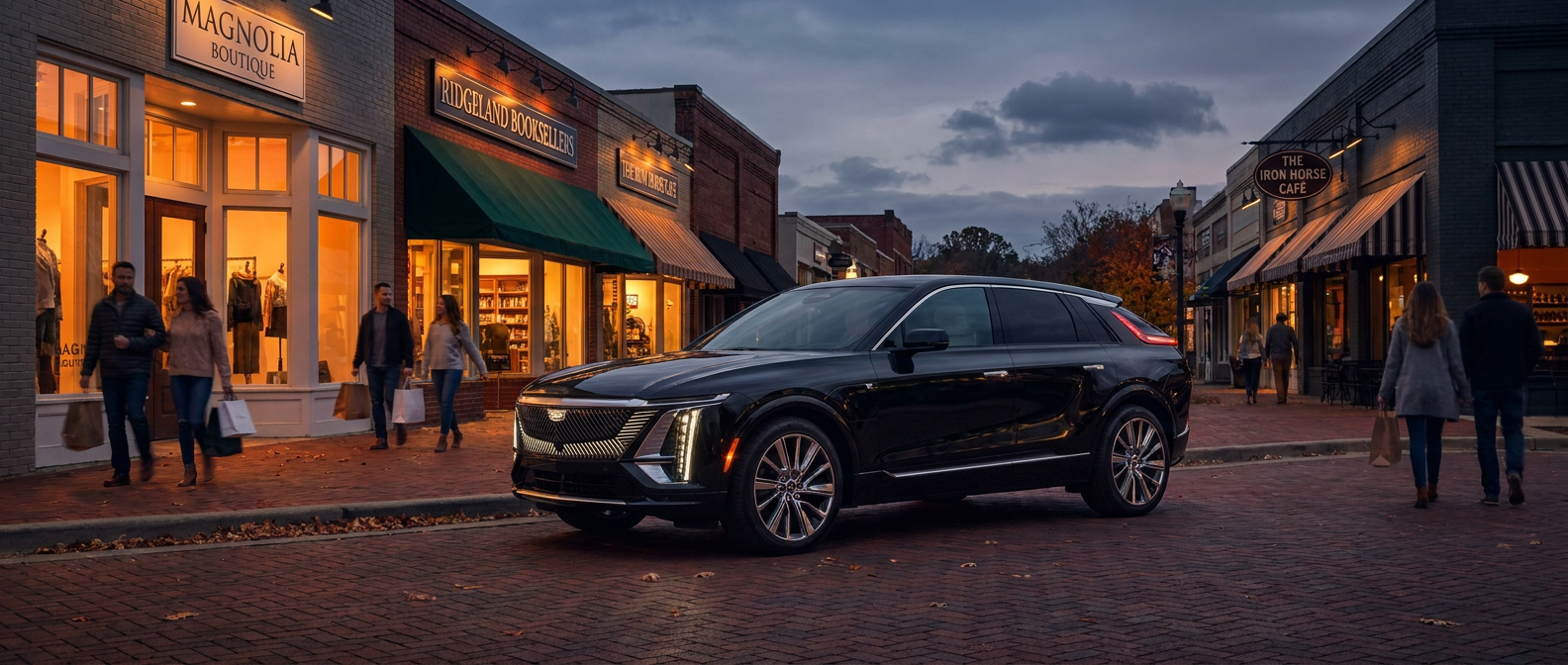
2026 Cadillac LYRIQ on I-55 corridor in Mississippi at dusk, ready for holiday road trip

LYRIQ RWD vs AWD for Holiday Travel from Jackson, MS

In this article What's the Real Range Difference Between RWD and AWD? Does Drivetrain Choice Affect How You Charge on I-55? Super Cruise on a Mississippi Holiday Run Cargo, Cabin, and the Load You're Actually Carrying So Which Should You Take on the Holiday Run? For a Mississippi November holiday run on I-55, either configuration handles the roads without complaint, and the choice you make before you leave home matters more than which motor is under the hood. The short version The 2026 LYRIQ RWD (EPA-estimated 326 miles) gives you a meaningful range cushion over the AWD (EPA-estimated 303-319 miles) on a straight I-55 corridor run to Memphis or New Orleans. AWD earns its keep if your holiday destination involves wet rural roads, hilly terrain east toward Atlanta, or a loaded cargo hold that benefits from traction stability. The preparation steps that actually protect your trip: set a Departure Time in the Charging App the night before, charge to 100% (not 80%) for the first leg, engage DC Fast Charge Prep before any en-route stop, and activate Super Cruise on I-55. Cadillac of Jackson's own EV Connect DC fast charger at 700 Adcock St is your last verified charge point before heading north on I-55 or south toward Hattiesburg. November temperatures in the Jackson metro (typical lows in the upper 40s) have a modest effect on range compared to northern winters, but the I-55 fast-charging corridor has meaningful gaps worth mapping before you go. The 2026 Cadillac LYRIQ lands in an unusually interesting spot for holiday travel out of Ridgeland or Madison. It carries enough EPA-estimated range to reach Memphis on a single charge from a full battery, and it runs Super Cruise on I-55 from the metro outward. We still see owners rolling in for a pre-trip service visit with questions the generic EV-road-trip content out there doesn't answer for a Jackson driver. So let's walk through what matters here. What's the Real Range Difference Between RWD and AWD? The gap between the two is real, but it's probably smaller than you'd guess once you run the route math for Mississippi, since Cadillac lists the 2026 LYRIQ RWD at an EPA-estimated 326 miles and the dual-motor AWD at 303 to 319 miles depending on trim. The LYRIQ-V, the 615-horsepower performance variant, comes in at 285 miles EPA-estimated. Those three numbers mark the spectrum. Configuration EPA-Est. Range Horsepower Best-fit holiday scenario RWD (single motor) 326 mi 365 hp Long I-55 corridors, solo or couple travel, flat-to-rolling terrain AWD (dual motor) 303-319 mi 515 hp Loaded cabin, wet or rural segments, eastern routes with grade changes LYRIQ-V AWD 285 mi 615 hp Performance priority; plan one extra fast-charge stop On a Jackson-to-Memphis run (roughly 210 miles on I-55 north), an RWD on a full charge gets you there with over 100 miles of remaining range in mild weather, and the AWD gets you there with 90 to 110 miles remaining. Neither needs a fast-charge stop on that corridor if you leave at 100%. Stretch it to a longer run, say Jackson to Atlanta (roughly 380 miles via I-20 east), and the calculation shifts. The AWD's traction confidence on I-20's grade changes through Alabama makes the modest range trade feel well-earned. And you're stopping once regardless. The RWD's 326-mile EPA-estimated range covers the Jackson-to-Memphis I-55 corridor on a single charge with a comfortable buffer. The AWD is worth the range trade if your route involves sustained grades, a fully loaded cabin, or wet rural segments at the destination. Does Drivetrain Choice Affect How You Charge on I-55? Yes, it does, and this is where Jackson-specific charging intelligence matters more than the motor you picked, because the fast-charging corridor on I-55 through Mississippi is developing but not yet seamless, and the AWD's slightly smaller buffer nudges how you plan the en-route stops. Bring your LYRIQ in before your holiday run so we can verify your charging port, software version, and tire pressure, all of which shape both charging speed and real-world range. Cadillac lists the 2026 LYRIQ's DC fast-charging capability at up to 190 kW, which Cadillac estimates adds approximately 75 miles of range in about 10 minutes under optimal conditions. That figure depends on the battery being at the right temperature when you reach the charger. On the LYRIQ, the feature that manages this is called DC Fast Charge Prep, and when you set a DC fast charger as a navigation destination, the car starts conditioning the battery on its own before you arrive. Owners who skip that step, usually because they didn't route through the onboard system, sometimes find charging rates well below that 190 kW ceiling, particularly if the battery has been sitting in a cooler garage overnight. The I-55 charging corridor as of November 2026 includes EVgo stations in Winona (about 100 miles north of Jackson) and DC fast options at the Outlets of Mississippi in Pearl just east of the metro. Cadillac of Jackson is at 700 Adcock St in Ridgeland. Our EV Connect DC fast charger makes us a logical last stop for a north-metro driver heading out on I-55. The Entergy Poindexter EV Hub in Brandon (opened February 2025) gives Brandon and Flowood drivers a 180 kW option before heading south on I-55. Before you leave: Set a Departure Time in the Charging App on the 33-inch display the night before departure. The LYRIQ will warm or cool the cabin and battery from your home charger's power rather than drawing on the pack, arriving at your morning start time with both systems ready. This is particularly useful in November, when overnight lows in the Jackson metro can pull the battery toward a temperature range where preconditioning earns its place. Super Cruise on a Mississippi Holiday Run On Super Cruise the two configurations converge completely, and this is the one spot in the comparison where the drivetrain debate stops mattering for a holiday driver leaving the Jackson metro, since the hardware and the mapped coverage come out identical either way. Both the RWD and AWD LYRIQ come standard with Super Cruise on every 2026 trim, paired with a three-year OnStar One plan, and Cadillac's Super Cruise operates on more than 600,000 mapped miles of North American roads, with I-55 through Mississippi counted as compatible territory. What that means in practice on a holiday run is simple enough. Once you clear the metro and merge onto I-55 heading north toward Grenada or Winona, Super Cruise can handle steering, lane-keeping, and speed management, while the driver-attention system monitors your gaze to keep you engaged. The system can also execute automatic lane changes on compatible sections. On a four-hour drive to Memphis carrying family, that's a different quality of arrival than white-knuckling holiday traffic. There's a limit worth respecting. Super Cruise is designed for compatible mapped highways. If your holiday route involves state routes off I-55, rural county roads, or a US highway with no divided lanes, you're driving those sections yourself. Plan that into your routing. Cargo, Cabin, and the Load You're Actually Carrying The practical axis for a holiday run isn't just range but what's going behind the rear seats, and the 2026 LYRIQ offers up to 28 cubic feet of cargo space with the rear seats up and up to 60.8 cubic feet with them folded, according to Cadillac's specifications. That's meaningful real-world context for a family loading gifts, luggage, and a cooler for a Thanksgiving run. If three-row seating is your real requirement for the holidays, The VISTIQ is worth knowing about, but for a two-row household, the LYRIQ's cargo hold handles the typical holiday load without forcing a cargo-carrier decision. A heavier load makes the AWD's torque distribution earn its keep on acceleration from rest and on any incline. That said, Mississippi's major I-55 corridors are largely flat, and neither configuration will struggle with a loaded LYRIQ on that terrain. So Which Should You Take on the Holiday Run? The decision comes down to three questions about your specific route, your passenger count, and the weather waiting at the far end, and once you've answered those, the drivetrain choice tends to make itself without much agonizing over the spec sheet. Take the RWD if: Your route stays on I-55 north toward Memphis or south toward New Orleans, your cabin has two to three passengers with a normal luggage load, and you want maximum EPA-estimated range as a buffer against any charging uncertainty on the corridor. Take the AWD if: Your holiday destination requires a leg on I-20 east toward Birmingham or Atlanta, you're carrying a fully loaded cabin with four or five passengers and significant luggage, or the weather forecast includes rain and wet rural roads at your destination. The AWD's traction stability on slick surfaces isn't relevant on Mississippi Novembers as often as it would be in a northern market, but it's not zero, either. Take the LYRIQ-V if: You understand the 285-mile EPA-estimated range ceiling and have pre-mapped one fast-charge stop into your route. It's a legitimate choice; just budget the stop into your timing. Whichever configuration sits in your driveway, the preparation routine stays the same. Charge to 100% the night before, set your Departure Time, let DC Fast Charge Prep engage on its own when you navigate to your first charging stop, and activate Super Cruise once you clear the metro. Schedule a Pre-Trip Service Check We can verify tire pressure, inspect the charging port and connector, confirm your software is current, and walk through the Departure Times setup on the 33-inch display if it's unfamiliar. A pre-trip visit typically takes under an hour, and it removes the variables that turn a comfortable holiday run into an unplanned stop. The LYRIQ is genuinely well-suited to this market's holiday travel patterns. Range works. The charging corridor is functional, though not yet seamless. Super Cruise handles the interstate miles with composure. Our job at Cadillac of Jackson is to make sure your specific vehicle, your charge level, your software version, your tires, is ready for the miles you're actually planning. Frequently Asked Questions Does the 2026 Cadillac LYRIQ charge to 100% for road trips? For everyday home charging, Cadillac's general guidance favors keeping the battery between 20% and 80% to support long-term pack health. For a holiday road trip, charging to 100% the night before is reasonable and appropriate. The LYRIQ's Departure Time feature in the Charging App handles this for you. You set the target charge level and departure time, and the vehicle does the rest, arriving at your departure hour with a full pack and a conditioned cabin and battery. Is I-55 through Mississippi compatible with Cadillac Super Cruise? I-55 through Mississippi sits within the mapped highway network where Super Cruise can engage. The system covers more than 600,000 miles of North American roads and works from LiDAR map data, high-precision GPS, real-time cameras, and radar sensors. On the I-55 corridor from the Jackson metro north toward Memphis, Super Cruise is available on the compatible divided-highway sections. State routes, county roads, and any unmapped segments hand control back to the driver, and the system alerts you clearly when a transition is needed. Explore Financing Options Cadillac of Jackson 700 Adcock St, Ridgeland, MS 39157 (601) 948-5183

2027 Cadillac Escalade ESV with liftgate open and luggage loaded, parked on a suburban Mississippi driveway in autumn

Escalade or Escalade ESV for Thanksgiving: Which One Fits Your Whole Family?

In this article Which model year is the current Cadillac Escalade, and what changed? Which years are the sweet spot for the Escalade and Escalade ESV? Which years should you watch out for? Pros and cons of the Escalade ESV versus the standard Escalade Which year and body fits which Thanksgiving buyer? Thanksgiving is the one trip that shows you exactly how well your vehicle fits your household. You're not running school pickup or commuting down I-55. You're loading three rows, a stack of bags, and probably a covered dish or two, then aiming the whole thing at family for most of a morning. A fair question to settle before November travel is simple. Does the standard Escalade handle all that, or do you need the ESV? The answer comes down to one number. How many adults are riding in the third row. The short version The 2027 Cadillac Escalade seats up to 8 passengers across three rows with 34.9 inches of third-row legroom; the Escalade ESV stretches that to 36.7 inches with a 134-inch wheelbase. Behind the third row with all seats occupied, the standard Escalade holds 25.5 cubic feet; the ESV holds 41.5 cubic feet, a difference that covers full-size rolling luggage for a family of six or seven. Both share the same 420-horsepower 6.2L V8, the same 55-inch Horizon Display, and the same trim structure from Luxury through Platinum. The ESV adds 15 inches of overall length (226.9 inches vs. 211.9 inches), which matters in a standard 20-foot residential garage. If your third row carries adults on a multi-hour drive, the ESV earns its length. If it carries children or sits empty for most trips, the standard Escalade is the sensible choice. see Escalade ESV availability to check what's on our lot right now. Which model year is the current Cadillac Escalade, and what changed? The 2027 Cadillac Escalade and Escalade ESV are the current models on sale now, and they started reaching dealerships in late summer 2026. For 2027 Cadillac carried the generation forward from the sweeping 2025 refresh, the one that brought the 55-inch panoramic Horizon Display, the current interior architecture, and Super Cruise hands-free driving on the higher trims. The powertrain and the dimensions don't change this year. You get the naturally aspirated 6.2L V8 making 420 horsepower and 460 lb-ft of torque, a 10-speed automatic, and the same three-row body in standard and extended lengths. Cadillac lists the standard Escalade at 211.9 inches and the ESV at 226.9 inches, per Cadillac's official specifications. Between them the wheelbase differs by 13 inches (121 inches versus 134 inches), and that gap feeds straight into the cabin and cargo numbers we get to below. None of the 2027 changes touch the passenger-space math. Which years are the sweet spot for the Escalade and Escalade ESV? The current full-size Escalade generation launched for 2021 on an entirely new platform, and the architecture matters far more here than any single model-year tweak. If you want the current-generation interior on a used budget, the 2025's the year to chase; if you just want the platform, anything from 2021 forward shares the same bones. Model Year Range Sweet Spot? Notes 2021-2022 Solid entry point (used) First of the current platform; Air Ride Adaptive suspension and 38-inch OLED display introduced. No major structural complaints. 2023 Good used buy Added the Escalade-V and Escalade-V ESV supercharged variants to the family; base models unchanged. 2024 Good used buy Mirror of 2023 for standard and ESV; V-Series continued. 2025 Strong used target Major interior refresh: Horizon Display grew to 55 inches, Super Cruise expanded. This is the year to look for in pre-owned. 2026 Near-new, limited used supply Carries the 2025 improvements forward with minor updates. Highest used value, closest to new. 2027 Current new model Carryover with the full current feature set; this is what we have on the lot. The 2025 model year is the sweet spot for used Escalade shoppers: it introduced the 55-inch Horizon Display and the expanded Super Cruise system that defines the current interior experience. Which years should you watch out for? The current generation, meaning 2021 forward, carries a clean NHTSA record next to its predecessor, so none of these years should scare you off outright. A few launch-year patterns are worth knowing before you sign, and most of them come down to a VIN check rather than a dealbreaker. The 2021 model year, being the launch of an all-new platform, drew early NHTSA investigations tied to the infotainment system and a limited recall for the front seatbelt pretensioner on certain build dates. Cadillac addressed both. If you're buying a 2021 used, confirm the recall work got done by running the VIN against the NHTSA database. View our pre-owned Escalade inventory to see the exact vehicles on hand. Our team pulls NHTSA VIN histories on every used vehicle we bring in, so that homework isn't landing on you. The 2022 model year picked up a noted NHTSA recall for the driver information center display on certain units. Resolvable again, and still worth the VIN check. From 2023 onward the standard and ESV models go quiet. The V-Series arrival bolted on a supercharged powertrain without creating documented issues on the naturally aspirated variants. Year Assessment What to Verify 2021 Watch: launch-year infotainment and seatbelt pretensioner recalls Confirm recall completion via NHTSA VIN lookup 2022 Watch: driver information center recall on certain builds VIN check recommended 2023-2024 Clean No documented recurring issues on standard/ESV 2025-2026 Strong Full current feature set, no major NHTSA activity 2027 Current new model No recall history yet Explore Financing Options Pros and cons of the Escalade ESV versus the standard Escalade The Thanksgiving planning question gets practical right here, because the ESV buys more space and demands more length in return. You gain cargo and third-row room; you give up a little maneuverability and a chunk of garage clearance. Both sets of numbers deserve a look side by side before you commit. Pros of the Escalade ESV Cons of the Escalade ESV 41.5 cu ft of cargo with all seats up (vs. 25.5 in the standard) 226.9 inches long. Tight in a standard 20-foot residential garage 36.7 inches of third-row legroom (vs. 34.9 in the standard) Less maneuverable in parking decks and narrow drives 94.1 cu ft behind the second row (vs. 72.9 in the standard) Slightly less tow capacity (8,000 lbs. 2WD vs. 8,100 lbs. on the standard) Same 420-hp engine, same trim ladder, same 55-inch display Higher sticker across comparable trims Power-release second-row seats ease third-row access Longer learning curve for drivers new to full-size SUVs The tradeoff is real. The ESV isn't simply "more Escalade." It makes one specific ask in return for its space, and you answer it with your driveway. You need room for 19 feet of SUV without drama. On our lot you feel that length the moment you back an ESV into a standard bay, where the tailgate clears but your walk-around room disappears. The ESV's harder to park. Period. Plenty of the newer homes around Ridgeland and Madison sit on deeper lots with two-car garages measuring 22 feet or more, and those households won't notice the length at all. If your garage runs closer to 20 feet, the standard Escalade is the sensible pick. Cadillac lists the standard Escalade's curb-to-curb turning circle at 39.7 feet, and the ESV adds length without rear-wheel steering to offset it. Treat that as the lived-in consideration, not a spec-sheet footnote. Which year and body fits which Thanksgiving buyer? For a Jackson metro household the decision really comes down to who rides in row three and how far they ride, not to badge or trim. Adults on a long haul tip you toward the ESV; kids and cargo on short runs keep the standard Escalade in play. Here's how we'd sort it. You have adults in the third row for the drive: The 1.8-inch legroom difference (34.9 vs. 36.7 inches, per Cadillac's specifications) means nothing on a 30-minute pickup run. Stretch it to a two-hour drive to a family gathering in the Delta or a run up to Memphis, and it stops being trivial. Adults in the back of the standard Escalade manage. Adults in the back of the ESV are genuinely comfortable. The ESV earns its length here. Your third row is for children and the adults take the second row: The standard Escalade is everything you need. The second row runs 41.7 inches of legroom in both bodies, so the gap sits almost entirely behind the third row, where the ESV adds 16 cubic feet of cargo space. If children are back there and bags are your priority, the ESV is still the better road-trip tool. If children are back there and bags are modest, the standard Escalade's 25.5 cubic feet handles it. You're looking at a 2025 or 2026 pre-owned and want the current-generation interior: The 2025 is the year to find, since it introduced the 55-inch Horizon Display and expanded Super Cruise. The 12.6-inch rear touchscreens available on Platinum trims and the Executive Second Row Seating Package make the experience feel less like a large SUV and more like a cabin on wheels. Seek a 2025 or 2026 ESV with 14-way power-adjustable second-row captain's chairs (heat, ventilation, massage) and the 8-inch Rear Command Center. Your household moves to a new home in 2027 with a deeper garage: Buy the ESV now. You'll never wish you'd bought less cargo space for Thanksgiving. Frequently Asked Questions Does the Cadillac Escalade ESV have more legroom than the standard Escalade? Yes, but only in the third row. Cadillac's specifications for both the 2026 and 2027 models show identical first-row legroom (44.5 inches) and second-row legroom (41.7 inches) across both body styles. The difference lives in row three, at 34.9 inches in the standard Escalade versus 36.7 inches in the ESV. That 1.8-inch gap's the result of a 13-inch longer wheelbase in the ESV. How much luggage can a 2027 Escalade ESV hold with all three rows occupied? Cadillac lists 41.5 cubic feet of cargo space behind the third row of the 2027 Escalade ESV with all seats in their upright position. The standard Escalade holds 25.5 cubic feet in the same configuration. The ESV figure's enough for a full family's rolling luggage on a multi-day trip without folding a seat. Will the Escalade ESV fit in a standard home garage? The 2027 Escalade ESV measures 226.9 inches (18.9 feet) in overall length. A standard residential garage bay typically runs 20 feet in depth, which leaves under 11 inches of clearance front to back. It fits, but only just, and rear sensors or a parking guide system become useful tools rather than optional conveniences. The standard Escalade at 211.9 inches leaves a more comfortable margin. FAQ: Does the Cadillac Escalade ESV have more legroom than the standard Escalade? Yes, but only in the third row. Cadillac's specifications for both the 2026 and 2027 models show identical first-row legroom (44.5 inches) and second-row legroom (41.7 inches) across both body styles. The difference lives in row three, at 34.9 inches in the standard Escalade versus 36.7 inches in the ESV. That 1.8-inch gap is the result of a 13-inch longer wheelbase in the ESV. How much luggage can a 2027 Escalade ESV hold with all three rows occupied? Cadillac lists 41.5 cubic feet of cargo space behind the third row of the 2027 Escalade ESV with all seats in their upright position. The standard Escalade holds 25.5 cubic feet in the same configuration. The ESV figure is enough for a full family's rolling luggage on a multi-day trip without folding a seat. Will the Escalade ESV fit in a standard home garage? The 2027 Escalade ESV measures 226.9 inches (18.9 feet) in overall length. A standard residential garage bay typically runs 20 feet in depth, which leaves under 11 inches of clearance front to back. It fits, but only just, and rear sensors or a parking guide system become useful tools rather than optional conveniences. The standard Escalade at 211.9 inches leaves a more comfortable margin. Get Your Trade-In Value Cadillac of Jackson 700 Adcock St, Ridgeland, MS 39157 (601) 948-5183

Cadillac EV Range for Halloween Weekend Errands in Ridgeland

Cadillac EV Range for Halloween Weekend Errands in Ridgeland

The question worth asking this weekend isn't which Cadillac looks best in a neighborhood trunk-or-treat line. It's whether an electric Cadillac can soak up a full Mississippi Halloween Saturday of stop-and-go errands without you thinking about charging once. Our answer is yes, with one caveat worth understanding before you plan the day. The 2026 Cadillac LYRIQ and its siblings in the electric lineup were engineered around exactly this kind of daily-errand density, but the three models differ in ways that matter on a weekend like this one. Here's what we'd tell a buyer standing in our showroom right now. How Far Will a Cadillac EV Actually Go on a Ridgeland Errand Day? Any of the three electric Cadillacs will clear a full Ridgeland errand day with range to spare, so it makes sense to treat the EPA figures as a baseline rather than a promise tuned to a warm Mississippi October afternoon. The 2026 LYRIQ RWD carries an EPA-estimated 326 miles of range; the AWD version comes in at 319 miles on the standard 11.5 kW charging setup. Step over to the 2026 OPTIQ and the RWD earns 317 miles EPA-estimated, with the AWD trim at 303 miles. The 2026 VISTIQ, the three-row option for families who need the space, lands at an EPA-estimated 305 miles with the standard charging configuration. In practice, a Ridgeland Halloween errand loop probably covers 40 to 60 miles, running from Lakeland Drive through the Renaissance at Colony Park corridor, over to County Line Road, out to Madison for pumpkins, then back through Steed Road to home. On a full charge, none of these three vehicles gets you anywhere close to a range concern. Call that the bottom line. So what shortens your effective range? Persistent cabin cooling. Mississippi in late October still runs warm, with afternoon temperatures sitting in the mid-to-upper 70s often enough that the cabin wants active cooling from the second you climb in off a hot parking lot. Running the HVAC system does pull from the battery, and the EPA rates range under standardized temperature assumptions, not a 78-degree afternoon with the sun loading through glass. For a 50-mile errand day, the practical impact stays minor and well inside the buffer these vehicles carry. For a longer run out toward Brandon or down I-55, it's worth keeping in mind. Model EPA Range (RWD) EPA Range (AWD) DC Fast Charge Peak Gain in ~10 min Charging Port 2026 LYRIQ 326 mi 303-319 mi 190 kW ~86 mi CCS (NACS adapter) 2026 OPTIQ 317 mi 303 mi 150 kW ~81 mi Native NACS 2026 VISTIQ AWD only 300-305 mi 190 kW ~80 mi CCS (NACS adapter) *All range figures are EPA estimates. Actual range varies with speed, temperature, load, and driving style.* Where Do You Charge Around Ridgeland? Charging around Ridgeland is more built-out than you might expect, and it runs straight through the commercial corridor you already drive on an errand day, which means a compatible station is rarely more than a few minutes off your route. The catch is that the options are scattered across a few different networks. Our service location at 700 Adcock Street is itself listed as a public charging point for the area. Along Highland Colony Parkway, the Electric Cooperatives of Mississippi location at 665 Highland Colony Pkwy carries ChargePoint DC fast-charge access. The Embassy Suites at 200 Township Place and the SpringHill Suites at 121 Southtowne Avenue both host Tesla Destination Chargers, and the Outlets of Mississippi has Tesla Supercharger access as well. Add it up, from dealership-adjacent charging to hotel destination chargers to Superchargers, and you're rarely more than a few minutes from a compatible station anywhere in Ridgeland. One distinction worth drawing before you buy involves the port. The OPTIQ's native NACS port means it plugs directly into Tesla Superchargers and the growing NACS network with no adapter required. The LYRIQ and VISTIQ use CCS ports and require a NACS adapter for Supercharger access. That adapter is one more thing to lose. For a Halloween errand day in Ridgeland, none of this matters, because you'll get home on a single charge. On a longer drive toward the Gulf Coast or up to Memphis, knowing your port type and which stations you can use without extra hardware turns into genuinely useful planning. Charging note: Plan to charge at home overnight, rather than mid-errand. The standard 11.5 kW Level 2 onboard charger on the LYRIQ adds approximately 31 miles of range per hour when paired with a 240V home wall charger. Start Saturday on a full charge and the errand loop takes care of itself. The OPTIQ's native NACS port is the cleanest solution for Supercharger access The LYRIQ and VISTIQ accept a NACS adapter for Supercharger use All three support 190 kW (LYRIQ and VISTIQ) or 150 kW (OPTIQ) DC fast charging ChargePoint access along Highland Colony Pkwy and Destination Chargers at Embassy Suites are both close to the Ridgeland retail corridor Overnight Level 2 home charging is the practical daily routine for every model in the lineup Explore Financing Options Plan the Weekend This Way The straightforward tradeoff here is that these Cadillacs reward routine, so plug in at home on Thursday night, keep the overnight charging habit, and you simply never think about range on a weekend like this one. Where planning actually earns its keep is an unplanned long drive that starts from a partial charge. A spontaneous trip to Natchez or a drive across the state deserves a few minutes with the in-vehicle trip planner before you leave, so you skip the detour mid-route. For the Halloween errand loop specifically, here's how our team sizes the choice. The XT5 is the right answer if you want a combustion luxury midsize and simply aren't ready for electric. A fair position, that. But for buyers who are ready, the OPTIQ is the one we'd hand to a Ridgeland professional covering mostly metro miles, with 317 EPA-estimated miles of range on RWD, a native NACS charging port, standard Super Cruise hands-free driver assistance technology, and a 33-inch diagonal display inside a compact footprint that parks easily at the Renaissance at Colony Park. The LYRIQ steps in when range ceiling matters more. Its 326 EPA-estimated miles on RWD and 190 kW fast-charge capability mean a 10-minute stop at a Highland Colony Pkwy DC charger adds approximately 86 miles. The VISTIQ is the three-row answer, with standard AWD, 305 EPA-estimated miles of range, the same 190 kW fast-charge architecture, and enough cargo space to carry the full Halloween haul without compromising the second or third row. What we'd say in the showroom is simple. Don't overthink the range, and think about the charging habit instead. An overnight Level 2 charge at home fits naturally with how our clients in Ridgeland and Madison already live, and it means every morning starts at full. That practical ownership pattern is what makes the metro errand day, Halloween weekend or any other, genuinely effortless. Frequently Asked Questions Will running the AC all day hurt my range on a Mississippi Halloween? Running the HVAC system does draw from the battery, and Mississippi's warm October temperatures keep your climate system working most of the day. For a typical 40-to-60-mile errand loop in Ridgeland, that draw stays modest and well within the buffer all three vehicles carry above everyday needs. The EPA rates range under standardized temperature conditions, so any sustained cabin cooling is additional draw beyond that baseline. The physics is simple, and it shows up more on extended highway drives than on a stop-and-go local day. Do Cadillac EVs work with Tesla Superchargers in Ridgeland? Yes, with one practical distinction. The 2026 OPTIQ ships with a native NACS port, so it plugs directly into Tesla Superchargers and the broader NACS network without any extra hardware. The 2026 LYRIQ and VISTIQ use CCS charging ports and require a NACS adapter for Supercharger access. The adapter's reliable and easy to find, so keep it in the vehicle. Tesla Destination Chargers at the Embassy Suites (200 Township Place) and the SpringHill Suites (121 Southtowne Avenue) in Ridgeland work with either port configuration, as does Supercharger access at the Outlets of Mississippi. Is 300 miles of EPA-estimated range actually enough for metro daily use? Comfortably, yes. A full Halloween errand day through Ridgeland and Madison rarely passes 60 miles of total driving. Even with HVAC draw and stop-and-go traffic figured in, all three Cadillac electric models carry enough EPA-estimated range to cover several days of metro driving on one charge. The practical discipline is overnight Level 2 home charging, which means you start every morning at or near full without a mid-week stop at a public station. Public charging infrastructure along Highland Colony Pkwy and the broader Ridgeland corridor is there for longer trips, though for daily metro use it's rarely the limiting factor. Get Your Trade-In Value Cadillac of Jackson 700 Adcock St, Ridgeland, MS 39157 (601) 948-5183
2026 Cadillac XT5 undergoing brake and tire inspection at Cadillac of Jackson service center in Ridgeland, MS

Cadillac Brake and Tire Service: Questions to Ask in Jackson

In this article What Actually Changes When You Choose Brake and Tire Service? Tire Size Is a Trim Decision, and It Changes the Service Conversation Brake Fluid and the Humidity Factor Jackson Drivers Should Know Match the Service to How You Actually Drive The right questions to ask at a Cadillac service appointment depend on which vehicle you drive, and on where you drive it. An XT5 Premium Luxury on 20-inch wheels doesn't have the same tire service needs as the same model on 18-inch wheels. A LYRIQ runs a brake system that behaves differently from any internal-combustion Cadillac on our lot. And in Mississippi's persistently humid climate, brake fluid degrades faster than it does in drier markets. None of that shows up in a generic "five signs you need new brakes" article. We've put together this guide to give you the specific questions worth raising with our team, mapped to your model and trim, so you arrive with the right frame rather than starting from scratch. The short version If you drive an XT5 on the Luxury trim (18-inch OEM tire), ask about sidewall height tradeoffs before any tire swap. If you drive an XT5 Premium Luxury or above (20-inch OEM), ask about load-index matching when replacing. Escalade owners: confirm load-index compliance on any replacement 275/50R22; the vehicle's curb weight demands it. LYRIQ drivers: ask how the Brake Pad Life Monitor reads differently on a regen-braking vehicle, and whether your pads have seen enough use to justify inspection cadence. Every Cadillac in the Jackson metro: ask about brake fluid condition. Humidity here accelerates moisture absorption faster than your service interval calendar assumes. Schedule a service appointment with our team What Actually Changes When You Choose Brake and Tire Service? Four variables set the entire conversation, and everything else follows from them; trim-level tire size, vehicle weight and load rating, whether your powertrain leans on regenerative braking, and how the local Jackson climate acts on the fluid chemistry inside your brake lines. Get those four right and you're mostly done. Service Question Best For Key Spec or Condition Honest Tradeoff "Do my 18-inch tires need replacing or rotating?" XT5 Luxury OEM 235/65R18, 35 PSI Taller sidewall cushions the ride; cheaper to replace, but the higher profile is more vulnerable to pothole impact on degraded road surfaces "Should I size up when I replace my 20-inch tires?" XT5 Premium Luxury, Sport, Platinum OEM 235/55R20, 35-36 PSI Lower sidewall improves cornering feel; replacement tires cost more and the load-index must meet or exceed the door-jamb placard spec "What load index do I need on the Escalade?" Escalade, Escalade ESV OEM 275/50R22, 39 PSI Large-format tires at Escalade curb weights require a load index verified against the placard, not just matched to the size "Will my LYRIQ pads really last longer?" LYRIQ, OPTIQ Ultium regen braking, blended friction-regen system Friction pads do last longer in normal driving; rotors still need periodic inspection because light use can cause surface oxidation "Is my brake fluid still good?" All models in the Jackson metro Glycol-based fluid absorbs humidity through hoses and reservoir seals Mississippi's year-round humidity accelerates moisture uptake; wet boiling point drops well before you'd notice a symptom "Does my Brake Pad Life Monitor reading mean I should act now?" All models with the DIC monitor Monitor reads 0-100% via sensor data; 10% signals end of effective friction material life The monitor estimates based on driving patterns; heavier towing or repeated hard stops consume the remaining percentage faster than the number suggests Tire Size Is a Trim Decision, and It Changes the Service Conversation On the 2026 XT5, Cadillac fits two distinct OEM tire sizes depending on trim, which means the service conversation isn't identical from one XT5 to the next, and the number printed on your door jamb is what decides which one you're having. The Luxury trim leaves the factory on 235/65R18 tires at 35 PSI. Move up to Premium Luxury, Sport, or Platinum and the standard fitment shifts to 235/55R20 at 35 to 36 PSI. The overall diameter stays close between the two, but the sidewall is meaningfully different. Ride character changes, so does what the tire can absorb from a broken road surface, and so does what you'll pay for a replacement. On our lot the practical version sounds familiar. Someone on 18-inch wheels wants to move to 20s at replacement time because they prefer the look. Fair preference, and we're glad to talk it through. But the load index on the replacement has to meet or exceed what's printed on your door-jamb placard, and the overall diameter has to stay close enough that the speedometer and stability systems read correctly. None of that is aesthetic. The placard sets the specification, and the replacement has to honor it. The Escalade sits in a different category entirely. Standard OEM fitment is 275/50R22 at 39 PSI, a large-format tire carrying a vehicle that can exceed 5,700 pounds before passengers and cargo load in. When replacements come due, the question isn't just "same size?" It becomes "same size AND correct load rating?" A tire that matches the size but falls short of the load index is undersized for the job, even if it looks identical. Tire service note: Before any rotation or alignment appointment, confirm which OEM size is fitted to your specific trim. This matters for cross-axle rotation decisions and for alignment specifications, which are set to the original equipment. On the 2026 XT5, two OEM tire sizes exist across trim levels (235/65R18 on Luxury, 235/55R20 on Premium Luxury and above), and each has a different load-index requirement for compliant replacements. Schedule Your Tire and Brake Inspection Brake Fluid and the Humidity Factor Jackson Drivers Should Know Brake fluid in the Jackson metro ages on a faster clock than the national maintenance calendars assume, and the reason is geographic as much as mechanical; Mississippi sits in a humid subtropical climate, and the fluid itself is chemically thirsty for the water in that air. Relative humidity here doesn't let up much in the cooler months either, so this isn't only a summer problem. Glycol-based fluids, the chemistry used in DOT 3 and DOT 4, are hygroscopic. They'll pull moisture from the surrounding atmosphere through rubber hoses, seals, and the vented reservoir cap. As water content accumulates, the fluid's wet boiling point drops. Fresh DOT 4 fluid meets a minimum dry boiling point of 230 degrees Celsius (446 degrees Fahrenheit) per federal FMVSS 116 standards. Once that fluid has absorbed moisture equivalent to 3.7 percent water content, that same DOT 4 specification drops to a wet boiling point floor of just 155 degrees Celsius (311 degrees Fahrenheit). The result is a reduction of 75 degrees Celsius in thermal headroom, and it happens quietly, with no warning light you'd notice. A technician can read the moisture content directly, so you're not guessing from calendar time. A flush restores the thermal margin when the number climbs too high. In an arid climate, this degradation runs slow. In the Jackson metro it doesn't. The question worth asking is simple. Can you test my brake fluid condition as part of this visit? The generic brake guides skip this conversation. They're written for a national audience, and you're driving through Ridgeland and Madison in August with the air-conditioning running hard, in conditions that are genuinely different. Match the Service to How You Actually Drive Regenerative braking rewrites the math for LYRIQ owners, since the Ultium platform leans on regenerative deceleration first and brings the friction brakes in second, which means the pads and rotors don't work as hard in normal driving and tend to last well beyond what a comparable internal-combustion Cadillac would show. Some Ultium owners report pad life well past 70,000 miles. The good news is mostly real, but there's a tradeoff worth saying plainly. Rotors that see infrequent friction contact develop surface oxidation, and light surface rust on an otherwise serviceable rotor looks alarming during an inspection even when it isn't structural. Ask our technicians to distinguish between cosmetic surface oxidation (which clears with normal driving) and actual rotor wear that affects the discard thickness spec. Those are two different findings with two different answers. The Brake Pad Life Monitor in your Driver Information Center gives you a percentage that reads 100% when new and triggers attention at 10%. At 10%, the friction material is near the end of its effective service life, so don't wait for zero. The countdown isn't uniform, though. If you've done a significant stretch of highway driving where the brakes barely engage, the number has been generous. Add a heavy week of towing or repeated stops in slow traffic, and the remaining percentage can drop faster than the driving history suggests. One question settles it. Given how I've been using the vehicle, does the monitor reading match what you actually see on the pad thickness? That's one answer specific to your car, not a category average. Frequently Asked Questions Does regenerative braking on the LYRIQ mean I can skip brake inspections? Not exactly. Regenerative braking does reduce friction pad wear significantly, and LYRIQ pads often last much longer than those on internal-combustion vehicles. But the friction brake components still need periodic inspection. Rotors that see infrequent friction contact can develop surface oxidation, which needs to be evaluated in person. Brake fluid also still absorbs humidity over time, regardless of how the vehicle decelerates. The inspection cadence may be less frequent, but it shouldn't be zero. Do the rotors have to be replaced every time the brake pads are replaced? No. Rotors should be measured for thickness at every brake service. If the rotor surface is smooth, the rotor is at least 1 millimeter thicker than its discard specification, and there's no pedal pulsation or steering-wheel vibration during braking, the rotors can typically remain in service. Replacement is necessary when a rotor is scored deeply, warped, or has worn to or below its discard thickness. Our technicians measure both dimensions before recommending either option. FAQ: Does regenerative braking on the LYRIQ mean I can skip brake inspections? Not exactly. Regenerative braking does reduce friction pad wear significantly, and LYRIQ pads often last much longer than those on internal-combustion vehicles. But the friction brake components still need periodic inspection. Rotors that see infrequent friction contact can develop surface oxidation, which needs to be evaluated in person. Brake fluid also still absorbs humidity over time, regardless of how the vehicle decelerates. The inspection cadence may be less frequent, but it shouldn't be zero. Do the rotors have to be replaced every time the brake pads are replaced? No. Rotors should be measured for thickness at every brake service. If the rotor surface is smooth, the rotor is at least 1 millimeter thicker than its discard specification, and there's no pedal pulsation or steering-wheel vibration during braking, the rotors can typically remain in service. Replacement is necessary when a rotor is scored deeply, warped, or has worn to or below its discard thickness. Our technicians measure both dimensions before recommending either option. Book Your Cadillac Service Appointment Cadillac of Jackson 700 Adcock St, Ridgeland, MS 39157 (601) 948-5183

2026 Cadillac Escalade at a Natchez Trace Parkway overlook in Mississippi during fall foliage season

Cadillac Weekend Trip Checklist from Brandon, MS | Cadillac of Jackson

A Cadillac travels well, composed and capable, yet it won't inspect itself. The five minutes before you leave the driveway aren't the inspection. We'd rather you confirm a short list the day before, sorted by drivetrain, so you pull out of Brandon and arrive wherever you're headed without a detour you never planned. The 2026 Cadillac XT5 is the vehicle we see most often loaded for a weekend run in this market, and most of what follows carries across the lineup. Where the electric cars need a different answer, we flag it on its own. What Goes on the Checklist? Run through these items before you back out of the driveway, and bookmark the page or screenshot the list so it rides along with you; most take a quick glance, though a couple are worth a few minutes the night before. For every Cadillac (ICE and electric): [ ] Tires: pressure and tread depth. The 2026 XT5 specifies 35 psi front and rear (check the placard on your door jamb for your specific trim). Underinflated tires flex at the sidewall and build heat, and that's where tire failure starts. Tread depth counts too. Below 2/32 of an inch, wet-road stopping distances climb sharply, per NHTSA guidance. [ ] Fluid levels (ICE models). Engine oil, coolant, brake fluid, windshield washer fluid. A long Mississippi October weekend still pushes afternoon temperatures into the mid-70s with intermittent rain. Low washer fluid is the one you'll notice at 65 mph on I-20. [ ] Brake feel. Press the pedal in a quiet lot before you go. Soft or pulsing means a service appointment comes before the road does. [ ] Cabin air filter. October pollen counts in central Mississippi are real. A clogged cabin filter cuts airflow noticeably and makes the climate system work harder, and you'll feel it on a three-hour drive. [ ] All exterior lights. One burned tail lamp is an invitation for a citation you don't want on a weekend. [ ] Wiper blades. The Natchez Trace Parkway runs without street lights and with limited cell service along stretches of its route through central Mississippi. A streaky wiper at dusk on an unlit two-lane matters more there than it does on I-55. [ ] OnStar subscription active. Confirm it in the Settings menu before you leave. The Trace is where you want it working, not where you find out it lapsed. [ ] Super Cruise map area. If your Escalade or XT5 has Super Cruise, confirm the Trace itself isn't a designated Super Cruise route (it is not; hands-on driving required for its entire length). Highway 61 south toward Natchez and the return on I-20 are the stretches where Super Cruise earns its keep. Electric models only (LYRIQ, OPTIQ, VISTIQ, ESCALADE IQ, ESCALADE IQL): [ ] State of charge before you leave. The 2026 LYRIQ carries an EPA-estimated range of 326 miles. Brandon to Natchez and back is roughly 200 miles round-trip. On paper you're comfortable. In practice, highway speeds pull range below the EPA figure, and the Trace itself has no public charging at any milepost. [ ] Pre-condition the cabin while plugged in. Running the climate system on shore power rather than the battery keeps your range for the road. Most owners skip it. [ ] Confirm a DC fast-charge stop. Hattiesburg and McComb both have public fast-charging options on the I-55 corridor if you're running south toward the coast instead. Plan the stop before you need it, not when the range display reads lower than you expected. [ ] Tire pressure on the ESCALADE IQ. Because the ESCALADE IQ is heavy (Cadillac lists curb weight above 9,000 lbs), tire pressure management matters more than it does on a lighter vehicle. The TPMS will alert you, but a manual check before a long run is still the right discipline. If you're towing or carrying a full load: [ ] Tongue weight and hitch rating. The 2026 Escalade (2WD) is rated to tow up to 8,100 lbs per Cadillac specifications. Confirm you're within that figure and that trailer lights are functioning before you leave Rankin County. [ ] Weight distribution in the cargo area. A heavily loaded third row and cargo section changes your braking geometry. Leave extra following distance. Why These Items Matter on a Mississippi Fall Trip The 2026 Escalade is the right vessel for a long run, and the Natchez Trace Parkway, which passes through Ridgeland and continues south toward Natchez, operates under conditions that reward preparation, and that's the reason the checklist above exists. The National Park Service manages the entire 444-mile route. Speed is capped at 50 mph for the full Mississippi segment. No commercial trucks, no gas stations, no billboards. The driving is genuinely composed. It's also a road where a low tire, a dead wiper, or a lapsed OnStar subscription becomes a more meaningful problem than it would on I-55. A pre-trip service visit at our Ridgeland service department covers all of this in one stop. We check tire pressure and condition, top fluids, test brake response, and inspect lights. It takes less time than most people assume. The tradeoff is simple. A full multi-point inspection runs longer than five minutes, and scheduling one goes smoother if you think of it Thursday rather than Friday at 4 p.m. That's the only constraint worth planning around. Before you leave Rankin County: The Natchez Trace has no cell coverage in stretches between Ridgeland and Port Gibson. The National Park Service advises checking their website (nps.gov/natr) for current road conditions and closures before you enter. Download an offline map and confirm your destination is set before you lose signal. The EV Range Conversation We Have Often The LYRIQ handles the Brandon-to-Natchez run on a single charge under normal conditions, with range to spare. The question we field is about the return leg, when a stop at Port Gibson, Windsor Ruins, or Emerald Mound has stretched the timeline into the evening. Highway speeds on I-20 east draw more range than the parkway's 50-mph cruise, and a car reading 180 miles of remaining range at Natchez won't read the same figure after a faster interstate return. None of that is a criticism, just the physics of how EVs respond to speed. Pre-condition before departure, drive the Trace at its posted limit, and plan one fast-charge stop if the return is highway-dominant, and it resolves entirely. The VISTIQ and ESCALADE IQ carry more buffer, noticeably so. The ESCALADE IQ's Cadillac-estimated range of 465 miles gives a Brandon-area driver room to complete an extended two-stop Trace itinerary without a charge stop at all, under moderate conditions. Item Why It Matters for a Mississippi Fall Run Tire pressure (per door-jamb spec) Sidewall flexion from underinflation generates heat; the Trace's 50-mph cruise is gentle, but arrival condition still matters Wiper blades No streetlights on the Trace; afternoon rain is still common in October Cabin air filter Central Mississippi pollen season extends into late fall OnStar active Limited cell coverage on parkway segments near Ridgeland and Port Gibson EV charge level (full before departure) No public charging on the Trace; return via I-20 is faster and draws more range than parkway cruise Brake fluid level and feel Full passenger and cargo loads change braking behavior; check before loading, not after Offline navigation downloaded GPS signal intermittent between Ridgeland and Port Gibson along the Trace Your Print-and-Go Recap The version you screenshot or print and leave on the passenger seat looks like this. The night before: Charge to full if electric (and pre-condition in the morning while still plugged in) Check tire pressure against the door-jamb placard Confirm OnStar is active Download offline navigation for the Trace Check nps.gov/natr for road conditions Morning of: Fluid levels (ICE: oil, coolant, brake, washer) Test wiper blades Walk around for lights Confirm trailer connection if towing For EV: set departure time in the app to pre-condition the cabin Worth scheduling at least 48 hours out: Multi-point inspection at our Ridgeland service department if it's been more than a few months Tire rotation if you're past the interval (your service history in the MyCadillac app will show it) Browse the ESCALADE IQ if you've been thinking about making a long-range EV the weekend vehicle. The range story changes the pre-trip calculus in a meaningful way. Frequently Asked Questions Does the Cadillac LYRIQ have enough range for a trip from Brandon to Natchez and back? The 2026 LYRIQ carries an EPA-estimated range of 326 miles. A round-trip from Brandon to Natchez runs approximately 200 miles. Under moderate highway and parkway conditions, that leaves meaningful buffer. The variable is return-leg speed: Interstate 20 at highway cruise draws range faster than the Trace's 50-mph limit does. If the return leg is fully on I-20, plan conservatively and consider a fast-charge stop in the Jackson area after you exit the Trace. Pre-conditioning the cabin while the vehicle's still plugged in the morning of departure preserves range and costs nothing. What should I do if my Cadillac shows a tire pressure warning before I leave? Bring it in or add air before you go. NHTSA guidance is clear that tires below their specified pressure generate heat through sidewall flexion, which is the mechanism behind tire failure. The Trace has no shoulder in most stretches, and the curves that make the drive beautiful also reduce sight lines. A TPMS alert before departure is the vehicle telling you something specific. Address it at home, not on a parkway with no commercial services. Our service team can check pressure, inspect for slow leaks, and confirm all four tires are at spec in a short visit. Schedule a Pre-Trip Service Check Cadillac of Jackson 700 Adcock St, Ridgeland, MS 39157 (601) 948-5183

2026 Cadillac LYRIQ and 2026 Cadillac XT5 side by side on an I-55 highway in Mississippi at dusk

LYRIQ vs. XT5: Which Cadillac SUV Fits Your Life in Pearl?

Start with the bottom line. The 2026 Cadillac LYRIQ and the 2026 Cadillac XT5 aren't interchangeable answers to the same question. They answer different questions entirely. One is an established, gas-powered SUV in the final year of a generation that's served the Jackson metro well for a decade. The other is a fully electric platform that Cadillac is building its entire next chapter around. Choosing between them isn't about which one is "better." It comes down to which one matches the specific way you move through Ridgeland, Madison, and points south on I-55. We see both in our showroom, and we spend real time with the buyers who cross-shop them. The conversation is almost never about what you get for the money. It's about which ownership model fits your week. What Do You Actually Get at Each Tier? Both vehicles wear the Cadillac crest and deliver a composed, refined interior, but the moment you move past that shared promise they diverge hard, with one leaning into an all-electric future and the other settling comfortably into proven, gas-powered habit that doesn't ask anything new of you. Below is the tier-by-tier breakdown, stripped of the marketing language. Feature 2026 LYRIQ (Luxury, base) 2026 XT5 (Luxury, base) Who It Matters To Powertrain All-electric, 325 hp RWD Turbo-4, 235 hp, FWD Daily commuter vs. flexible traveler EPA Range / Efficiency 326 mi estimated (RWD) 24 mpg combined (EPA) Charger-at-home vs. stops-on-the-road Center Display 33" Horizon Display, 9K LED 8" touchscreen Tech-forward buyer vs. keep-it-simple Driver Assistance Super Cruise, standard on all trims Adaptive cruise, blind-spot; no Super Cruise Long I-55 commute vs. city errands Charging / Refueling 190 kW DC fast, 50 mi in ~10 min Fill up anywhere, anytime Home-charger household vs. flexibility first Cargo (behind rear seat) 28.0 cu ft 30.0 cu ft Similar day-to-day; XT5 wins folded (63 cu ft) Interior Feature Highlight SkyGlass roof, 126-color ambient lighting standard Bose 8-speaker; heated seats, 18" wheels Immersive cabin vs. refined simplicity Connectivity Google Built-In, wireless CarPlay + Android Auto Wireless CarPlay + Android Auto Integrated vs. paired Generation Status Current platform, Cadillac's EV architecture Final year of current generation Forward investment vs. proven quantity The last row on that table deserves a word. Going forward, Cadillac is building its platform strategy around The LYRIQ. The XT5, by contrast, is finishing its current generation in 2026. A redesign is due next year. None of that is a knock on the XT5; it still delivers everything it promised, and the 2026 model year received meaningful driver-assistance upgrades. But if you care about the platform you're buying into and where it's headed, context is worth having before you sign. Plan for it. Intelligent Ownership Beyond the Sticker The XT5 makes a plain, unhurried case for itself, and it's a strong one for the right driver, even though it won't pretend to be the newest thing on the lot and won't try to reinvent how you spend your week. You can fuel it anywhere between Ridgeland and New Orleans without a second thought, and that simplicity is the point. The 310-horsepower V6 option on the Sport trim is genuinely capable on extended Interstate runs, and 30 cubic feet of cargo behind the rear seat keeps family travel practical. Nothing about the XT5 asks you to change your habits. No surprises. For a buyer who spends real time traveling outside the metro, or who isn't ready to redesign their parking situation around a Level 2 charger, the XT5 earns its place. Explore financing options on new inventory The LYRIQ argues from the opposite direction. Cadillac lists Super Cruise, the 33-inch Horizon Display with 9K resolution, and 190 kW DC fast charging as standard on every trim, including the base Luxury. In the XT5, Super Cruise isn't available at all, and the 8-inch touchscreen on the base Luxury trim feels narrow against a vehicle built in the mid-2010s. If the technology suite matters to you, and for a working professional commuting out of Ridgeland or Madison it often will, the LYRIQ hands it over on the base trim. No climb required. The charging question is real, and we won't soften it. Mississippi's public charging network is growing, but it isn't yet at the density of markets that have led EV adoption nationally. If you've got a garage and the ability to install a Level 2 charger, your daily charging happens overnight, silently, and the public network turns into a convenience rather than a requirement. The Renaissance at Colony Park off Highland Colony Parkway in Ridgeland has DC fast charging in place. Brandon, just off the I-20 and I-55 corridor, has it too. Pearl has a Supercharger at the Outlets of Mississippi. The network exists. It isn't yet frictionless for anyone who can't charge at home. Next step: Map your weekly drive pattern before you commit to either one. If most of your miles stay within the metro and you've got a garage, the LYRIQ's EPA-estimated 326-mile range on the RWD model covers a week of Ridgeland-to-Jackson commutes and back with meaningful reserve. If your work takes you regularly to Hattiesburg, Baton Rouge, or Memphis and you'd rather fuel and go, the XT5 removes that planning entirely. See what your current vehicle is worth toward either model Consider this: The Cadillac XT5 Premium Luxury and Sport trims do add surround-view cameras, a rearview camera mirror, and a head-up display as standard for 2026, and they're meaningful additions for a buyer who stays in the XT5 tier. The generational gap in digital architecture is still real. A 14-speaker Bose system and navigation on the XT5's upper trims are genuine refinements. But the LYRIQ's 23-speaker AKG Studio system with Dolby Atmos, available on Premium trims, is a different experience altogether. You feel it immediately. The Smart Choice Depends on One Honest Question The deciding question isn't which vehicle carries more features or which platform is newer; it's narrower and far more practical than either of those, and in our experience it sorts almost every buyer cleanly once they stop comparing spec sheets and look at their own driveway. Do you charge at home, or do you need to stop on the road? Everything else follows from that one answer. If you charge at home, the 2026 Cadillac LYRIQ is the more complete vehicle for a Ridgeland or Madison driver today. The technology suite is a full generation ahead. Super Cruise on I-55 between Ridgeland and the medical district earns its keep, and you'll notice it on the daily commute. The cabin experience, beginning with that 33-inch display and the standard SkyGlass roof, is the one Cadillac is orienting its entire lineup toward. A Mississippi summer is hard on interior materials. On the lot we can usually tell which trade-ins spent their afternoons baking in an open driveway, and the LYRIQ's standard ventilated and massaging seats on upper trims answer that directly. If you can't charge at home, or your regular pattern takes you well beyond the metro several times a week, the XT5 stands on its own as the right answer for your situation. The 2026 model year is its strongest yet, and a buyer who wants a refined, composed Cadillac SUV without a new ownership model gets exactly that. We're glad to walk through both in the showroom and help you figure out which one truly fits your week. Come drive them. FAQ: Does the 2026 Cadillac LYRIQ have enough range for regular drives between Ridgeland and other Mississippi cities? For most Mississippi driving, yes. The 2026 Cadillac LYRIQ is EPA-estimated at 326 miles of range on the rear-wheel-drive configuration and 319 miles on the all-wheel-drive. A round trip from Ridgeland to Hattiesburg runs roughly 230 miles, and Baton Rouge is roughly 280 miles, so both sit inside the RWD range on a full charge, though the Baton Rouge run leaves less reserve than many buyers prefer without a charge stop. For within-metro daily use, the range is genuinely comfortable. The math shifts when you're heading to Memphis (roughly 210 miles one way) or making frequent out-of-state trips. Those itineraries are workable with planning, but they mean knowing where the DC fast chargers sit along your route. Is the 2026 Cadillac XT5 worth buying if there's a redesign coming in 2027? It depends on what you're optimizing for. The 2026 XT5 is a finished, proven product with meaningful updates for this model year, including standard surround-view cameras, a head-up display, and a rearview camera mirror on Premium Luxury and Sport trims. If you want a capable Cadillac gas SUV with no adaptation curve and no charging-infrastructure worries, the 2026 model delivers that completely. If you'd rather own the current platform than the outgoing generation, waiting or choosing the LYRIQ makes more sense. We don't pressure either decision. It's a fair question with a real answer, and it turns on your timeline and how much weight you put on the technology architecture. Explore Your Financing Options Cadillac of Jackson 700 Adcock St, Ridgeland, MS 39157 (601) 948-5183

Cadillac OEM parts department counter at Cadillac of Jackson in Ridgeland, MS

Local Guide to Cadillac Parts Ordering in Ridgeland, MS

Ordering the wrong part for a Cadillac isn't a small inconvenience. It's a delay, a return, and in some cases a fitment problem that doesn't show up until something fails. The short answer runs like this. Bring your VIN, call or visit us at Cadillac of Jackson on Adcock Street, and we'll confirm every detail before anything gets ordered, every time. What follows is what the full process actually looks like, and why each step matters for owners in Ridgeland and across the Jackson metro. The Parts Ordering Do's and Don'ts The table below sorts the ordering habits that work from the ones that create problems, and each row reflects a real pattern our parts team sees come across the counter, not a hypothetical we dreamed up to fill a grid. Do Don't Order by full 17-digit VIN Order by model name alone Confirm trim level and factory-installed options Assume all trims share the same part number Request dealer installation for high-voltage EV components Install high-voltage EV components yourself Ask about parts availability before scheduling service Assume common parts are always in stock Keep your receipt and job card for your records Discard purchase documentation Call the parts line before making a trip Arrive without a part name or part number Brake and suspension components for the Escalade show exactly why that last row matters, since they vary across wheel sizes and electronic suspension configurations. Two Escalades in the same model year can require different rotors, oddly enough. The VIN is what tells us which one is yours. Professional Installation and EV Components For high-voltage EV components in the LYRIQ and ESCALADE IQ, professional installation by an authorized dealer is required per GM policy, and that requirement isn't a gatekeeping posture so much as a sign of how different the hardware actually is. The architecture in those vehicles sits well apart from conventional repair work. The safety and installation requirements are real. There's no shortcut around them. Parts tip. When you call our parts line at 888-499-8543, have your VIN ready. You'll find it on your registration, your insurance card, or the lower corner of the windshield on the driver's side. Those 17 digits tell us your exact build configuration, and they're the only reliable way to confirm fitment on trim-specific parts like sensors, interior panels, lighting modules, and brake hardware. Where Ridgeland's Climate Enters the Picture October in Ridgeland still runs warm, warm enough that the heat keeps working on seals and filters long after you'd expect the season to let up, which is exactly why climate belongs in a parts conversation around here. The NWS Jackson office recorded heat index values reaching 111 degrees Fahrenheit during August 2026, and October highs stay in the upper 80s. That sustained heat cycle accelerates wear on cabin air filters, rubber seals, and weatherstripping in ways that shorter, cooler seasons don't. Our parts team stocks the XT5 and full-size SUV cabin filters regularly, because the air quality and heat load in this market genuinely shorten their effective service life compared to manufacturer intervals written for milder climates. If you're coming in from Madison or Brandon, the Saturday window is worth planning around before the afternoon closes. Our parts department is open Monday through Friday 7:00 a.m. to 6:00 p.m. and Saturday 8:00 a.m. to 2:00 p.m. You can also reach the parts team directly at 888-499-8543. Genuine parts, installed correctly, are what keep a Cadillac performing as it was engineered to. Our team is here when you need it. Schedule Service at Cadillac of Jackson Cadillac of Jackson 700 Adcock St, Ridgeland, MS 39157 (601) 948-5183

2026 Cadillac CT4 Sport in Coastal Blue Metallic, Ridgeland Mississippi

CT4 Luxury vs Sport: Which Trim Fits Ridgeland Drivers?

In this article What's the Real Difference Between CT4 Trim Levels? Does the Engine Choice Actually Matter Here? Ventilated Seats, Ambient Lighting, and What the Luxury Trim Skips The Safety Suite Across All Three Trims So Which CT4 Should You Choose? The 2026 Cadillac CT4 is the last one Cadillac will build for North American buyers. If you've been watching this sedan and waiting for the right moment, that moment is now, and the trim you pick shapes two very different driving experiences inside the same bodywork. Browse available CT4 trims on our lot The short version The CT4 Luxury and CT4 Sport share the same 237-horsepower engine and rear-wheel-drive platform but diverge sharply on interior focus and available technology. The Sport adds 18-way sport-bolstered seats, alloy paddle shifters, and a sport-tuned suspension; the Luxury is the cleaner, quieter long-distance trim. The Premium Luxury is the only trim with an optional 2.7-liter engine (310 horsepower, 350 lb-ft of torque) and is the only one that can be equipped with Super Cruise. For Ridgeland summers, ventilated front seats matter: they're standard on Premium Luxury and Sport, not on the base Luxury. This is the final CT4. Inventory will not be refreshed. What's the Real Difference Between CT4 Trim Levels? All three core trims (Luxury, Premium Luxury, and Sport) ride on the same rear-wheel-drive architecture, with the same 2.0-liter twin-scroll turbocharged four-cylinder making 237 horsepower and 258 lb-ft of torque, bolted to an eight-speed automatic. The EPA rates that combination at 22 city and 32 highway for the RWD configuration. So if the powertrain were everything, this would be a short article. But that isn't the end of it. What separates these trims is where Cadillac spent its engineering attention. The Sport gets the chassis and the driver's cockpit. Comfort features and the sole route to the stronger powertrain and Super Cruise live on the Premium Luxury. The Luxury hands you the full safety package and the platform itself at the widest entry point. Feature CT4 Luxury CT4 Premium Luxury CT4 Sport Engine 2.0L turbo, 237 hp 2.0L or 2.7L turbo (237 or 310 hp) 2.0L turbo, 237 hp Torque 258 lb-ft 258 or 350 lb-ft 258 lb-ft EPA Combined (RWD, 2.0L) 26 mpg 26 mpg (2.0L) / 25 mpg (2.7L) 26 mpg Transmission 8-speed automatic 8 or 10-speed automatic 8-speed automatic Ventilated Front Seats Not included Standard Standard Heated Front Seats Standard (new for 2026) Standard Standard Seat Style 12-way power 12-way power with driver memory 18-way sport bolsters Steering Wheel Heated, leather-wrapped Heated, leather-wrapped Heated, thick-rim sport wheel Paddle Shifters Not included Not included Alloy paddle shifters Alloy Sport Pedals Not included Not included Standard Super Cruise Not available Available Not available Ambient Lighting Not included Standard Standard Brembo Front Brakes Not available Not available Available Surround-Vision Camera Not available Available Not available AWD Available Available Available Trunk Capacity 10.7 cu-ft 10.7 cu-ft 10.7 cu-ft The Premium Luxury is the only CT4 trim that can be equipped with the 2.7-liter engine and Super Cruise, two features that live exclusively on that middle rung. Does the Engine Choice Actually Matter Here? For the Luxury and Sport buyer, there's really no choice to make, because both trims come only with the 2.0-liter, and the EPA rates that four-cylinder at 22 city and 32 highway in rear-wheel-drive form, which covers most of what drivers here need. On the run up I-55 toward Madison or the commute south toward Jackson, that highway number does the heavy lifting, and it's the figure you'll live with most of the day. See how the larger CT5 compares if cabin space is the priority The Premium Luxury is where things get interesting. Cadillac makes the 2.7-liter twin-scroll turbo available on that trim, pushing output to 310 horsepower and 350 lb-ft of torque, now paired to a ten-speed automatic. The EPA rates that combination at 21 city and 31 highway, one mpg lower in each direction. One mpg is a genuine difference, though for most north-metro drivers who spend the bulk of their miles on I-55 and I-220, it won't register in daily life. What registers is the torque. The 2.7-liter delivers 350 lb-ft against the 258 lb-ft of the 2.0-liter. At highway merge speeds and at low-rpm pull in traffic, that gap is perceptible in a way horsepower figures usually aren't. If the Premium Luxury pulls you in for other reasons (and there are several), the engine upgrade is worth a serious look. According to the U.S. EPA, the 2026 Cadillac CT4 with the 2.0-liter turbocharged engine returns an estimated 22 city and 32 highway MPG in rear-wheel-drive configuration. The 2.7-liter option is rated at 21 city and 31 highway. Explore financing options at Cadillac of Jackson Ventilated Seats, Ambient Lighting, and What the Luxury Trim Skips Ventilated front seats carry more weight in Ridgeland than they would in Chicago, because the metro runs into the mid-80s and 90s from May through September, and the I-55 and I-220 corridors hold heat in afternoon stop-and-go in ways a quick highway loop never would. Here they're a practical difference in whether the first ten minutes of a commute are pleasant or not. The base CT4 Luxury trim skips ventilated front seats, and that's the spec to check first if you're cross-shopping. Both the Premium Luxury and the Sport include them as standard for 2026, a change this model year that makes the base trim's omission easier to spot. The Luxury also goes without ambient interior lighting, driver seat memory, and the 12-inch digital instrument cluster. Those arrive on the upper two trims through the optional Technology Package. None of that is a deal-breaker for everyone. If you want the CT4's rear-drive chassis, the correct safety suite, the heated seats that are now standard on all 2026 trims, and a clean interior without the sport-focused ergonomics, the Luxury delivers all of it. Just know what you're skipping. The Sport pours its differentiation into the driver's interface. You get 18-way sport-bolstered front seats, a thick-rim sport steering wheel, alloy paddle shifters, alloy pedals, and a sport-tuned suspension. On a winding road it drives with a noticeably different character than the Luxury. On Ridgeland's flat grid, that character shows up in steering feel more than in cornering, and the Sport feels more alert, more present in the driver's hands. The Safety Suite Across All Three Trims All three trims carry a strong base safety package, which is worth stating plainly rather than treating it as a footnote, because the standard equipment runs deep enough that the entry car isn't left exposed next to the top trim. Standard on every 2026 CT4, you'll find automatic emergency braking, forward collision alert, lane keep assist with lane departure warning, blind-zone monitoring with lane change alert, rear cross-traffic alert, rear park assist, and a HD rear vision camera. The Safety Alert Seat, which vibrates to warn the driver of detected hazards, is standard too. The Premium Luxury adds adaptive cruise control, front pedestrian braking enhancements, and the surround-view camera that makes tight parking situations considerably easier. Ridgeland sits in Madison County, Mississippi. Super Cruise, Cadillac's hands-free driver assistance system for compatible divided highways, is available only on the Premium Luxury through an optional package, and it does not appear on the Luxury or the Sport. View the full 2026 CT4 selection currently in stock So Which CT4 Should You Choose? The Sport is the right trim for a driver who wants the steering and chassis to talk back, and it won't overwhelm you on Ridgeland surface streets even as it makes I-55 ramps feel sharper and long highway stretches more engaged. The tradeoff is real. You give up the optional 2.7-liter engine, and Super Cruise is off the table. You do get ventilated seats, sport bolsters, and a cockpit that feels purpose-built rather than comfortable by default. If your priorities run toward technology, comfort on longer runs, and the ability to spec the car the way you want it, the Premium Luxury is the one we'd point toward. It's the single trim where the 2.7-liter engine and Super Cruise both exist as options, and it carries standard driver seat memory (which matters more than it sounds when more than one person drives the car regularly). Its ventilated seats are standard, and that rounds out the broadest option set in the lineup. The Luxury is the right choice if you want the CT4's platform and driving character without the sport-specific ergonomics or the technology package, and the base infotainment screen doesn't concern you. It's a composed, complete car. Just know that ventilated seats and ambient lighting don't come along. Because this is the final model year, there is no "next year's version" to revisit. The car being built is the car available. Our team is glad to walk you through what's on the lot and what the option packages actually add, in person. Explore Your Financing Options Frequently Asked Questions Is the 2026 Cadillac CT4 the last model year? Yes. Cadillac ended North American production of the CT4 in June 2026, making the 2026 model year the final one for this nameplate. Inventory is finite and will not be replenished with a new model year. Does the CT4 Sport have a more powerful engine than the CT4 Luxury? No. Both the CT4 Luxury and CT4 Sport use the same 2.0-liter turbocharged four-cylinder engine producing 237 horsepower and 258 lb-ft of torque. The Sport's differentiation is in the chassis tuning, seat design, and interior controls, not in powertrain output. Only the Premium Luxury offers an optional upgrade to the 2.7-liter engine (310 horsepower, 350 lb-ft of torque). By the Cadillac of Jackson Team | October 2026 Value Your Current Vehicle Cadillac of Jackson 700 Adcock St, Ridgeland, MS 39157 (601) 948-5183
Contact Us

Fill out this form below and we'll contact you shortly
*Required Fields