Blog

Escalade Luxury vs. Platinum vs. IQ: Long-Drive Tech Compared for Families

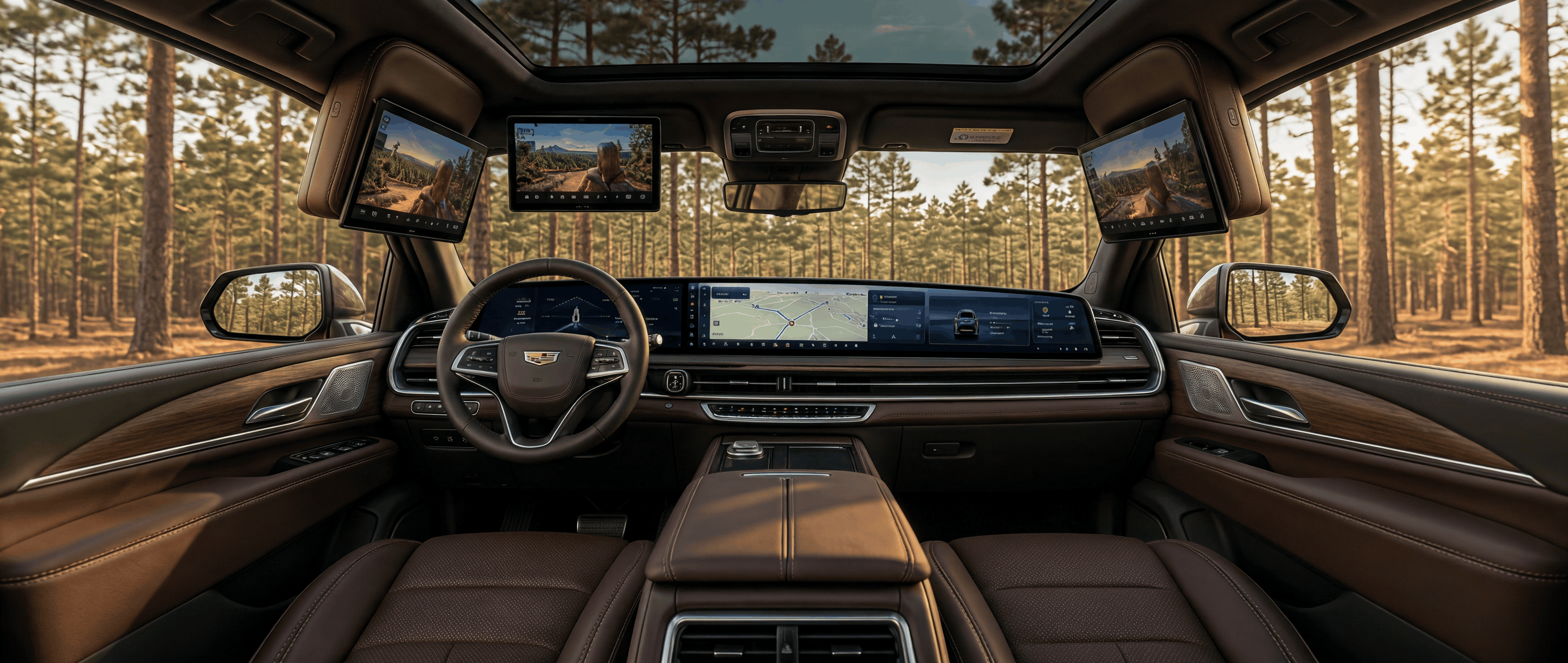
2027 Cadillac Escalade Platinum Luxury interior with 55-inch Horizon Display and rear seat entertainment screens

The 55-inch Horizon Display sits in every 2027 Escalade. Super Cruise is standard across every trim. So why does the choice of trim still matter enormously on a six-hour drive with three kids?

Because the technology that keeps the back seat genuinely occupied (independent rear entertainment screens, a 38-speaker audio environment, second-row wireless charging) isn't standard. It arrives with the Platinum step-up, and it reshapes the rear cabin in a way no amount of driver-facing hardware can match. The 2027 Escalade isn't one vehicle on a family run. It's three meaningfully different experiences depending on the tier, and the ESCALADE IQ adds a fourth dimension entirely (a different platform, a different range calculation, a different answer to what a 400-mile day looks like).

We spend plenty of time on our lot walking families through exactly this, and the breakdown worth having before you choose follows below.

The short version
  • Every 2027 Escalade trim includes the 55-inch Horizon Display and standard Super Cruise hands-free driver assistance for compatible roads. The Luxury trim isn't a stripped version.
  • The Platinum Luxury and Platinum Sport unlock the rear seat entertainment system with dual 12.6-inch independent touchscreens and the 38-speaker AKG Studio Reference system with Dolby Atmos. Neither comes on the Luxury or Sport.
  • The ESCALADE IQ is a fully electric, platform-separate vehicle with an estimated 460-mile range per charge and a premium rear entertainment suite standard; it rewards families who charge at home and rarely need a mid-trip stop.
  • For most Jackson metro families taking I-55 north or south, the Platinum Luxury delivers the most complete long-drive technology stack in a gasoline Escalade.
  • The honest tradeoff worth flagging. The rear entertainment system works best with an HDMI streaming device connected and the vehicle's 5G Wi-Fi hotspot active, so it takes a short setup session before the first long trip.

How Do the Three Tiers Actually Compare for a Family Road Trip?

The three tiers compare closely on driver tech and diverge hard on rear-seat tech, so the table below maps only the features that actually change a long drive, not every spec, just the ones a family feels at the 300-mile mark.

Technology FeatureEscalade LuxuryEscalade Platinum Luxury/SportESCALADE IQ
Horizon Display (front)55-inch curved OLED, standard55-inch curved OLED, standard55-inch Horizon Display, standard
Super Cruise hands-freeStandard, all compatible roadsStandard, all compatible roadsStandard, all compatible roads
Rear seat entertainmentNot includedDual 12.6-in. touchscreens, availableDual rear screens, standard
Audio system21-speaker AKG Studio38-speaker AKG Studio Reference, Dolby AtmosAKG Studio Reference audio
Second-row wireless chargingNot standardAvailable (Executive Second Row package)Standard
5G Wi-Fi hotspotAvailableAvailableAvailable
Air Ride Adaptive SuspensionNot standardStandard (Platinum)Standard
Powertrain6.2L V8, 420 hp6.2L V8, 420 hpElectric, est. 460-mi range
Best forDriver-focused; back seat brings personal devicesFull family, mixed ages, longer runsHome-charging households; premium rear cabin standard

Browse our current Escalade inventory

Does the Trim Choice Actually Change What Happens in the Back Seat?

Yes, the trim changes the back seat substantially, with the Luxury keeping the second row calm and comfortable and the Platinum trims handing that row a full entertainment and audio environment of its own, the single biggest experience gap across the lineup on a long drive.

The Luxury trim's cabin is composed and quiet. The 21-speaker AKG system fills the front row well, and the 55-inch Horizon Display keeps navigation and connectivity unified for the driver and front passenger. What it doesn't do is give the second row their own environment. Kids bring tablets, teenagers bring phones, and everyone runs their own content through the vehicle's 5G hotspot. For plenty of families that works entirely well. The Luxury isn't a lesser vehicle; it's a different answer to the question.

The Platinum Luxury changes the back seat's relationship to the vehicle. The dual 12.6-inch touchscreens mount to the backs of the front headrests, each running content independently of the other and of whatever's on the main display. Each accepts an HDMI input (where a streaming device connects and runs without occupying anyone's personal screen). The 38-speaker AKG Studio Reference system with Dolby Atmos spatial audio means the front cabin sounds categorically different at highway speed. The available Executive Second Row package adds a second wireless charging pad alongside massaging seats with 16-way power adjustment.

One thing worth knowing from our floor, the rear entertainment setup isn't the simplest out of the box. It runs best with an HDMI streaming device and the vehicle's 5G hotspot active, and once that configuration is set, it stays consistent. Plan on about fifteen minutes before the first long trip to get it dialed. Set it up once and it holds.

Explore the Escalade ESV if the standard wheelbase feels close but cargo is the constraint. Same technology suite, longer body.

Value Your Current Trade-In

What Makes Super Cruise Different on a Six-Hour Run?

Super Cruise is standard on every 2027 Escalade trim, and what it changes on a six-hour run is driver stamina, holding lane centering, following distance, and speed on compatible highways so you manage attention rather than grip, though it never hands over the responsibility of watching the road. That green light bar does a lot of quiet work. It functions on compatible highways, including I-55 and the interstate network radiating out of the Jackson metro toward Memphis, Nashville, New Orleans, and the Gulf Coast. On a compatible road, the steering wheel light bar turns green and the system holds its line without your hands on the wheel. A 3-year OnStar One plan is included with every 2027 Escalade, keeping the system connected to live map and road data.

Super Cruise is a driver assistance system for attentive drivers on compatible roads. It monitors driver attention and requires your eyes forward at all times.

On the practical side of a long family drive, the driver's fatigue curve flattens considerably after the third hour, and that's the specific payoff on a run from Ridgeland to Memphis or down to the coast. It doesn't remove the need for attentiveness; it removes the sustained grip. Automatic lane changing is also available across all Escalade trims when you signal, and Super Cruise evaluates traffic conditions before executing the change.

On long interstate runs, the Escalade's Magnetic Ride Control reads road conditions up to 1,000 times per second, adjusting damping continuously. On Mississippi interstate surfaces, which range from smooth to outright rough depending on the stretch, that system works in the background to keep the ride settled through the third and fourth hours when passenger fatigue compounds.

Which Escalade Fits Your Family's Drive?

The right Escalade for your family comes down to who's in the second row and how far you drive before a stop, and none of these three is a downgrade, so here are the picks shaped around what different families actually need on an I-55 run.

Choose the Escalade Luxury if your family travels with older kids who manage their own devices, you want the full driver-technology suite (Super Cruise, Horizon Display, AKG audio), and the rear seat's job is to be comfortable and quiet rather than to host a shared entertainment system. It's a complete vehicle, and nothing about it feels compromised.

Choose the Escalade Platinum Luxury or Platinum Sport if you're traveling with children in the second row who need something to watch that isn't their personal device, or if the idea of a 38-speaker, Dolby Atmos cabin at highway speed matters to you. This is the tier where the Escalade becomes a full-family road trip environment rather than simply a very capable and quiet SUV.

Choose the ESCALADE IQ if you charge at home, your typical long drive doesn't require a mid-trip charge stop, and you want the most technologically complete rear cabin Cadillac makes in this segment. The dual rear entertainment screens and AKG Studio Reference audio system come standard. The tradeoff is real. The ESCALADE IQ rides on a different platform from the gas Escalade, DC fast charging becomes part of the planning discipline, and not every destination on a Jackson metro family road trip has fast charging convenient to the route yet.

Our finance team can walk you through the options

For families deciding between the Escalade and the ESV, the wheelbase choice is primarily about cargo capacity and third-row access. The technology suite is identical at matching trim levels.

Frequently Asked Questions

Does every 2027 Escalade come with Super Cruise?

Yes. Super Cruise hands-free driver assistance for compatible roads is standard on every 2027 Escalade trim, including the base Luxury, and includes a 3-year OnStar One plan. The system works on compatible highways, including the major interstate corridors out of the Jackson metro toward Memphis, Nashville, and the Gulf Coast. It monitors driver attention continuously and requires your eyes on the road; it relieves the physical grip on long highway runs, not the responsibility of driving.

Is rear seat entertainment standard on the 2027 Escalade?

No. The rear seat entertainment system with dual 12.6-inch independent touchscreens is available on the Platinum Luxury and Platinum Sport trims, not on the Luxury or Sport. Each screen runs content independently and accepts an HDMI input. The system works best with a streaming device connected and the vehicle's 5G Wi-Fi hotspot active. On the ESCALADE IQ, dual rear entertainment screens are included as standard equipment.
Cadillac of Jackson

700 Adcock St, Ridgeland, MS 39157

(601) 948-5183


Recommended Posts

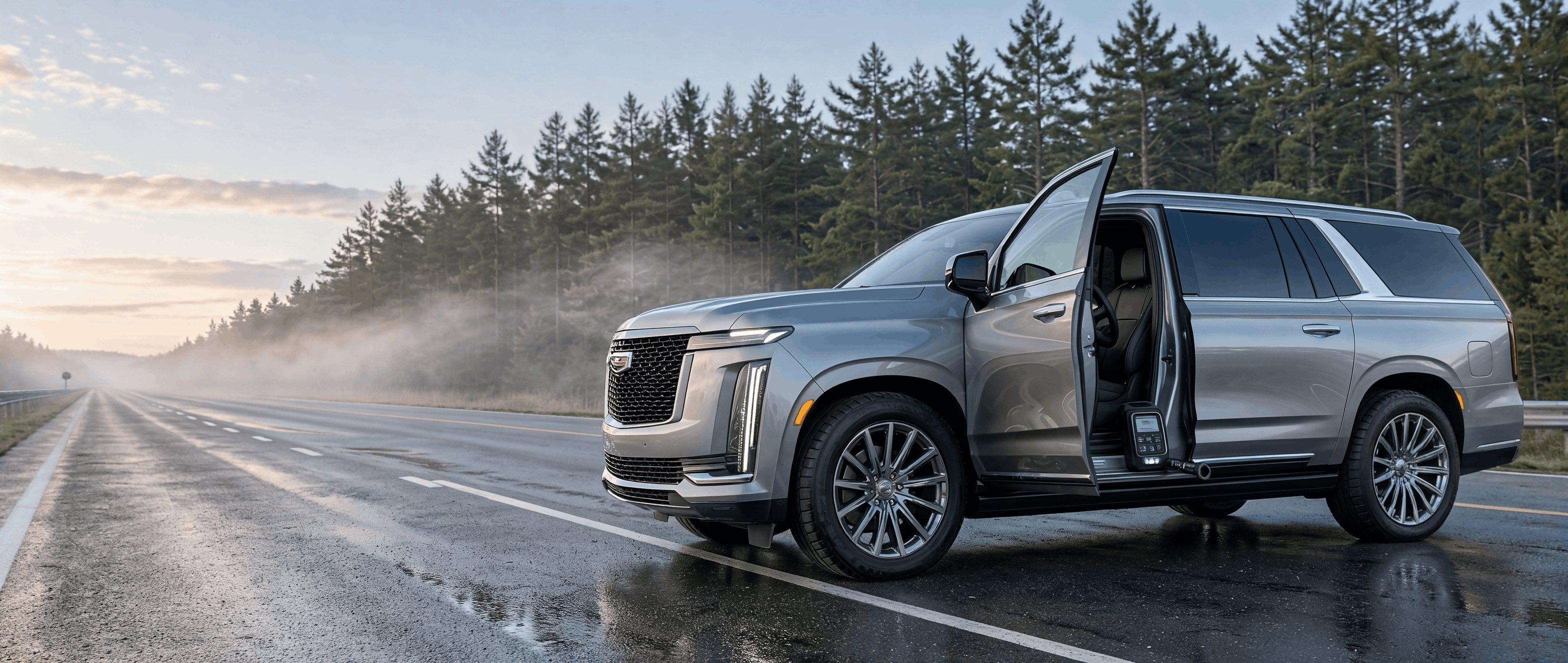
2027 Cadillac Escalade on a Mississippi highway at dawn with tire pressure gauge, pre-holiday travel inspection

Cadillac Tire Tread and Pressure: Holiday Travel Reminder | Ridgeland

In this article What actually matters when checking tires before a highway run? Pressure: the door jamb is the only number that matters Tread depth: the quarter beats the penny Match the gear to how you actually drive this time of year The week before Thanksgiving is a rough time to learn your tires have been quietly bleeding off pressure since September. Here in the Jackson metro, a November morning can run 30 degrees cooler than that same day's mid-afternoon high, and that swing costs you real PSI before you ever turn a key. Our service team at Cadillac of Jackson watches the same thing arrive every November. Vehicles that read fine all summer throw a TPMS light on the first genuinely cold morning, often the week a family is packing for a road trip. The cause is physics, not a leak. What follows is what we actually check, and the order we check it in, so you can run through it yourself before you load the car. The short version Check pressure cold: before driving, using the door-jamb placard number, never the sidewall maximum. In Mississippi's November temperature swings, expect to lose 2 to 3 PSI overnight without any leak at all. The TPMS light is a late warning; it triggers well below where tire performance begins to degrade. Tread at 4/32 inch is the threshold to start shopping. At 2/32 inch, replace before the trip. A six-year-old tire that still looks fine may be compound-degraded. Check the DOT date on the sidewall. What actually matters when checking tires before a highway run? Two numbers run the whole show when you're prepping for a long run, pressure and tread depth, and while rotation intervals, sidewall condition, and spare tire state are all real concerns, those two are what decide how the vehicle behaves on a wet interstate on a November evening. What to Check Best For Key Spec Tradeoff Cold inflation pressure Every drive, every season Door-jamb placard (varies by model and trim) The sidewall number is the max, not the target; overinflating is also wrong Tread depth: front Wet-road grip, water evacuation 4/32 in. = shop threshold; 2/32 in. = replace now Rear wear is often worse and less visible from the driver's side Tread depth: rear Driven-axle longevity; AWD balance Same 4/32 in. / 2/32 in. standard Easy to overlook when you only check fronts Tread uniformity Diagnosing inflation history Center wear = chronic overinflation; edge wear = chronic underinflation Tells you what the tire has lived through, not just where it is now Spare tire pressure The roadside situation you hope never happens Printed on the spare itself or in the door-jamb placard A flat spare discovered on I-55 at night is a worse problem than the original flat Tire age (DOT date) Long highway miles where tread wears slowly Six-year replacement window from manufacture date A 2019 tire with 6/32 of tread is not the same compound it was at the factory The 2027 Escalade and Escalade ESV roll on P275/50R22 all-season tires as standard equipment. Those are large, capable tires. Their size means a 3 PSI drop is proportionally significant, and their weight asks the tread to do real work once the road turns wet. Pressure: the door jamb is the only number that matters The number molded into your tire's sidewall is the maximum pressure the tire can hold, which looks authoritative enough to trust, but it isn't your target at all; your target sits on the placard inside the driver's door jamb, and it differs by model, trim, and sometimes by axle position. Mississippi's November climate becomes directly relevant right about now. For every 10 degrees Fahrenheit the temperature drops, tire pressure falls by approximately 1 PSI. Set your tires to spec on a 70-degree afternoon in October, then park outside overnight. If it's 42 degrees the next morning, you've shed roughly 2 to 3 PSI without a single molecule leaving the tire. For every 10 degrees Fahrenheit the temperature drops, tire pressure falls by approximately 1 PSI. A tire set correctly on a warm fall afternoon can read 2 to 3 PSI low on a cold Mississippi November morning. The TPMS in your Cadillac is a genuine safety feature, though it trips at a threshold well under where handling and wear begin to suffer. By the time that light shows up, the tire has already been underperforming for a while. We'd check with a quality gauge every month, and always before a road trip of any real distance. Check the pressure cold, meaning the car's been parked at least three hours, before the morning's first drive. Check right after driving and the heat of use will pad the reading. Schedule a pre-trip tire inspection with our service team before you leave town if you haven't had one this fall. On EVs and larger platforms: The ESCALADE IQ runs LT275/50R24 tires. It carries additional weight from the battery platform, and the door-jamb spec is calibrated for exactly that load. Don't approximate from a friend's conventional-vehicle placard. Tread depth: the quarter beats the penny There are two coins that will tell you roughly where your tread depth stands, a penny and a quarter, and the distinction between what each one reveals is well worth knowing before you ask the tires to hold a wet highway on a holiday morning. The penny: Insert it tread-first into a groove with Lincoln's head pointing down. If the top of Lincoln's head stays fully visible, your tread sits at or below 2/32 of an inch, which is the legal minimum in most states and the point where wet-road performance is genuinely compromised. See that, and replace the tires before the trip. The quarter: Same method, Washington's head pointing down. If the top of Washington's head shows, you're at or below 4/32 of an inch. The tire still passes inspection, but stopping distance in standing water has already grown measurably. Treat that number as your cue to start budgeting for replacement. Here is the fair tradeoff. 4/32 is not 2/32, and we won't pretend a tire at that number is unusable on a highway run, because that overstates it. What we will say is that Mississippi's late November can drag rain across the region, and a tire at 4/32 on a wet road is working harder than a tire at 6/32. I-55 and I-20 both pass through Jackson. Do both axles. Rear tires on AWD SUVs and sedans can wear differently than the fronts. The coin test takes about 90 seconds. Match the gear to how you actually drive this time of year If your Cadillac is loaded for a Thanksgiving run (luggage, passengers, roof cargo), the pressure spec on some configurations steps upward for maximum load, and the door-jamb placard often lists both figures, one for a lightly loaded vehicle and one for the full house. Use the one that matches how you're traveling. XT5 owners heading out on longer holiday runs should watch for even tread wear across the rear axle. The XT5's AWD system shuffles torque actively, and an uneven rear pair creates the same mismatched grip the system is already working to compensate for. One item gets skipped every season, and that's the spare. Full-size under the floor or a compact temporary, check its pressure before you pull out of the driveway. Finding it flat the moment you need it is precisely the wrong time to find out. FAQ Does cold weather cause the TPMS warning light to come on even if there's no actual problem? Yes, and cold mornings are a classic trigger this time of year. The TPMS in your Cadillac monitors pressure continuously, but its warning threshold sits well below the recommended spec. What happens in November is that a tire set correctly at 70 degrees can drop 2 to 3 PSI overnight as temperatures slide into the 40s, and in some cases that's enough to approach the threshold. It doesn't mean the tire has a leak. Top it off to the door-jamb spec using cold readings. If the light returns after you've corrected the pressure, you may have a slow leak worth having inspected. How do I know if my Cadillac's tires are too old to trust on a highway trip, even if the tread looks fine? Tire compounds degrade over time no matter how much tread remains. The practical guidance is a six-year replacement window measured from the tire's manufacture date, not from when you bought the vehicle. That date is encoded in the last four digits of the DOT number on the sidewall, where the first two digits are the week of manufacture and the last two are the year. A tire reading "2419" was made in the 24th week of 2019. If yours are approaching or past that mark, have them evaluated before a long trip, particularly if you do most of your driving on highway miles where tread wears slowly and age can go unnoticed. By the Cadillac of Jackson Team | November 2026 Schedule a Pre-Trip Tire Inspection Cadillac of Jackson 700 Adcock St, Ridgeland, MS 39157 (601) 948-5183

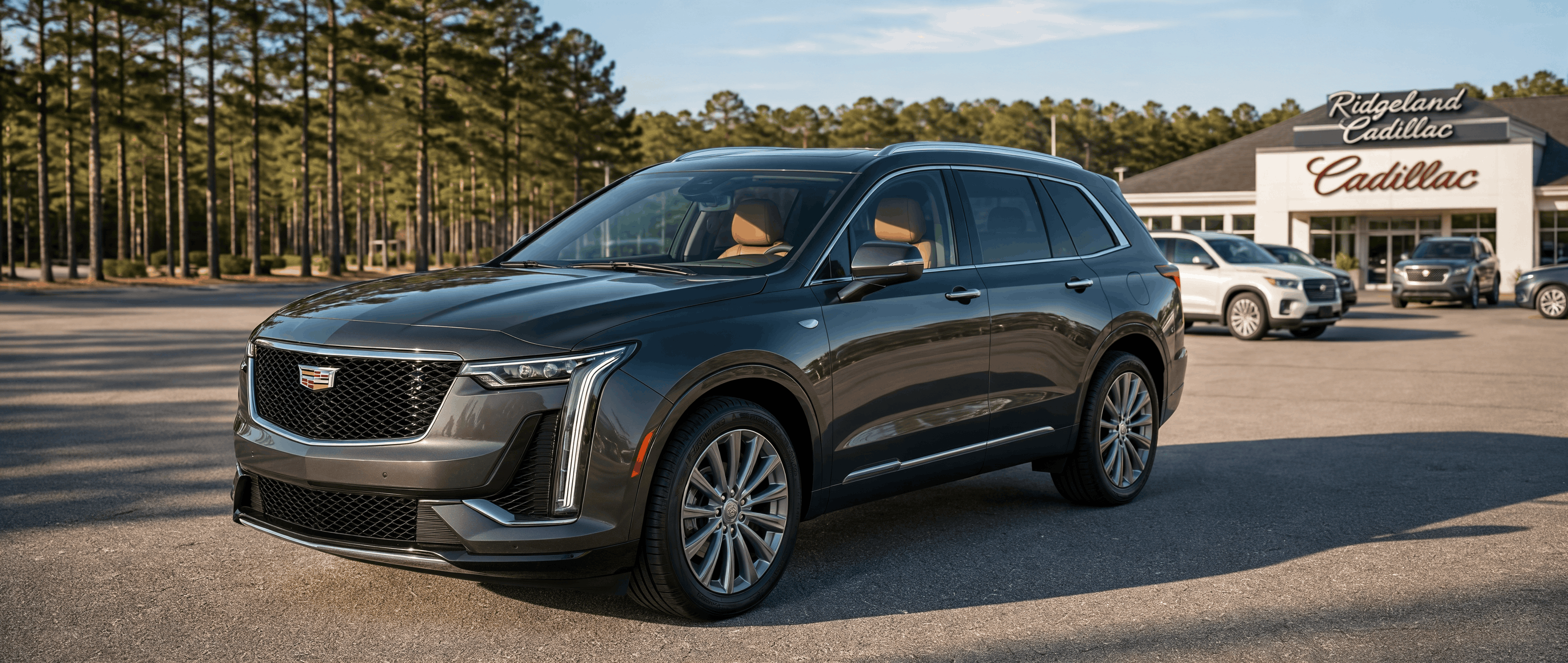
Pre-owned Cadillac XT5 on a Ridgeland MS dealership lot with Mississippi pine treeline in background

Pre-Owned Cadillac Buying Guide: Which Years to Target in Ridgeland

In this article Which XT5 Years Are the Sweet Spot? Which CT5 Years Deserve a Closer Look? Which Escalade Years Hold Up? Which Year Fits Which Buyer in Ridgeland? Not every year of a Cadillac nameplate is the same vehicle, and that's worth saying before anything else. The badge stays constant. What's bolted underneath it does not. For a buyer in Ridgeland weighing a used XT5, CT5, or Escalade, knowing which model years cleared Cadillac's growing pains and which carried them is what separates a rewarding ownership stretch from an expensive education. We've worked through this using NHTSA's complaint and recall database, the Cadillac CPO framework, and the demands Mississippi's climate puts on any pre-owned luxury vehicle. The short version sits just below. The fuller case follows it. The short version XT5 sweet spot: 2021-2022. Lower NHTSA complaint volume than the 2017-2019 generation, meaningful 2020 refresh behind it, and still within CPO eligibility range depending on mileage. XT5 years to watch: 2017 and 2018. The 2017 drew the highest complaint volume of any XT5 year on record and carries a documented brake caliper recall (NHTSA #16V802000). The 2018 improved but retained early-generation transmission concerns. CT5 sweet spot: 2022-2023. Markedly lower NHTSA complaint counts than the 2020 launch year, and the 10-speed transmission recall (NHTSA Campaign 25V148000) affecting 2020-2021 vehicles is resolved on most certified examples. Escalade sweet spot: 2018-2020 (fourth gen) or 2022+ (fifth gen with independent rear suspension). Avoid the 2015 first-year fourth gen for its infotainment and sensor complexity; the 2021 first-year fifth gen for documented transmission shudder complaints. Mississippi inspection layer matters. Long, humid summers stress ventilated seating systems, leather surfaces, and cabin filtration in ways that a standard pre-purchase check can miss. We'll tell you what to look at. Browse our current pre-owned inventory Which XT5 Years Are the Sweet Spot? The 2021-2022 XT5 is the sweet spot, and the 2020 refresh is the line that makes it so, splitting the earlier 2.0-liter turbo four and eight-speed pairing (the XT5's most concentrated complaint period) from a revised powertrain, updated technology, and a complaint profile that's noticeably calmer afterward. NHTSA's records for the 2017-2025 Cadillac XT5 show 294 total owner complaints across the generation. The 2017 model year takes a lopsided share of that, 117 complaints in a single year against 11 for the 2021. That gap isn't marginal. It reflects a first-year vehicle with brake caliper concerns documented under recall NHTSA #16V802000, early transmission calibration trouble, and a CUE infotainment system that threw more service bulletins than any year that followed. Put plainly, the 2017 is a poor used buy. Model Year Generation NHTSA Complaints Key Recall to Verify Our Verdict 2017 1st Gen ~117 NHTSA #16V802000 (brake caliper) Avoid 2018 1st Gen ~64 None formal; check transmission service history Caution 2019 1st Gen ~31 None on record Acceptable 2020 Refresh ~23 5 recall campaigns; check each VIN Caution 2021 Refresh ~11 NHTSA #22V427000 (rear toe link, 2022 only) Good 2022 Refresh ~9-10 NHTSA #22V427000 (rear toe link). Verify completion Good/Best Value 2023-2024 Refresh Very low Minor instrument panel recall; verify VIN Good The 2022 XT5 carries one specific item, a rear suspension toe link recall (NHTSA #22V427000) covering rear toe link bolt torque. It's a straightforward service action, and on any certified example it should already be done. Ask for the paperwork. For buyers who want the most settled XT5 on the market, the 2022-2023 range gives you a mature version of the refresh with the lowest documented complaint counts. See available XT5 models in our lineup The honest tradeoff is this. The 2021-2022 XT5 offers the best reliability-to-availability ratio we can point to, but these cars are nudging the edge of CPO eligibility. Cadillac's CPO program requires a vehicle to be under four model years old and under 50,000 miles. A 2021 bought in late 2026 sits right at that boundary. That doesn't disqualify it. It just means you verify CPO status at the time of purchase instead of assuming it. Which CT5 Years Deserve a Closer Look? For the CT5, the 2022-2023 cars deserve the closest look, because the 2020 launch behaved the way first model years tend to, and that's how the 2020 CT5 ended up leading the generation with the highest complaint count on record, with calibration and early-owner issues piling into NHTSA's database before the later cars settled down. The specific concern for 2020-2021 CT5 buyers is NHTSA Campaign 25V148000, issued in March 2025. It covers certain 2020-2021 CT4 and CT5 vehicles equipped with the 10-speed automatic transmission. Per NHTSA, excessive wear in the transmission control valves can cause harsh shifting and, in rare cases, momentary wheel lockup. Any 2020 or 2021 CT5 you're evaluating should carry documented proof that this recall has been completed. Not a maybe. Get it in writing before you sign. Model Year NHTSA Complaints Recalls Key Item Our Verdict 2020 ~39 (highest for generation) 4 NHTSA 25V148000 (transmission); verify completion Watch Carefully 2021 ~27 3 NHTSA 25V148000 (transmission); verify completion Caution 2022 ~11 2 Airbag curtain and DRL; both resolved on most examples Acceptable 2023 ~9-13 1 Minor DRL recall; verify VIN Good/Sweet Spot 2024-2025 Very low Minimal Cleanest record in the generation Strong The 2023 CT5 is where the picture clears. NHTSA's complaint data shows a marked improvement over the 2020-2021 period, and the generation's calibration issues had largely worked themselves out by then, so you're on much safer ground. For buyers eyeing the CT5-V or CT5-V Blackwing, those trims carry their own complaint profiles worth a separate look at NHTSA's public database; the powertrain tuning on a Blackwing is a different engineering proposition than the standard V6. View CT5 listings in our inventory Which Escalade Years Hold Up? The Escalade splits cleanly along its generation line, and that boundary matters more here than any single year, with the fourth generation (2015-2020) riding body-on-frame on a solid rear axle and the fifth generation (2021-present) moving to independent rear suspension, a 35-inch curved OLED display across the instrument cluster, and a heavily revised interior. These are meaningfully different vehicles in how they ride and in what they give you. Fourth gen (2015-2020): what to target and what to watch. The 2015 first-year launch brought its own complexity, with Magnetic Ride Control suspension calibration issues and CUE infotainment concerns that generated notable service bulletin volume. The 2018 and 2019 stand out within this generation. Per NHTSA complaint data, the 2019 and 2018 Escalade carry complaint rates well below the generation average, and the 6.2-liter V8 powering these vehicles is a known quantity with strong longevity when it's maintained properly. Year Gen/Platform Key Consideration Verdict 2015 4th Gen (K2XX) First-year sensor and infotainment complexity Caution 2016 4th Gen (K2XX) Improved from 2015; check Magnetic Ride Control service history Acceptable 2017 4th Gen (K2XX) Refined transmission; solid record in this period Good 2018-2019 4th Gen (K2XX) Low complaint rate; strong 6.2L V8; best fourth-gen value Sweet Spot 2020 4th Gen (K2XX) Last pre-redesign year; among lowest complaint rates in generation Good 2021 5th Gen First-year transmission shudder complaints; check VIN history Caution 2022-2023 5th Gen Improved; verify any active recall campaigns Good 2024+ 5th Gen Most settled fifth-gen examples available used Strong On the fifth-gen specifically: the 2021 first-year release drew well-documented transmission shudder complaints. Read that as a first-year pattern, not a condemnation of the generation. The 2022-2023 fifth-gen models resolved much of it, and the independent rear suspension, the curved OLED cabin, and the available Super Cruise driver assistance make these substantially more capable long-haul vehicles than the fourth gen, and you'll feel it on a longer run. See current Escalade listings The fifth-generation Escalade's independent rear suspension changed third-row comfort fundamentally. Fourth-gen buyers will notice the difference on any run longer than an hour. Pros and Cons of Buying a Pre-Owned Cadillac vs. New Pros Cons Lower initial acquisition relative to new First-year model years carry higher documented risk CPO program available on qualifying vehicles (under 4 years, under 50,000 miles) CPO eligibility narrows on older sweet-spot years Access to 172-point inspection and vehicle history on CPO examples Non-CPO used vehicles require independent inspection investment Established service history on well-maintained examples Mississippi humidity and heat accelerate wear on neglected interiors and seals Reduced depreciation curve on 2-4 year-old vehicles Technology updates between generations can be significant (especially Escalade 4th to 5th gen) Which Year Fits Which Buyer in Ridgeland? Which year fits you depends on how you'll actually use the car, so the data only gets you halfway; the rest is matching a model year to a commute, a road trip, and a Mississippi summer, which is where the XT5, CT5, and Escalade each pull in a slightly different direction. The XT5 buyer who commutes across the metro or travels to the Gulf Coast. The 2021-2022 XT5 is the right target if that's your drive. It captures the 2020 powertrain and technology refresh, carries the lowest complaint profile of any XT5 years with meaningful real-world history, and still qualifies for CPO certification on mileage-appropriate examples. Highway comfort, the available ventilated front seating (a real asset in a Mississippi summer), and all-wheel-drive confidence on a wet I-55 at night all land in one vehicle. The CT5 buyer who wants a driver's sedan. Go 2022 at minimum, 2023 or newer if the inventory allows. The transmission recall picture is cleaner by 2022, and composure at highway speed is what this sedan does best. If the Blackwing variant is on the table, you'll want to treat it as its own category and inspect accordingly; a modified powertrain tune earns individual scrutiny beyond the standard complaint data. The Escalade buyer who needs three-row capability for extended family travel or long highway runs. Here you're genuinely choosing between generations. The 2018-2020 fourth gen offers proven reliability and a well-understood powertrain at a lower acquisition point. The 2022-2023 fifth gen brings the kind of interior technology and ride composure that marks a different vehicle in character. If the third row will carry adults regularly on longer runs (think Jackson to Atlanta, or Ridgeland to Destin), the fifth gen's independent rear suspension makes a material difference across four or five hours. The Mississippi-specific inspection layer. Does the ventilation actually blow cold air, or just push warm cabin air around? On any pre-owned Cadillac that's spent its life in this climate, that's the kind of thing our team checks closely, because long humid summers here wear on ventilated seat blower systems and we want them cycling cold, not circulating heat. Inspect the leather bolsters and door panel surfaces for UV and humidity damage that soft-touch materials in this segment soak up over time. Check the cabin filtration. And on any vehicle with Magnetic Ride Control, ask for the suspension service history; the fluid dynamics in those dampers degrade differently in sustained heat than in milder climates. Before committing to any pre-owned Cadillac, run the VIN through NHTSA's public recall database at nhtsa.gov to confirm every open campaign is resolved. It takes three minutes and costs nothing. That three-minute check is the single most useful pre-purchase step going, and it'll tell you exactly what the vehicle's history looks like from a safety standpoint. Frequently Asked Questions What is the best used Cadillac XT5 year to buy? The 2021 and 2022 model years represent the strongest combination of reliability and availability. Per NHTSA's database, the 2021 XT5 drew approximately 11 complaints, compared with 117 for the 2017 launch year. The 2022 carries one resolved rear toe link recall (NHTSA #22V427000) worth verifying on the specific VIN. Both years benefit from the 2020 powertrain refresh and an updated technology suite. Does the 2020 or 2021 Cadillac CT5 have a recall I should know about? Yes. NHTSA Campaign 25V148000, issued March 2025, covers certain 2020-2021 CT4 and CT5 vehicles equipped with the 10-speed automatic transmission. Per NHTSA, the concern involves excessive wear in the transmission control valves that can cause harsh shifting and, in some cases, momentary wheel lockup. Before purchasing any 2020 or 2021 CT5, confirm in writing that this recall has been completed on that specific VIN. Is a Cadillac CPO vehicle worth it over a standard used purchase? The CPO program's value depends on where the vehicle sits in its eligibility window. Cadillac's CPO requires the vehicle to be under four model years old and under 50,000 miles. It includes a 172-point inspection and extends certified coverage beyond what a standard used purchase provides. For a buyer considering a 2022-2023 XT5 or CT5, that additional coverage layer is real and meaningful. For a 2019 vehicle, CPO eligibility has passed entirely, which shifts the entire burden to your pre-purchase inspection and service history review. Schedule a Pre-Purchase Inspection Cadillac of Jackson 700 Adcock St, Ridgeland, MS 39157 (601) 948-5183

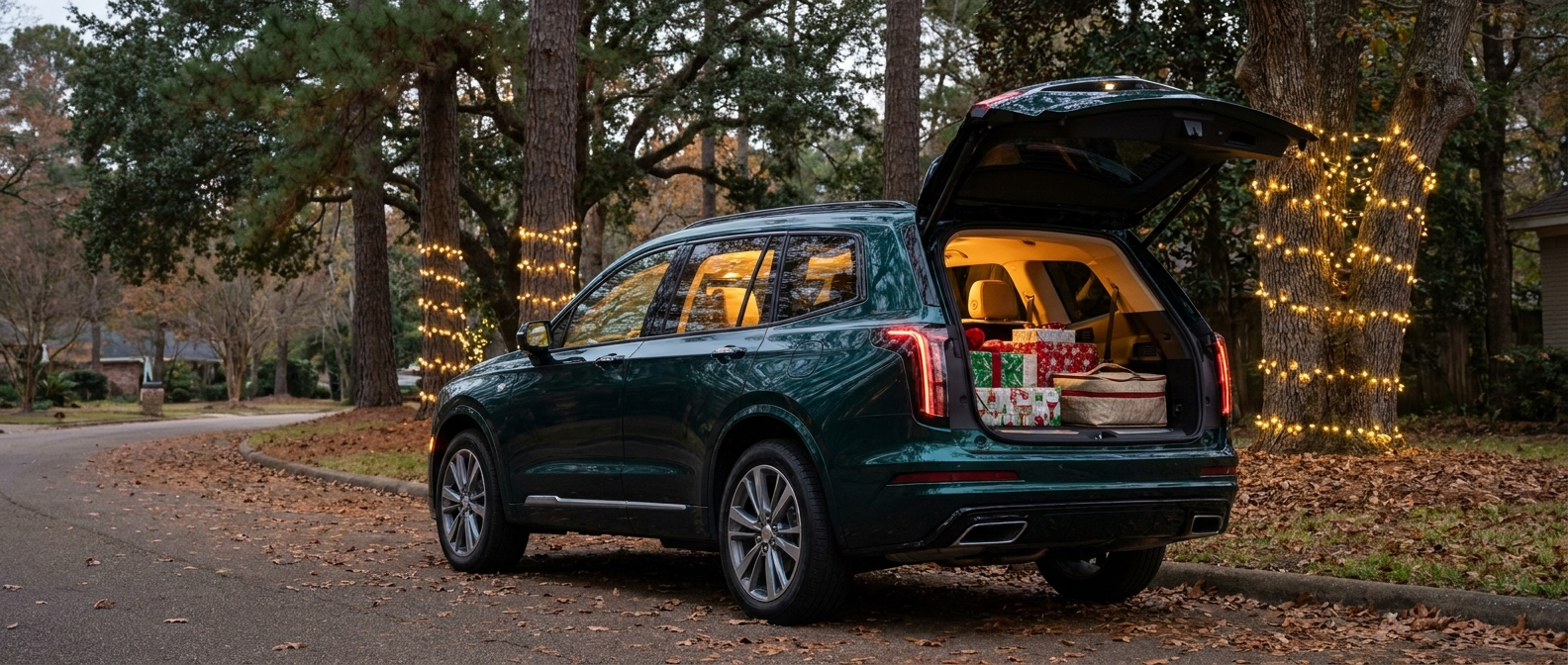
2025 Cadillac XT6 liftgate open with holiday cargo loaded on a residential street in Ridgeland, MS

XT6 Holiday Seating and Cargo Checklist for Madison Gatherings

The 2025 XT6 closes out this generation for North America, so the examples on our lot right now are the most sorted version of a three-row Cadillac that seats seven, folds down to 78.7 cubic feet of cargo, and still feels composed on a December evening run up Highland Colony Parkway to the Ridgeland Christmas Tree Lighting. Work this checklist, and you'll load it correctly, seat everyone comfortably, and skip the trunk-rearrangement moment in a neighbor's driveway. See our available Cadillac VISTIQ inventory if you're also weighing the all-electric three-row that follows the XT6 in the lineup. What Goes on the Holiday Checklist? Run through these items before every gathering trip from Thanksgiving through New Year's, since seating, cargo staging, cabin comfort, and a clean exit each come down to a handful of decisions you make before the first bag goes in, and the XT6 rewards that bit of planning more than most three-rows do. Seating configuration [ ] Confirm your headcount. Seven passengers? Keep the second-row bench. Six? The available captain's chairs add pass-through access to the third row and a more composed second-row experience. Useful when the ride to the Madison Christmas Parade on Old Canton Road includes both adults and school-aged kids. [ ] Assign the third row intentionally. Cadillac lists 29.5 inches of legroom back there. That seats two children comfortably and two smaller adults on a short run. For a cross-town drive to Thanksgiving dinner it works fine. For the full I-55 trip up to grandparents' house, plan to rotate adults through the middle row every hour. [ ] Confirm second-row headroom before the seatback positions are locked in. The 2025 XT6 gives 39.1 inches of headroom in row two. Put your tall passengers there; row three gives 37.2 inches. [ ] Check that the 60/40 split-folding second-row bench is fully latched if you're in seven-passenger configuration. A partially folded seatback is the one interior detail that shifts cargo mid-trip. Cargo staging [ ] Match your cargo plan to the actual configuration. With all three rows occupied, you have 12.6 cubic feet behind the third row. That covers a carry-on, a small cooler, and a gift bag or two. A full Thanksgiving haul is out. [ ] Fold the third row flat to unlock 43.1 cubic feet, the figure for a family of five with a holiday grocery run or a stack of wrapped gifts, still with five comfortable seats in use. [ ] Need full capacity? Both rear rows down gives you 78.7 cubic feet, the floor of an XT6 with everything stowed. At that point it's a cargo vehicle, and two adults ride up front. [ ] Place fragile items (the casserole dish, the fruitcake nobody asked for) on the floor rather than a folded seatback. The XT6's flat fold gives you a genuine load floor instead of a tilted shelf. [ ] Bring a trunk organizer or a low-profile cargo bin. It keeps the 12.6-cubic-foot space usable as a contained zone instead of a shifting pile. Cabin comfort before the drive [ ] Set tri-zone climate control before passengers board. Mississippi Novembers run mild to cool, but the rear zones need a head start, particularly for young passengers who don't have direct vents. [ ] Activate heated second-row seats for outboard passengers on the bench. Figure a 20-minute drive from our lot on Adcock Street to most Madison addresses; the cabin warms quickly, and seat heat closes the gap immediately. [ ] Confirm phone connectivity for navigation and music before departure. The XT6 runs wireless Apple CarPlay and wireless Android Auto. No cable required, but the phone still needs to be in Bluetooth range on first connection. Load security and exit [ ] Use the hands-free liftgate if your arms are full. Hands-free is standard on the Premium Luxury and Sport trims. Know which trim you have before you're standing in a parking lot with a 9x13 pan. [ ] Confirm cargo load balance side-to-side. An off-center load barely registers in a vehicle this size. On the interstate it shows. Why These Items Matter: The Space Math Behind the Season The utility story on the XT6 comes down to one plain tension, since seven occupied seats and a meaningful holiday haul cannot coexist in the same trip, and with all three rows full Cadillac's published figure is 12.6 cubic feet behind them, roughly the volume of a carry-on bag and a soft cooler. That's the trade, and we're straightforward about it in our showroom. Compare the two-row XT5 if your household regularly runs five passengers and prioritizes cargo over the third seat. The workaround the XT6 handles cleanly is the third row, which folds flat in seconds and lifts the available volume to 43.1 cubic feet, a meaningful figure for a family of five carrying the full holiday supply run. One thing worth doing, in that order, is dropping the third row before you load, because reaching the release with bags already stacked turns into a two-handed job in a tight driveway. What we see on the lot, working through configurations with Madison-area families, is that the bench-versus-captain's-chairs call matters more than the cargo question. The bench carries seven and keeps the setup simple. The captain's chairs seat six, add a natural aisle to the third row, and make the second-row ride noticeably more composed. Bring two rows of adults and two kids in the back, and the captain's chairs earn their keep. View our current XT6 inventory On the third row and adult passengers: Cadillac's published third-row legroom of 29.5 inches leads its direct segment peers, a real number rather than marketing language. It won't make every adult comfortable for 90 minutes. It does mean two adults of average build can ride back there for a 20-minute cross-town drive without complaint. Know your route. Item Why It Matters for Holiday Trips Second-row bench (7-seat) vs. captain's chairs (6-seat) Bench maximizes headcount; chairs ease third-row boarding and second-row comfort 12.6 cu ft (all rows up) Fits a carry-on, small cooler, and gift bags, not a full Thanksgiving haul 43.1 cu ft (third row folded) Handles a family of five plus a full holiday grocery or gift run 78.7 cu ft (both rows folded) Full cargo mode; the largest load floor in this vehicle Tri-zone climate control Rear-row passengers control their own temperature independently of front 60/40 split-folding second row Lets one side fold for cargo while one side keeps a passenger Hands-free liftgate (Premium Luxury, Sport) Critical when both arms are carrying food or gifts Wireless Apple CarPlay and Android Auto Navigation and music without a cable on a busy holiday evening Explore Financing Options Your Print-and-Go Recap Before Every Holiday Run Check your headcount before you touch the liftgate, because every holiday run starts with the same choice between people and cargo, and getting the configuration right the first time saves you the parking-lot reshuffle at the far end. Count your passengers first. Seven people means 12.6 cubic feet of trunk. Five people means you can fold the third row and use 43.1 cubic feet. The number changes what you can bring. Assign the third row to children or shorter adults for longer drives. For the drive across Madison to the Festival of Trees at Madison Square Center for the Arts on Main Street, it's fine for anyone. For an hour on the interstate, honest planning matters. Stage fragile cargo on the XT6's flat load floor rather than folded seatbacks. The fold gives you a genuine flat surface. Use it. Activate climate zones and seat heat before the first passenger boards. November in central Mississippi is mild enough that the cabin warms in minutes, but the first few minutes matter when you're loading a full vehicle. Connect your phone before you close the door. Wireless CarPlay and Android Auto sync quickly, but don't attempt first connection while navigating Old Town Ridgeland during the Christmas Parade on December 4. Know your liftgate. Hands-free is on Premium Luxury and Sport. If you're on a Luxury trim, the liftgate is power-operated but button-activated. Build in the extra five minutes. Parking at Northpark in Ridgeland during December fills faster than any other month. Leave before you think you need to. Schedule a pre-holiday service check to confirm tires, fluids, and lighting before the busy stretch begins. Frequently Asked Questions Can the 2025 Cadillac XT6 comfortably fit seven adults for a holiday gathering? It can transport seven adults for shorter cross-town trips. Cadillac's published third-row legroom is 29.5 inches, which leads the segment, and third-row headroom is 37.2 inches. For a 20-minute drive to a gathering in Madison or Ridgeland, two adults in the back row are comfortable. For a longer interstate trip, we'd recommend rotating adults through the second row (39.1 inches of legroom) periodically, or using the captain's chairs configuration to give second-row passengers more personal space while keeping two spots in the third row for smaller adults or children. How much holiday cargo can the XT6 carry if all seven seats are occupied? With all three rows in use, Cadillac's published cargo volume is 12.6 cubic feet behind the third row. That accommodates a weekend bag, a soft cooler, and a few gifts. Enough for a day trip, not a full holiday haul. Folding the third row flat (which the 60/40 split seatback enables on one side) expands the space to 43.1 cubic feet. With both rear rows folded, the XT6 opens up to 78.7 cubic feet of load floor. The practical guidance for holiday use is simple. Decide whether you're carrying seven people or you're carrying significant cargo, and configure accordingly before you load the first item. Schedule Your Pre-Holiday Service Check Cadillac of Jackson 700 Adcock St, Ridgeland, MS 39157 (601) 948-5183