

The week before Thanksgiving is a rough time to learn your tires have been quietly bleeding off pressure since September. Here in the Jackson metro, a November morning can run 30 degrees cooler than that same day's mid-afternoon high, and that swing costs you real PSI before you ever turn a key.
Our service team at Cadillac of Jackson watches the same thing arrive every November. Vehicles that read fine all summer throw a TPMS light on the first genuinely cold morning, often the week a family is packing for a road trip. The cause is physics, not a leak. What follows is what we actually check, and the order we check it in, so you can run through it yourself before you load the car.
- Check pressure cold: before driving, using the door-jamb placard number, never the sidewall maximum.
- In Mississippi's November temperature swings, expect to lose 2 to 3 PSI overnight without any leak at all.
- The TPMS light is a late warning; it triggers well below where tire performance begins to degrade.
- Tread at 4/32 inch is the threshold to start shopping. At 2/32 inch, replace before the trip.
- A six-year-old tire that still looks fine may be compound-degraded. Check the DOT date on the sidewall.
What actually matters when checking tires before a highway run?
Two numbers run the whole show when you're prepping for a long run, pressure and tread depth, and while rotation intervals, sidewall condition, and spare tire state are all real concerns, those two are what decide how the vehicle behaves on a wet interstate on a November evening.
| What to Check | Best For | Key Spec | Tradeoff |
|---|---|---|---|
| Cold inflation pressure | Every drive, every season | Door-jamb placard (varies by model and trim) | The sidewall number is the max, not the target; overinflating is also wrong |
| Tread depth: front | Wet-road grip, water evacuation | 4/32 in. = shop threshold; 2/32 in. = replace now | Rear wear is often worse and less visible from the driver's side |
| Tread depth: rear | Driven-axle longevity; AWD balance | Same 4/32 in. / 2/32 in. standard | Easy to overlook when you only check fronts |
| Tread uniformity | Diagnosing inflation history | Center wear = chronic overinflation; edge wear = chronic underinflation | Tells you what the tire has lived through, not just where it is now |
| Spare tire pressure | The roadside situation you hope never happens | Printed on the spare itself or in the door-jamb placard | A flat spare discovered on I-55 at night is a worse problem than the original flat |
| Tire age (DOT date) | Long highway miles where tread wears slowly | Six-year replacement window from manufacture date | A 2019 tire with 6/32 of tread is not the same compound it was at the factory |
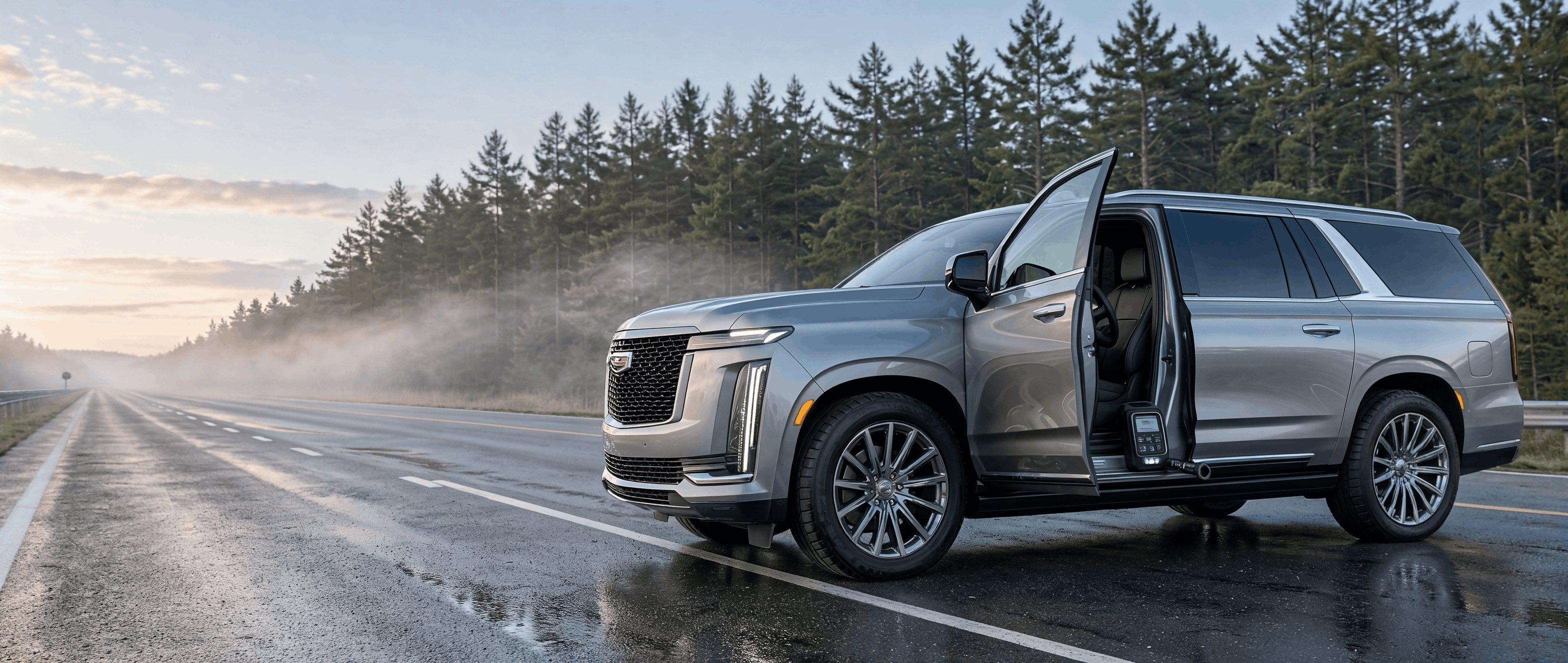
The 2027 Escalade and Escalade ESV roll on P275/50R22 all-season tires as standard equipment. Those are large, capable tires. Their size means a 3 PSI drop is proportionally significant, and their weight asks the tread to do real work once the road turns wet.
Pressure: the door jamb is the only number that matters
The number molded into your tire's sidewall is the maximum pressure the tire can hold, which looks authoritative enough to trust, but it isn't your target at all; your target sits on the placard inside the driver's door jamb, and it differs by model, trim, and sometimes by axle position.
Mississippi's November climate becomes directly relevant right about now. For every 10 degrees Fahrenheit the temperature drops, tire pressure falls by approximately 1 PSI. Set your tires to spec on a 70-degree afternoon in October, then park outside overnight. If it's 42 degrees the next morning, you've shed roughly 2 to 3 PSI without a single molecule leaving the tire.
The TPMS in your Cadillac is a genuine safety feature, though it trips at a threshold well under where handling and wear begin to suffer. By the time that light shows up, the tire has already been underperforming for a while. We'd check with a quality gauge every month, and always before a road trip of any real distance.
Check the pressure cold, meaning the car's been parked at least three hours, before the morning's first drive. Check right after driving and the heat of use will pad the reading.
Schedule a pre-trip tire inspection with our service team before you leave town if you haven't had one this fall.
Tread depth: the quarter beats the penny
There are two coins that will tell you roughly where your tread depth stands, a penny and a quarter, and the distinction between what each one reveals is well worth knowing before you ask the tires to hold a wet highway on a holiday morning.
The penny: Insert it tread-first into a groove with Lincoln's head pointing down. If the top of Lincoln's head stays fully visible, your tread sits at or below 2/32 of an inch, which is the legal minimum in most states and the point where wet-road performance is genuinely compromised. See that, and replace the tires before the trip.
The quarter: Same method, Washington's head pointing down. If the top of Washington's head shows, you're at or below 4/32 of an inch. The tire still passes inspection, but stopping distance in standing water has already grown measurably. Treat that number as your cue to start budgeting for replacement.
Here is the fair tradeoff. 4/32 is not 2/32, and we won't pretend a tire at that number is unusable on a highway run, because that overstates it. What we will say is that Mississippi's late November can drag rain across the region, and a tire at 4/32 on a wet road is working harder than a tire at 6/32. I-55 and I-20 both pass through Jackson.
Do both axles. Rear tires on AWD SUVs and sedans can wear differently than the fronts.
The coin test takes about 90 seconds.
Match the gear to how you actually drive this time of year
If your Cadillac is loaded for a Thanksgiving run (luggage, passengers, roof cargo), the pressure spec on some configurations steps upward for maximum load, and the door-jamb placard often lists both figures, one for a lightly loaded vehicle and one for the full house. Use the one that matches how you're traveling.
XT5 owners heading out on longer holiday runs should watch for even tread wear across the rear axle. The XT5's AWD system shuffles torque actively, and an uneven rear pair creates the same mismatched grip the system is already working to compensate for.
One item gets skipped every season, and that's the spare. Full-size under the floor or a compact temporary, check its pressure before you pull out of the driveway. Finding it flat the moment you need it is precisely the wrong time to find out.
FAQ
Does cold weather cause the TPMS warning light to come on even if there's no actual problem?
Yes, and cold mornings are a classic trigger this time of year. The TPMS in your Cadillac monitors pressure continuously, but its warning threshold sits well below the recommended spec. What happens in November is that a tire set correctly at 70 degrees can drop 2 to 3 PSI overnight as temperatures slide into the 40s, and in some cases that's enough to approach the threshold. It doesn't mean the tire has a leak. Top it off to the door-jamb spec using cold readings. If the light returns after you've corrected the pressure, you may have a slow leak worth having inspected.
How do I know if my Cadillac's tires are too old to trust on a highway trip, even if the tread looks fine?
Tire compounds degrade over time no matter how much tread remains. The practical guidance is a six-year replacement window measured from the tire's manufacture date, not from when you bought the vehicle. That date is encoded in the last four digits of the DOT number on the sidewall, where the first two digits are the week of manufacture and the last two are the year. A tire reading "2419" was made in the 24th week of 2019. If yours are approaching or past that mark, have them evaluated before a long trip, particularly if you do most of your driving on highway miles where tread wears slowly and age can go unnoticed. By the Cadillac of Jackson Team | November 2026