Blog

How to Manage Cadillac Tire Pressure in Mississippi's Fall Mornings

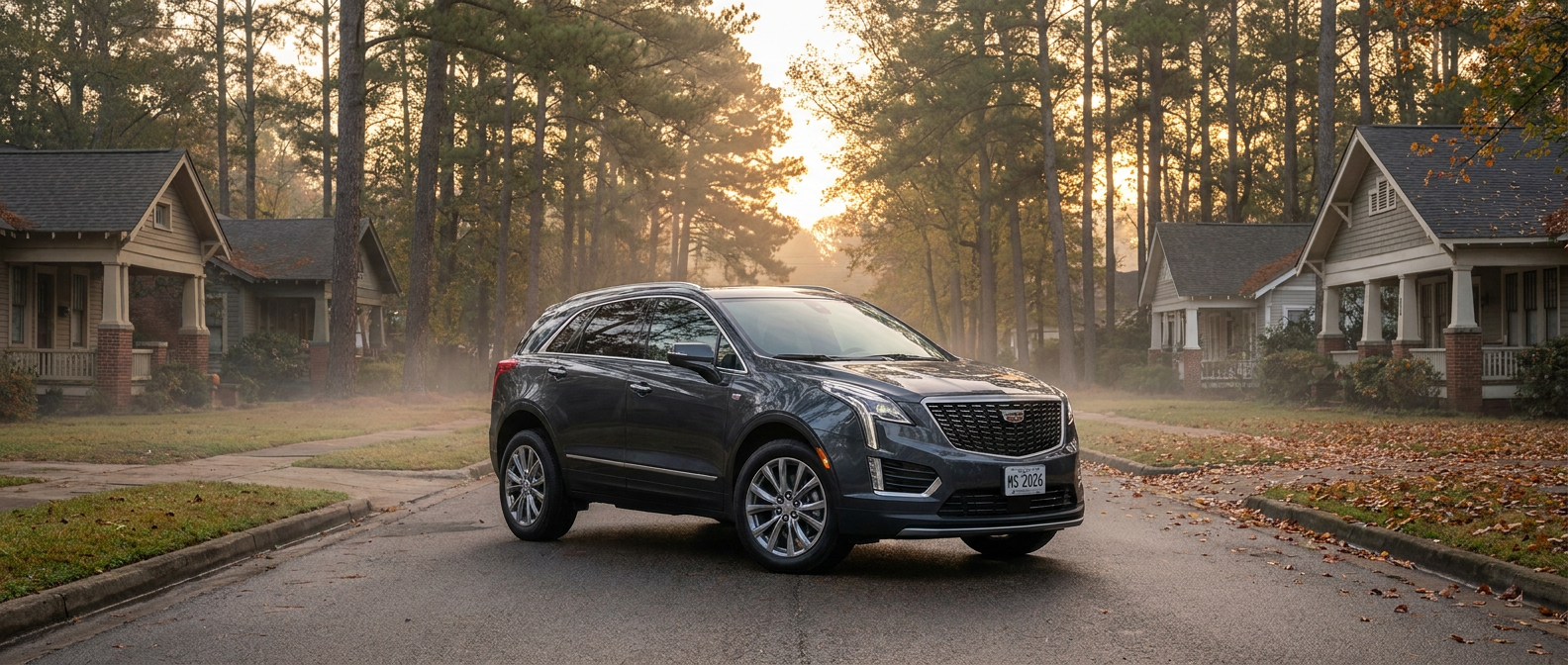
2026 Cadillac XT5 parked in Ridgeland MS on a cool fall morning with pine trees and soft amber light

October mornings in Ridgeland work on your tires before you feel a thing. Near Ross Barnett Reservoir the temperature sits in the mid-to-upper 40s before sunrise, then climbs into the low 80s by early afternoon. That 35-degree swing shows up inside your tires as roughly 3 to 4 PSI of change, every single day. So the TPMS warning that lit your dash this morning and vanished on its own by lunch isn't a sensor glitch. The cause is physics. The fix is simple.

Our team at Cadillac of Jackson watches this pattern roll in with October, cold front after cold front. Your specific model shapes the right response, and the rest of this guide walks through how to read it.

The short version
  • Every 10 degrees Fahrenheit of temperature drop pulls roughly 1 PSI out of your tires. Cadillac confirms this directly.
  • Ridgeland's October morning-to-afternoon swing of about 35 degrees equals 3 to 4 PSI of daily pressure oscillation.
  • The TPMS light activates when pressure falls 25% below your door-placard spec. A morning low can cross that threshold even when pressure was correct the evening before.
  • Always check and set pressure with cold, undriven tires. A warm tire reads 4 to 6 PSI high and will mislead you.
  • Each Cadillac model carries a different placard spec. Use your door jamb, not a general number.

What Actually Determines Whether You Need Air?

What decides it isn't the dashboard light at all but the gap between your current cold reading and the door-placard target, and until you measure that gap on a tire that's sat overnight, you're only guessing, no matter how certain the morning warning looked. The number on your gauge settles it, nothing else.

Cadillac's own tire guidance states the rule plainly, that for every 10 degrees Fahrenheit of temperature change, tire pressure shifts by approximately 1 PSI. Call it gas physics, the air inside contracting as it cools, not a design flaw. The morning-to-afternoon temperature range in central Mississippi during October averages roughly 30 to 35 degrees of swing, per AccuWeather data for Ridgeland this month. Run the math. A tire set correctly at 82 degrees on a Tuesday afternoon can read 3 PSI low by Wednesday morning at 47 degrees. That matters because federal law requires Cadillac's TPMS to illuminate when pressure drops 25% below the placard recommendation. For a model spec'd at 36 PSI, the light triggers around 27 PSI. A 3 or 4 PSI overnight drop won't reach that threshold from a well-inflated tire, but it will if the tire was already 1 or 2 PSI low heading into the cool night.

That last part is the actual trouble our service team keeps meeting in the lane. Not a dramatic blowout. A tire that drifted 2 PSI under all summer, then got shoved past the warning threshold by the first real fall morning. Small cause, loud light.

FactorWhat It Tells YouWhat to Do
TPMS light at startup, gone by 10 a.m.Pressure was borderline cold; warmed to thresholdCheck cold pressure the next morning before driving
TPMS light stays on past noonPressure is genuinely low regardless of temperatureAdd air immediately; match door-placard spec
Pressure reads correctly in the afternoonCannot confirm cold-state accuracyRecheck the following morning before the vehicle moves
Morning reading 1-2 PSI below specSub-threshold but trending lowTop off; don't wait for the light

Our service team can check cold pressure and reset the TPMS during any routine visit.

Your Cadillac's Door Jamb Is the Authoritative Number

The authoritative number lives inside your driver's door frame, never in an app and never in a generic "35 PSI" figure from a search result, because the placard there carries the exact cold-inflation pressure Cadillac's engineers set for your vehicle's weight, suspension geometry, and OEM tire size. No app can know your fitment. The frame does.

Across the models on our lot, those specs vary in ways that matter.

ModelTypical Cold-Inflation SpecNotes
CT5 (sedan trims)30-38 PSIVaries by trim and tire size; check your specific placard
XT535-36 PSI35 PSI on 18-inch fitment; 36 PSI on 20-inch
Escalade / Escalade ESV~39 PSIHigher spec supports the vehicle's substantial curb weight
LYRIQ (electric)38 PSI front / 42 PSI rearFront-rear split spec; EV weight distribution drives the difference
On the LYRIQ and other electric models, a 3 PSI drop from the rear spec of 42 PSI affects estimated range measurably. Underinflation increases rolling resistance, and rolling resistance costs kilowatt-hours.

The CT5 range spans for a reason. Performance trims ride on lower-profile tires, wider wheels, and higher pressures than the standard trims carry.

Check the placard on your own vehicle rather than the model family's average. The average is a starting guess, and your door frame is the final word.

Why EVs carry higher specs: Electric vehicles weigh more than comparable internal-combustion vehicles because of the battery pack. That extra curb weight pushes more load onto the tire contact patch, which is why Cadillac engineers call for higher cold-inflation pressures on the LYRIQ and ESCALADE IQ lineup to hold the same handling precision and wear pattern you'd expect.

Matching the Season to How You Actually Drive

Matching your routine to the season means accepting that Mississippi's fall only half-commits, swinging from 82-degree afternoons to 47-degree mornings and back, so the sane cadence is a check tied to the first real cold front rather than a textbook daily ritual that nobody keeps anyway. Some days the gap is wide. Some days it barely moves.

Fall here doesn't settle in until late October, and even then it hedges. You'll get the warm week and the cool dawn in the same stretch, and the daily spread wanders from one morning to the next.

The honest tradeoff is plain. Checking pressure daily is the technically correct answer, and it's also the answer nobody follows. A more realistic plan for this climate (and for anyone who isn't going to crouch by a valve stem every dawn) is a monthly check plus one more when the first genuine cold front arrives. In the Jackson metro, that front usually drops morning lows below 50 degrees, the point where a tire set to spec all summer can start reading low enough to wake the TPMS.

The list below fits this climate. Work through it and the morning warning mostly stays dark.

  • Check cold pressure monthly, before the first drive of the day, after the car's sat at least three hours
  • Set to your door-placard spec at the lowest temperature you expect for the coming month
  • After a warm-afternoon check, toss that reading out and wait for the next cold morning
  • Never bleed air off a post-drive reading; the heat of driving inflates it 4 to 6 PSI above the true cold state
  • On the LYRIQ and other electric models, check front and rear separately; the specs differ

Browse current Cadillac inventory if you're evaluating whether your model's tire spec is still the right setup for your driving profile.

When to See the Service Team Rather Than the Air Pump

Most of what we've covered stays owner-manageable with a decent digital gauge, a cold morning, and your door placard, yet a few situations belong in the service lane instead of at the gas-station air pump, and telling them apart saves you a pointless top-off on a tire that's actually fine. A gauge handles the routine. The rest we'll look at.

If the TPMS light comes on and stays on no matter the outdoor temperature, the loss isn't the seasonal swing. Have the team look for a slow nail, a valve stem leak, or, less often, a sensor that needs replacing. A flashing TPMS light, as opposed to the steady glow, signals a system malfunction instead of low pressure.

Any vehicle that spent a Mississippi summer on repeatedly soft tires also earns a tread-wear inspection. Chronic underinflation loads the outer shoulders harder than the center of the tread, so they wear first, and that uneven pattern hides from a quick glance.

Frequently Asked Questions

Why does my Cadillac's tire pressure light come on every morning and then turn off by itself?

That behavior reflects the gap between your overnight cold temperature and your afternoon temperature. Cadillac states that tire pressure changes approximately 1 PSI for every 10 degrees Fahrenheit of temperature change. In Ridgeland during October, mornings in the mid-to-upper 40s followed by afternoon highs near 80 degrees produce a swing of 30 to 35 degrees, or roughly 3 PSI of pressure oscillation. The TPMS light activates when pressure drops 25% below your door-placard recommendation. If your tires are already 1 or 2 PSI below spec, a cool morning can push them across that threshold. The light extinguishes by midday because warmer air expands the pressure back above the warning point. The fix is to add air in the morning with cold tires until you reach your placard spec, not to wait for the light to self-resolve.

Is the Cadillac LYRIQ's tire pressure maintenance different from a gas model?

Yes, in two ways. First, the LYRIQ carries a front-rear split specification (approximately 38 PSI front, 42 PSI rear on most configurations) rather than a uniform spec, which means you need to check and adjust each axle separately. Second, tire pressure on an electric vehicle directly affects range. Underinflation increases rolling resistance, and rolling resistance consumes battery energy. A tire that's 3 PSI low on the rear axle of the LYRIQ doesn't just wear unevenly; it reduces the EPA-estimated range you'd otherwise expect from a full charge. The same 1-PSI-per-10-degree rule applies, but because the rear spec is already higher at 42 PSI, Ridgeland's morning temperature drops are proportionally less dramatic, and the TPMS trigger threshold (25% below 42 PSI) sits lower in absolute terms. Still worth a monthly cold check.

Cadillac of Jackson

700 Adcock St, Ridgeland, MS 39157

(601) 948-5183


Recommended Posts

2026 Cadillac LYRIQ outside Cadillac of Jackson dealership in Ridgeland MS with pine treeline in background

Cadillac Test Drive Myths Debunked at Cadillac of Jackson

Plenty of buyers walk into a luxury dealership carrying the same quiet concern, that they'll be steered toward a decision before they've had a fair shot at evaluating anything. Maybe they sat through a pressured loop somewhere else. Maybe they just heard the stories. Either way, they show up guarded. That's a reasonable response to a bad experience. It isn't what a visit here looks like. The short version Myth: You need to know exactly which model you want before you walk in. Reality: We expect you to have questions, and we build the visit around answering them. Myth: A test drive is a short supervised loop around the block. Reality: We route you onto real roads, including the I-55 corridor, so the vehicle's highway composure, cabin quiet, and technology reveal themselves under conditions that actually matter here. Myth: EV range numbers are optimistic and won't hold in Mississippi heat. Reality: The 2026 LYRIQ's 326-mile range is an EPA estimate, not a manufacturer projection, and the drive is designed to show you how the system behaves in real conditions. Myth: A test drive creates an obligation to buy. Reality: It doesn't. The drive is information. You leave with more clarity than you arrived with, and the decision stays yours. Myth: Super Cruise is a gimmick real drivers ignore. Reality: It's a hands-free driver assistance system built on LiDAR-mapped roads, and I-55 north of Jackson is exactly the kind of highway it was engineered for. The 2026 Cadillac LYRIQ is one of those models that changes its argument the second it starts moving. The same holds across the lineup. Start with the myths, because they're what keep buyers from ever reaching that moment. Are These Cadillac Test Drive Assumptions Actually True? Mostly, no, though every one of these assumptions grows out of a real frustration a buyer carried in from somewhere else. The useful thing is to set each myth beside what actually happens here, on our lot and on the roads around Ridgeland, so the comparison does the arguing instead of us. The Myth What's Actually True "You need to arrive knowing exactly which model you want." We expect you to be deciding. We help you narrow the field, not confirm a conclusion you've already reached. "The drive will be a scripted lot loop with a salesperson narrating specs." We put you on real roads. The I-55 corridor through Ridgeland and into Madison replicates the highway quiet, ride compliance, and technology questions that matter for a north-metro commute. (Source: MDOT confirms I-55 runs directly through Ridgeland.) "EV range figures are inflated. Mississippi heat will destroy the numbers." The 2026 LYRIQ carries an EPA-estimated 326-mile range in rear-wheel-drive configuration. EPA estimates are not manufacturer projections. Heat and climate use affect real-world range, the drive shows you how the system manages that honestly. "Super Cruise is a novelty." Per Cadillac, Super Cruise uses LiDAR-scanned map data, cameras, GPS, and radar to maintain lane position on compatible highways. I-55 qualifies. The system earns a different kind of attention from someone commuting it daily. "Driving the car creates a buying obligation." It doesn't. The drive is an evaluation. Bring your trade-in questions, your range questions, your three-row seating questions. Leave with data. "The EV lineup is thin." The 2026 Cadillac electric lineup spans the LYRIQ, OPTIQ, VISTIQ, ESCALADE IQ, and ESCALADE IQL. From compact crossover to full-size three-row. There's a meaningful range to evaluate. What the Drive Reveals That the Spec Sheet Cannot On the road, the myths give way to something you can measure with your own senses, because a configurator reports the numbers without ever conveying what those numbers feel like at speed. A few things about these cars just don't transmit through a spec sheet, and the drive is where they land. The 2026 Cadillac VISTIQ carries an EPA-estimated range of 300 to 305 miles depending on trim and 615 horsepower from its dual-motor all-wheel-drive system, per Cadillac. Road noise cancellation is built into the cabin, too. Those numbers read clearly on a page. What they don't convey is the character of the silence. Put the VISTIQ on a stretch of I-55, with the concrete expansion joints and patched asphalt that mark this section of highway, and the noise management becomes something you feel rather than something you tally. The standard chassis damping control is part of that equation, and the drive makes the case more efficiently than any written description. Super Cruise earns the same recalibration once you're moving. Activating it takes a single button press on compatible highway sections. What the test drive surfaces is the quality of the handoff, how the system reads lane markings, manages following distance, and returns control to the driver through clear, progressive alerts. Per Cadillac's published technical documentation, it uses LiDAR-scanned map data combined with camera and GPS inputs. That description is accurate. What it leaves out is the smoothness of the transition, or what the system feels like across a 20-minute commute between Ridgeland and downtown Jackson rather than in a feature overview. The 2026 CT5 in Sport trim pairs a 3.0L twin-turbocharged V6 with 335 horsepower, per Cadillac. The base configuration runs a 2.0L turbocharged four-cylinder. At highway speed, the acoustic gap between the two is audible (more than the trim sheet would lead you to expect). Acoustic glass and active noise control do specific, measurable work here, and the test drive is where that registers rather than the trim comparison table. For this market specifically, Mississippi summers run long, and cabin-cooling speed, ventilated seat response, and the way interior materials behave under sustained heat are legitimate evaluation points. For a Jackson-metro buyer these count as practical questions about a car that will sit in full sun from May through October. Even an October drive carries enough residual heat to keep those systems relevant. Explore Your Financing Options The 2026 LYRIQ's 33-inch Horizon Display, standard Super Cruise, and EPA-estimated 326-mile range (RWD) are not features you evaluate accurately from a photograph. The drive is the argument. Insider note from our team: Come in with your actual commute in mind, not a generic checklist. Think of the Ridgeland-to-Jackson run on I-55, or the stretch toward Madison or Brandon. Those are the conditions worth replicating. Tell us your daily mileage, your garage situation if you're weighing an EV, and which models you're genuinely torn between. That shapes a drive built to answer your questions rather than a demonstration of the car at its best. So What Should You Do Before You Come In? Less preparation than you'd think, though there's a genuine tradeoff at work. The more context you bring about your commute, your charging, and the vehicles you're weighing, the more the drive gives back, and the thinner your prep, the more generic the demonstration tends to be. A little groundwork changes what the hour is worth. The 2026 XT5, the VISTIQ, the LYRIQ, and the Escalade serve different buyers and different daily patterns. A physician commuting five days a week with the occasional longer run to Memphis or New Orleans asks different questions of range and cabin composure than a household swapping a three-row for school runs and weekend travel. Neither is a wrong answer. They just shape different evaluations, and knowing which set of questions you're carrying makes the visit more productive. Three things worth having in mind: Your daily mileage and charging access. If you're considering the LYRIQ or VISTIQ, knowing whether your home or office supports Level 2 charging changes what the drive is demonstrating. Per Cadillac, the 2026 LYRIQ supports DC fast charging at up to 190 kW, which can add approximately 86 miles of range in about 10 minutes at a compatible public fast-charger. Worth testing that figure against your actual routine, not against an abstract range number. What you're replacing and why. When the current vehicle has a specific limitation, cabin heat, highway noise, insufficient third-row space on longer drives, the test drive reads more clearly against a known baseline. Which questions you haven't been able to answer online. The specs are available everywhere. We can often add something the build-and-price tool doesn't surface, like how the third row of the VISTIQ accommodates adult passengers on a two-hour run, what the Escalade's wide-format infotainment feels like to operate while stopped, or how the CT5's rear-wheel-drive character distinguishes itself once the car is at temperature and the metro opens up on I-55. No appointment is required to look. For a drive across multiple models, or for any of the electric vehicles, where we like to walk through the charging conversation first, a call ahead to (601) 948-5183 means the right vehicles are ready. It's a small step, and it removes a common source of friction on busy days. FAQ: Do I need to know which Cadillac model I want before scheduling a test drive? No, and we'd actually make the case that it's better if you don't. Arriving with a fixed conclusion limits what the visit can do for you. Our team works through the lineup based on your real driving conditions, your daily distances, and the specific questions you want to answer, whether those are about EV range, highway cabin quiet, three-row seating for adults, or hands-free technology on your commute. Plenty of people come in planning to evaluate one model and leave having driven two or three. That is the process doing its job, not a detour from it. Will Mississippi heat affect the EV range I see during a test drive? Honestly, yes. Sustained heat and heavy climate use draw on the battery, and that's true of every electric vehicle on the road, ours included. What matters is understanding how much, and under what conditions. The 2026 LYRIQ's EPA-estimated 326-mile range (RWD) is an EPA figure, tested across a range of conditions. During the drive, the real-time range estimate adjusts based on climate load, speed, and terrain, and watching that system respond to actual October conditions in Ridgeland is more informative than any static number. If you're considering an EV purchase, the drive and the charging conversation together give you a realistic picture. Get Your Trade-In Value Cadillac of Jackson 700 Adcock St, Ridgeland, MS 39157 (601) 948-5183

2026 Cadillac XT5 on a Rankin County Mississippi road in October morning light

Fall Cadillac Car Care: Questions Pelahatchie Owners Should Ask

In this article Which Model Years Carry the Heaviest Fall Service Priority? Which Model Years Should You Watch Out For? Pros and Cons of Addressing Fall Service in October (vs. Waiting Until December) What Does Fall Actually Demand of Your Cadillac in Central Mississippi? Which Year and Trim for Which Pelahatchie Owner? Ask us what fall maintenance your Cadillac needs, and the truthful answer isn't a universal checklist. It depends on which model year sits in your driveway, and it depends on where you live. Pelahatchie in October isn't suburban Chicago. Your vehicle just came through four or five months of sustained heat, humidity, and air conditioning that ran almost without a break. The fall service question here isn't "prepare for winter." It's "assess the damage summer left behind, and catch any open recall work before the holiday travel season." The short version Mississippi fall means recovering from summer heat load, not prepping for snow. Different question, different checklist. Cadillac's Oil Life Monitor calculates algorithmically and alerts within 600 miles of your next service interval; trust it, but summer heat accelerates degradation, so a check is warranted regardless of the percentage displayed. Tire pressure drops roughly 1 PSI for every 10 degrees Fahrenheit of temperature change, per Cadillac's own guidance. Pelahatchie's swing from a 95-degree August afternoon to a 55-degree October morning is enough to trigger your TPMS light without any actual leak. Model years 2020-2021 of the CT5 and XT5 carry the highest NHTSA recall and complaint volume; 2024 XT5 owners should confirm an airbag module recall is resolved; 2023-2025 XT5 owners should verify an instrument panel illumination recall is complete. A cabin air filter that ran through a full Mississippi summer is saturated. That matters for both defrost performance this fall and air quality now. Schedule your fall service visit before the Thanksgiving travel push. Our current Cadillac XT5 inventory is one place to begin if this fall check points toward a trade, though the more useful first step is reading what your current vehicle's model year tells us about where to focus. Which Model Years Carry the Heaviest Fall Service Priority? Not all Cadillac model years around Pelahatchie reach fall in the same shape, and between NHTSA recall history and documented owner complaint patterns, some years ask for more deliberate attention than others, so the first move is matching your year to its risk profile. What follows is a working guide to where your model year stands. Model Year Range Models Sweet Spot? Documented NHTSA Concerns Fall Priority 2020 CT5, XT5 Watch CT5: 4 recalls, 43 complaints (powertrain, electrical); XT5: highest recall count per NHTSA (5 campaigns) Verify all recalls closed; confirm OLM reset 2021 CT5, Escalade Watch CT5: 4 recalls incl. roof rail side-curtain airbag (21V611000); Escalade: electrical/airbag campaign Confirm airbag recall remedy completed 2022-2023 CT5, XT5, Escalade Moderate CT5 headlight recall (22V903000) affecting 2020-2023 CT4/CT5; XT5 rearview camera (22V709000) 2020-2021; Escalade headlight same campaign Headlight and camera recall check 2023-2025 XT5 Watch Instrument panel fails to illuminate with high beams/signals active (24V459); 6,942 units affected Confirm software remedy applied 2024 XT5 Watch Driver's front airbag cushion may tear during deployment (24V311000); windshield bonding (23V681000) Highest urgency: airbag and windshield recalls 2025-2026 CT5, XT5, Escalade, LYRIQ, OPTIQ, VISTIQ Sweet Spot Complaint volumes significantly lower; 2025 CT5 shows 0 recall campaigns in NHTSA data Standard fall service; confirm OLM status Every recall remedy is performed free of charge by a Cadillac dealer, so the only open question is whether the work is done. A VIN check at nhtsa.gov takes under two minutes, and it tells you definitively whether your vehicle has open campaigns. Which Model Years Should You Watch Out For? The 2020 and 2021 CT5 carry the weight here, accounting for a combined 63 of the 94 total NHTSA complaints logged across the entire CT5 production run through 2026, per NHTSA data compiled by RecallExplained. That concentration matters. It doesn't mean those cars are fundamentally flawed (they aren't), but it does mean a Cadillac technician reading your specific VIN this fall is a more productive use of your time than a generic oil change at a quick-lube. The VIN is the tell. Browse our CT5 inventory if a newer model year is on your radar, but check nhtsa.gov for your VIN first. The 2024 XT5 brings two specific campaigns worth your attention. NHTSA recall 24V311000 involves the driver's front airbag cushion, which may tear during deployment rather than inflating as designed. Recall 23V681000 separately covers windshields that may not have been bonded with the proper urethane sealant. Both remedies are dealer-performed at no cost. For 2023-2025 XT5 owners, recall 24V459 covers an instrument panel that can go dark when high beams or turn signals are active (6,942 units potentially affected). A quick VIN lookup confirms whether your vehicle's software has been updated. Our Escalade inventory reflects the current lineup. Escalade owners in the 2022-2023 range should note that NHTSA recall 22V903000 covered a lighting control module software issue affecting the exterior lighting system. Across the CT5, XT5, and the electric lineup, the 2025 and 2026 model years show markedly lower complaint volumes, and the 2025 CT5 carries zero recall campaigns in NHTSA data as of this writing. These cars still benefit from a fall service visit, though the urgency reads differently. Schedule Your Fall Cadillac Service Check Pros and Cons of Addressing Fall Service in October (vs. Waiting Until December) Pros of Acting Now Cons / Trade-offs Beat the pre-Thanksgiving service backlog Pelahatchie October temps (93 degrees Fahrenheit as of mid-October) mean no cold-weather urgency yet Cabin air filter saturated after full Mississippi summer AC season If your OLM shows 40%+ life, an oil change isn't technically due Recall work is free and appointment availability is better now A November visit catches any additional NHTSA campaigns filed between now and then Tire pressure check is meaningful as morning temps begin dropping TPMS alert may not appear until a cold front arrives Battery load test catches summer heat degradation before any real cold A battery in good shape has no visible symptoms yet The trade-off is straightforward. No mechanical emergency forces a Pelahatchie Cadillac owner into the service bay in October specifically. The case for October is scheduling clarity and thoroughness, and there's no crisis pushing it. You're mostly buying a calm appointment slot and a thorough once-over, and summer is genuinely hard on vehicle systems in this climate, so catching that wear in fall means the vehicle is sorted before holiday travel becomes a factor. What Does Fall Actually Demand of Your Cadillac in Central Mississippi? Fall in central Mississippi asks something different of your Cadillac than the generic checklists assume, because here the season is about recovering from a long, hot summer, and that recovery lands on four systems in particular (oil, tires, cabin filter, and battery). The generic lists miss that part. Oil Life Monitor: what it's actually telling you. Cadillac's Oil Life Monitor doesn't run on a simple mileage clock. The system runs an algorithm that weighs driving conditions, engine load, and operating temperatures. It alerts you within 600 miles of your next service interval, according to Cadillac's published maintenance guidance. A summer of highway commutes between Pelahatchie and Ridgeland, running in high heat with the air conditioning adding engine load, will have burned through oil life faster than the same mileage in cooler months. Between 30 and 50%, you're probably fine through November, but check the date on your last service. Below 30%, schedule service now. The TPMS light and Mississippi temperature swings. Cadillac's tire guidance puts the change at roughly 1 PSI for every 10 degrees Fahrenheit of ambient temperature shift. Pelahatchie's October runs afternoon highs in the low 90s and overnight lows that can fall into the mid-50s on a cold front. A 35-degree swing is a 3-4 PSI drop. Your TPMS light was set at a specific threshold for your trim's recommended pressure (you'll find it on the driver's door placard, not the sidewall). The light coming on at 6 a.m. after a cold front is the system doing its job. It's not a slow leak. Check pressure cold, meaning the vehicle has sat at least three hours, inflate to placard spec, and recheck. Cabin air filter: the most overlooked Mississippi fall item. Your Cadillac ran its climate system in full cooling and dehumidification mode from May through September, and the cabin filter is the first component our Pelahatchie service lane watches load up with the dust and pollen off central Mississippi's rural roads, well before you'd notice it as weaker airflow at the vents. Independent fall-care guidance notes that a heavily loaded cabin filter restricts defrost airflow, which is the first thing you'll feel when the windows start fogging on October mornings. On the Cadillac maintenance schedule, the cabin air filter shows up at 22,500 miles and every 22,500 miles after that. In this climate, though, condition matters more than mileage. Condition beats the odometer here. Battery: summer heat is harder on batteries than cold. Summer heat is tougher on a battery than cold, which runs counter to what a lot of Southern drivers expect. Cold weather reduces a battery's available output (a battery operating at 0 degrees Fahrenheit loses up to 60% of its starting capacity, by Cadillac's service guidance). Sustained summer heat, though, degrades the internal plates and electrolyte chemistry. A battery that's been running the climate system, seat cooling, and infotainment through a Mississippi summer rarely fails dramatically. It just gets weaker. A load test in October tells you where it actually stands. Which Year and Trim for Which Pelahatchie Owner? Your model year determines your fall priority, not just your mileage. Open recall work is free, and it should happen before holiday travel. Driving a 2025 or 2026 Cadillac (XT5, CT5, LYRIQ, OPTIQ, or VISTIQ), your fall checklist is genuinely routine, covering OLM percentage, tire pressure calibration as the overnight lows start dropping, cabin filter condition, and a battery load test. The electric lineup (LYRIQ, OPTIQ, VISTIQ) adds one item. Confirm the 12-volt auxiliary battery, which powers vehicle systems independent of the high-voltage pack, is healthy. Our service team checks that as a standard item. If you're driving a 2022-2024 Cadillac XT5 specifically, the fall visit has a non-negotiable step. Open nhtsa.gov, enter your VIN, and confirm the instrument panel (24V459) and, for 2024 models, the airbag recall (24V311000) are resolved. If not, that work comes first. If you're in a 2020-2021 CT5 or XT5, this fall visit matters more than any other on your ownership calendar. Those years carry concentrated NHTSA complaint and recall activity. Not all of it is catastrophic, but a Cadillac-certified technician reviewing your specific vehicle's VIN against the current recall database is the right move. We do that as part of every service appointment. If you're in an Escalade of any recent vintage, the service picture is cleaner than the sedans and crossovers. The principal 2022-2023 recall (22V903000, exterior lighting software) is a straightforward software update. Beyond that, the Escalade's fall needs mirror the XT5's, with an OLM check, tire pressure, battery load test, and cabin filter. The I-20 corridor runs between Pelahatchie and Ridgeland. For a lot of our clients that corridor is a real commute, and if it's 30 miles each way, your annual mileage is climbing toward the filter and fluid intervals faster than you may expect. Worth knowing going into winter. Frequently Asked Questions What does the Cadillac Oil Life Monitor actually measure, and should I trust it in fall? The Oil Life Monitor runs an algorithm, not a simple dipstick reading. It calculates remaining oil life from engine operating conditions, load, and temperature rather than mileage alone. Cadillac's published maintenance guidance confirms it alerts the driver within 600 miles of the next required service interval. Through a Mississippi summer, sustained high-heat operation and heavy air conditioning load consume oil life faster than the same mileage in cooler conditions. Trust the system, but if you're below 30% and traveling over the holidays, schedule service before you go. Why does my Cadillac's TPMS light come on in fall if there's no leak? Cadillac's tire guidance states that pressure changes approximately 1 PSI for every 10 degrees Fahrenheit of temperature shift. Central Mississippi's fall mornings can land 30-40 degrees below the afternoon highs of August and September. A 30-degree overnight drop works out to a 3-PSI pressure loss, which can bring a tire from properly inflated to below threshold without any puncture or valve issue. Check pressure cold (after the vehicle has sat for at least three hours), inflate to the placard specification on the driver's door jamb, and the light should clear. How do I know if my Cadillac has an open recall that should be addressed this fall? Go to nhtsa.gov and enter your 17-digit VIN in the recall lookup tool. It takes under two minutes and returns every open recall campaign against your specific vehicle. For context, the 2024 XT5 has an open airbag module recall (NHTSA 24V311000), and model years 2023-2025 of the XT5 carry a documented instrument panel illumination campaign (NHTSA 24V459) affecting nearly 7,000 units. Both are remedied free of charge by a Cadillac dealer. Any open recall work should be the first item scheduled, not the last. See What Your Cadillac Is Worth Cadillac of Jackson 700 Adcock St, Ridgeland, MS 39157 (601) 948-5183

2026 Cadillac Escalade in dealership service bay at Cadillac of Jackson in Ridgeland MS before holiday travel

Schedule Cadillac Service Before the Holidays | Ridgeland, MS

In this article What's the Plan at a Glance? Why the Holiday Window Is Tighter Than You Think How the Oil Life System Actually Works, and What It Doesn't Tell You What Changes for the LYRIQ and Other Electric Models The Road You're Actually Driving The single move that protects a holiday road trip is a Cadillac service appointment finished at least two weeks before you travel. Give yourself that window. Any tighter and you're competing with every other family in the metro who also remembered at the last minute. The Escalade and the rest of the lineup are built to cover serious mileage without drama, and that engineering relies on service intervals being met on schedule rather than approximated. So you'll want a few things straight before you call us. What's the Plan at a Glance? Step What to do Best time to act Notes Book your appointment Call or schedule online 2-3 weeks before Thanksgiving week Service lanes fill in early November Pull your Oil Life percentage Check the instrument cluster display Before you call Tells us exactly where you are in the interval Note any dashboard alerts Write down any active messages Same day you check oil life Cabin air, tire pressure, brake alerts all count Confirm your transportation plan Wait, shuttle, or loaner When you book Let us coordinate timing properly Post-service reset check Verify Oil Life System resets to 100% Before you leave the lane A missed reset means a false reading on your next trip Why the Holiday Window Is Tighter Than You Think Our service lane sees a genuine compression every year in the weeks before Thanksgiving, and the compression is reliable rather than theoretical. Appointments that'd normally turn in two or three days stretch closer to a week once the whole metro's trying to get road-ready at the same moment. Two to three weeks of lead time is what gets you a same-week slot instead of a scramble. Book your appointment online now, before the first week of November. We'll give you that advice straight. Insider note: If your Oil Life percentage is anywhere below 30%, book immediately. Cadillac's Oil Life System alerts you within 600 miles of service being due, per the owner's manual, and "within 600 miles" during a Thanksgiving run to New Orleans (186 miles each way on I-55) is not a comfortable margin. How the Oil Life System Actually Works, and What It Doesn't Tell You The GM Oil Life System on every gas-powered Cadillac (the CT5, the XT5, the Escalade and Escalade ESV) does not count odometer miles, which throws people who expect a simple mileage countdown. It runs an algorithm that weighs engine temperature, RPM, trip length, and idle time to estimate how much useful life remains in the oil. Cadillac's published maintenance guidance specifies a hard 12-month cap regardless of the percentage displayed. Meaning a low-mileage vehicle driven mostly on short Madison-to-Ridgeland commutes can reach its annual limit before the display shows any concern. The short-trip effect is the piece that slips past easily. The oil ages. Short trips wear it down faster than the odometer ever suggests. Cadillac mandates a 12-month oil change maximum even if the Oil Life System percentage hasn't reached zero. Short-trip driving around the Jackson metro accelerates oil degradation faster than the odometer alone indicates. The system also doesn't flag your brake fluid condition, cabin air filter state, or tire tread depth on its own. Those have their own intervals. On a 2026 Escalade, the Cadillac owner's manual calls for a cabin air filter inspection around 22,500 miles and an evaporative control system check at 45,000. Neither appears on the instrument cluster countdown. When you come in before the holidays, our team checks the full picture, not just what the alert triggered. The system also won't reset itself. The Oil Life System must be manually reset at every service. If you've had work done elsewhere and that reset was missed, your display is reading stale data. Worth confirming with us before you leave. What Changes for the LYRIQ and Other Electric Models The LYRIQ, OPTIQ, and ESCALADE IQ carry no Oil Life System, because there's no combustion engine, so the oil-change rhythm drops out of the calendar entirely. The simplification is genuine. But no oil change does not mean no pre-trip service. Before a holiday run, an electric Cadillac benefits from a multi-point inspection that covers tire condition and inflation (range and handling both respond to pressure), brake system health (regenerative braking reduces pad wear, but the hydraulic system still needs attention), cabin air filter condition, and a software update check. Cadillac's Certified Service technicians are trained on the full electric architecture. We wouldn't hand that to a general shop that's never seen the high-voltage system. Schedule Your Pre-Holiday Service Appointment The Road You're Actually Driving A pre-trip inspection matters most here because of where we sit, and the route you pick for the holidays decides how hard the drivetrain actually works. Ridgeland sits at the I-55 and I-220 interchange. The interchange puts our buyers at the spine of every major holiday route in the metro. I-55 south carries you to New Orleans in roughly 186 miles. I-55 north runs toward Memphis. I-20 west toward Vicksburg. The Escalade family handles all of it without complaint when it's properly maintained, and it struggles when it isn't. We see a pattern on post-holiday return appointments. Vehicles that went out borderline on tires or brakes come back with a problem a pre-trip inspection would have caught. The professional class this community is made of travels often and travels far, so an inspection before that first long run is simply the more composed choice. If your Cadillac is due for service, or close enough that the holidays will push it past the annual limit, now is the time to act. Don't let the calendar make the decision. Reserve Your Service Appointment Cadillac of Jackson 700 Adcock St, Ridgeland, MS 39157 (601) 948-5183