Blog

Local Guide to Cadillac Parts Ordering in Ridgeland, MS

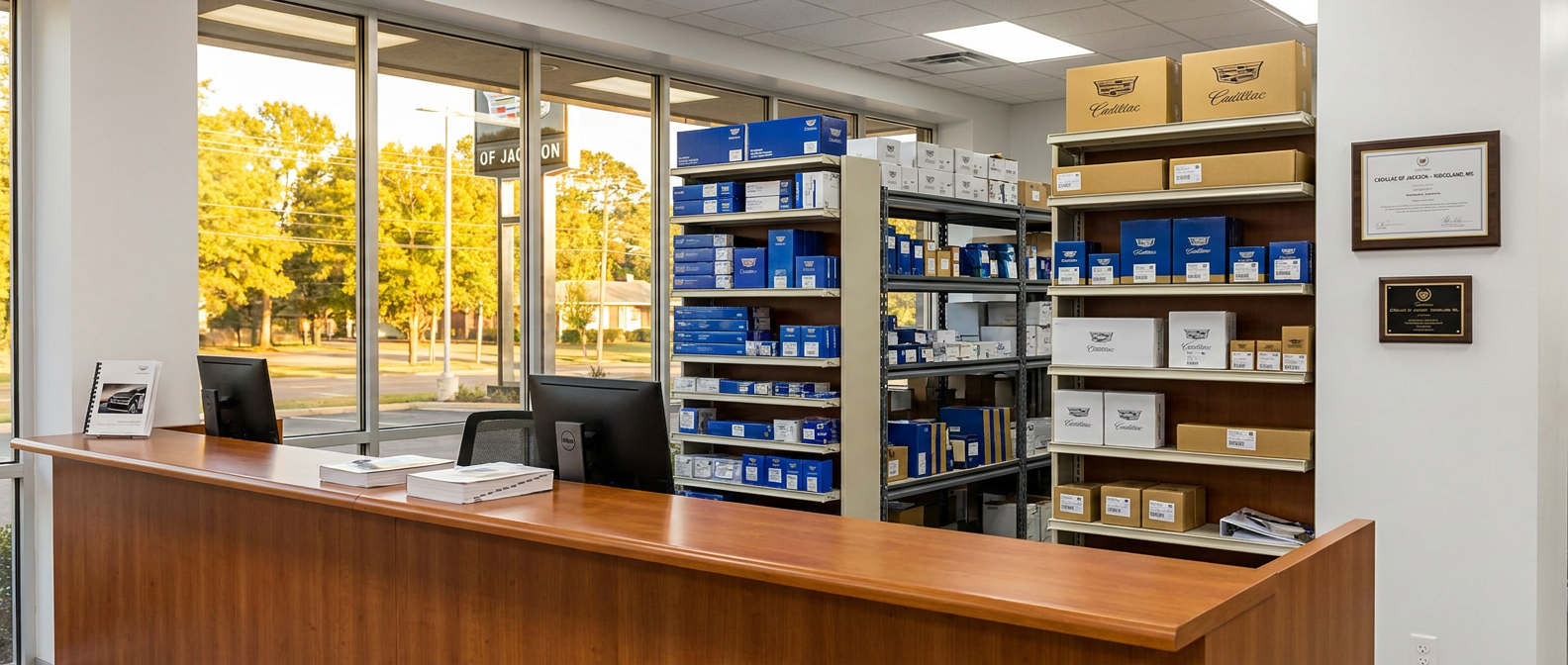
Cadillac OEM parts department counter at Cadillac of Jackson in Ridgeland, MS

Ordering the wrong part for a Cadillac isn't a small inconvenience. It's a delay, a return, and in some cases a fitment problem that doesn't show up until something fails. The short answer runs like this. Bring your VIN, call or visit us at Cadillac of Jackson on Adcock Street, and we'll confirm every detail before anything gets ordered, every time. What follows is what the full process actually looks like, and why each step matters for owners in Ridgeland and across the Jackson metro.

The Parts Ordering Do's and Don'ts

The table below sorts the ordering habits that work from the ones that create problems, and each row reflects a real pattern our parts team sees come across the counter, not a hypothetical we dreamed up to fill a grid.

DoDon't
Order by full 17-digit VINOrder by model name alone
Confirm trim level and factory-installed optionsAssume all trims share the same part number
Request dealer installation for high-voltage EV componentsInstall high-voltage EV components yourself
Ask about parts availability before scheduling serviceAssume common parts are always in stock
Keep your receipt and job card for your recordsDiscard purchase documentation
Call the parts line before making a tripArrive without a part name or part number

Brake and suspension components for the Escalade show exactly why that last row matters, since they vary across wheel sizes and electronic suspension configurations. Two Escalades in the same model year can require different rotors, oddly enough. The VIN is what tells us which one is yours.

Professional Installation and EV Components

For high-voltage EV components in the LYRIQ and ESCALADE IQ, professional installation by an authorized dealer is required per GM policy, and that requirement isn't a gatekeeping posture so much as a sign of how different the hardware actually is. The architecture in those vehicles sits well apart from conventional repair work.

The safety and installation requirements are real. There's no shortcut around them.

Parts tip. When you call our parts line at 888-499-8543, have your VIN ready. You'll find it on your registration, your insurance card, or the lower corner of the windshield on the driver's side. Those 17 digits tell us your exact build configuration, and they're the only reliable way to confirm fitment on trim-specific parts like sensors, interior panels, lighting modules, and brake hardware.

Where Ridgeland's Climate Enters the Picture

October in Ridgeland still runs warm, warm enough that the heat keeps working on seals and filters long after you'd expect the season to let up, which is exactly why climate belongs in a parts conversation around here. The NWS Jackson office recorded heat index values reaching 111 degrees Fahrenheit during August 2026, and October highs stay in the upper 80s. That sustained heat cycle accelerates wear on cabin air filters, rubber seals, and weatherstripping in ways that shorter, cooler seasons don't. Our parts team stocks the XT5 and full-size SUV cabin filters regularly, because the air quality and heat load in this market genuinely shorten their effective service life compared to manufacturer intervals written for milder climates.

If you're coming in from Madison or Brandon, the Saturday window is worth planning around before the afternoon closes. Our parts department is open Monday through Friday 7:00 a.m. to 6:00 p.m. and Saturday 8:00 a.m. to 2:00 p.m. You can also reach the parts team directly at 888-499-8543.

Genuine parts, installed correctly, are what keep a Cadillac performing as it was engineered to. Our team is here when you need it.

Cadillac of Jackson

700 Adcock St, Ridgeland, MS 39157

(601) 948-5183


Recommended Posts

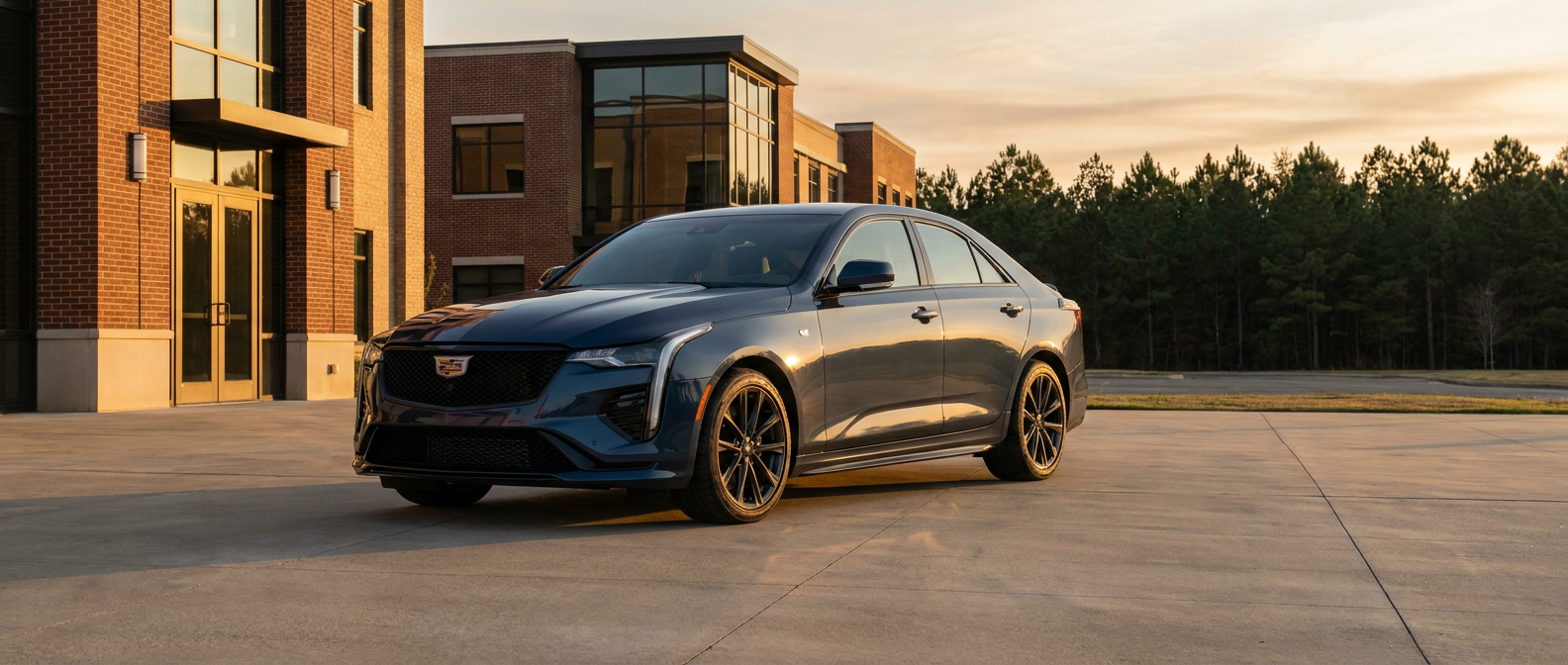
2026 Cadillac CT4 Sport in Coastal Blue Metallic, Ridgeland Mississippi

CT4 Luxury vs Sport: Which Trim Fits Ridgeland Drivers?

In this article What's the Real Difference Between CT4 Trim Levels? Does the Engine Choice Actually Matter Here? Ventilated Seats, Ambient Lighting, and What the Luxury Trim Skips The Safety Suite Across All Three Trims So Which CT4 Should You Choose? The 2026 Cadillac CT4 is the last one Cadillac will build for North American buyers. If you've been watching this sedan and waiting for the right moment, that moment is now, and the trim you pick shapes two very different driving experiences inside the same bodywork. Browse available CT4 trims on our lot The short version The CT4 Luxury and CT4 Sport share the same 237-horsepower engine and rear-wheel-drive platform but diverge sharply on interior focus and available technology. The Sport adds 18-way sport-bolstered seats, alloy paddle shifters, and a sport-tuned suspension; the Luxury is the cleaner, quieter long-distance trim. The Premium Luxury is the only trim with an optional 2.7-liter engine (310 horsepower, 350 lb-ft of torque) and is the only one that can be equipped with Super Cruise. For Ridgeland summers, ventilated front seats matter: they're standard on Premium Luxury and Sport, not on the base Luxury. This is the final CT4. Inventory will not be refreshed. What's the Real Difference Between CT4 Trim Levels? All three core trims (Luxury, Premium Luxury, and Sport) ride on the same rear-wheel-drive architecture, with the same 2.0-liter twin-scroll turbocharged four-cylinder making 237 horsepower and 258 lb-ft of torque, bolted to an eight-speed automatic. The EPA rates that combination at 22 city and 32 highway for the RWD configuration. So if the powertrain were everything, this would be a short article. But that isn't the end of it. What separates these trims is where Cadillac spent its engineering attention. The Sport gets the chassis and the driver's cockpit. Comfort features and the sole route to the stronger powertrain and Super Cruise live on the Premium Luxury. The Luxury hands you the full safety package and the platform itself at the widest entry point. Feature CT4 Luxury CT4 Premium Luxury CT4 Sport Engine 2.0L turbo, 237 hp 2.0L or 2.7L turbo (237 or 310 hp) 2.0L turbo, 237 hp Torque 258 lb-ft 258 or 350 lb-ft 258 lb-ft EPA Combined (RWD, 2.0L) 26 mpg 26 mpg (2.0L) / 25 mpg (2.7L) 26 mpg Transmission 8-speed automatic 8 or 10-speed automatic 8-speed automatic Ventilated Front Seats Not included Standard Standard Heated Front Seats Standard (new for 2026) Standard Standard Seat Style 12-way power 12-way power with driver memory 18-way sport bolsters Steering Wheel Heated, leather-wrapped Heated, leather-wrapped Heated, thick-rim sport wheel Paddle Shifters Not included Not included Alloy paddle shifters Alloy Sport Pedals Not included Not included Standard Super Cruise Not available Available Not available Ambient Lighting Not included Standard Standard Brembo Front Brakes Not available Not available Available Surround-Vision Camera Not available Available Not available AWD Available Available Available Trunk Capacity 10.7 cu-ft 10.7 cu-ft 10.7 cu-ft The Premium Luxury is the only CT4 trim that can be equipped with the 2.7-liter engine and Super Cruise, two features that live exclusively on that middle rung. Does the Engine Choice Actually Matter Here? For the Luxury and Sport buyer, there's really no choice to make, because both trims come only with the 2.0-liter, and the EPA rates that four-cylinder at 22 city and 32 highway in rear-wheel-drive form, which covers most of what drivers here need. On the run up I-55 toward Madison or the commute south toward Jackson, that highway number does the heavy lifting, and it's the figure you'll live with most of the day. See how the larger CT5 compares if cabin space is the priority The Premium Luxury is where things get interesting. Cadillac makes the 2.7-liter twin-scroll turbo available on that trim, pushing output to 310 horsepower and 350 lb-ft of torque, now paired to a ten-speed automatic. The EPA rates that combination at 21 city and 31 highway, one mpg lower in each direction. One mpg is a genuine difference, though for most north-metro drivers who spend the bulk of their miles on I-55 and I-220, it won't register in daily life. What registers is the torque. The 2.7-liter delivers 350 lb-ft against the 258 lb-ft of the 2.0-liter. At highway merge speeds and at low-rpm pull in traffic, that gap is perceptible in a way horsepower figures usually aren't. If the Premium Luxury pulls you in for other reasons (and there are several), the engine upgrade is worth a serious look. According to the U.S. EPA, the 2026 Cadillac CT4 with the 2.0-liter turbocharged engine returns an estimated 22 city and 32 highway MPG in rear-wheel-drive configuration. The 2.7-liter option is rated at 21 city and 31 highway. Explore financing options at Cadillac of Jackson Ventilated Seats, Ambient Lighting, and What the Luxury Trim Skips Ventilated front seats carry more weight in Ridgeland than they would in Chicago, because the metro runs into the mid-80s and 90s from May through September, and the I-55 and I-220 corridors hold heat in afternoon stop-and-go in ways a quick highway loop never would. Here they're a practical difference in whether the first ten minutes of a commute are pleasant or not. The base CT4 Luxury trim skips ventilated front seats, and that's the spec to check first if you're cross-shopping. Both the Premium Luxury and the Sport include them as standard for 2026, a change this model year that makes the base trim's omission easier to spot. The Luxury also goes without ambient interior lighting, driver seat memory, and the 12-inch digital instrument cluster. Those arrive on the upper two trims through the optional Technology Package. None of that is a deal-breaker for everyone. If you want the CT4's rear-drive chassis, the correct safety suite, the heated seats that are now standard on all 2026 trims, and a clean interior without the sport-focused ergonomics, the Luxury delivers all of it. Just know what you're skipping. The Sport pours its differentiation into the driver's interface. You get 18-way sport-bolstered front seats, a thick-rim sport steering wheel, alloy paddle shifters, alloy pedals, and a sport-tuned suspension. On a winding road it drives with a noticeably different character than the Luxury. On Ridgeland's flat grid, that character shows up in steering feel more than in cornering, and the Sport feels more alert, more present in the driver's hands. The Safety Suite Across All Three Trims All three trims carry a strong base safety package, which is worth stating plainly rather than treating it as a footnote, because the standard equipment runs deep enough that the entry car isn't left exposed next to the top trim. Standard on every 2026 CT4, you'll find automatic emergency braking, forward collision alert, lane keep assist with lane departure warning, blind-zone monitoring with lane change alert, rear cross-traffic alert, rear park assist, and a HD rear vision camera. The Safety Alert Seat, which vibrates to warn the driver of detected hazards, is standard too. The Premium Luxury adds adaptive cruise control, front pedestrian braking enhancements, and the surround-view camera that makes tight parking situations considerably easier. Ridgeland sits in Madison County, Mississippi. Super Cruise, Cadillac's hands-free driver assistance system for compatible divided highways, is available only on the Premium Luxury through an optional package, and it does not appear on the Luxury or the Sport. View the full 2026 CT4 selection currently in stock So Which CT4 Should You Choose? The Sport is the right trim for a driver who wants the steering and chassis to talk back, and it won't overwhelm you on Ridgeland surface streets even as it makes I-55 ramps feel sharper and long highway stretches more engaged. The tradeoff is real. You give up the optional 2.7-liter engine, and Super Cruise is off the table. You do get ventilated seats, sport bolsters, and a cockpit that feels purpose-built rather than comfortable by default. If your priorities run toward technology, comfort on longer runs, and the ability to spec the car the way you want it, the Premium Luxury is the one we'd point toward. It's the single trim where the 2.7-liter engine and Super Cruise both exist as options, and it carries standard driver seat memory (which matters more than it sounds when more than one person drives the car regularly). Its ventilated seats are standard, and that rounds out the broadest option set in the lineup. The Luxury is the right choice if you want the CT4's platform and driving character without the sport-specific ergonomics or the technology package, and the base infotainment screen doesn't concern you. It's a composed, complete car. Just know that ventilated seats and ambient lighting don't come along. Because this is the final model year, there is no "next year's version" to revisit. The car being built is the car available. Our team is glad to walk you through what's on the lot and what the option packages actually add, in person. Explore Your Financing Options Frequently Asked Questions Is the 2026 Cadillac CT4 the last model year? Yes. Cadillac ended North American production of the CT4 in June 2026, making the 2026 model year the final one for this nameplate. Inventory is finite and will not be replenished with a new model year. Does the CT4 Sport have a more powerful engine than the CT4 Luxury? No. Both the CT4 Luxury and CT4 Sport use the same 2.0-liter turbocharged four-cylinder engine producing 237 horsepower and 258 lb-ft of torque. The Sport's differentiation is in the chassis tuning, seat design, and interior controls, not in powertrain output. Only the Premium Luxury offers an optional upgrade to the 2.7-liter engine (310 horsepower, 350 lb-ft of torque). By the Cadillac of Jackson Team | October 2026 Value Your Current Vehicle Cadillac of Jackson 700 Adcock St, Ridgeland, MS 39157 (601) 948-5183

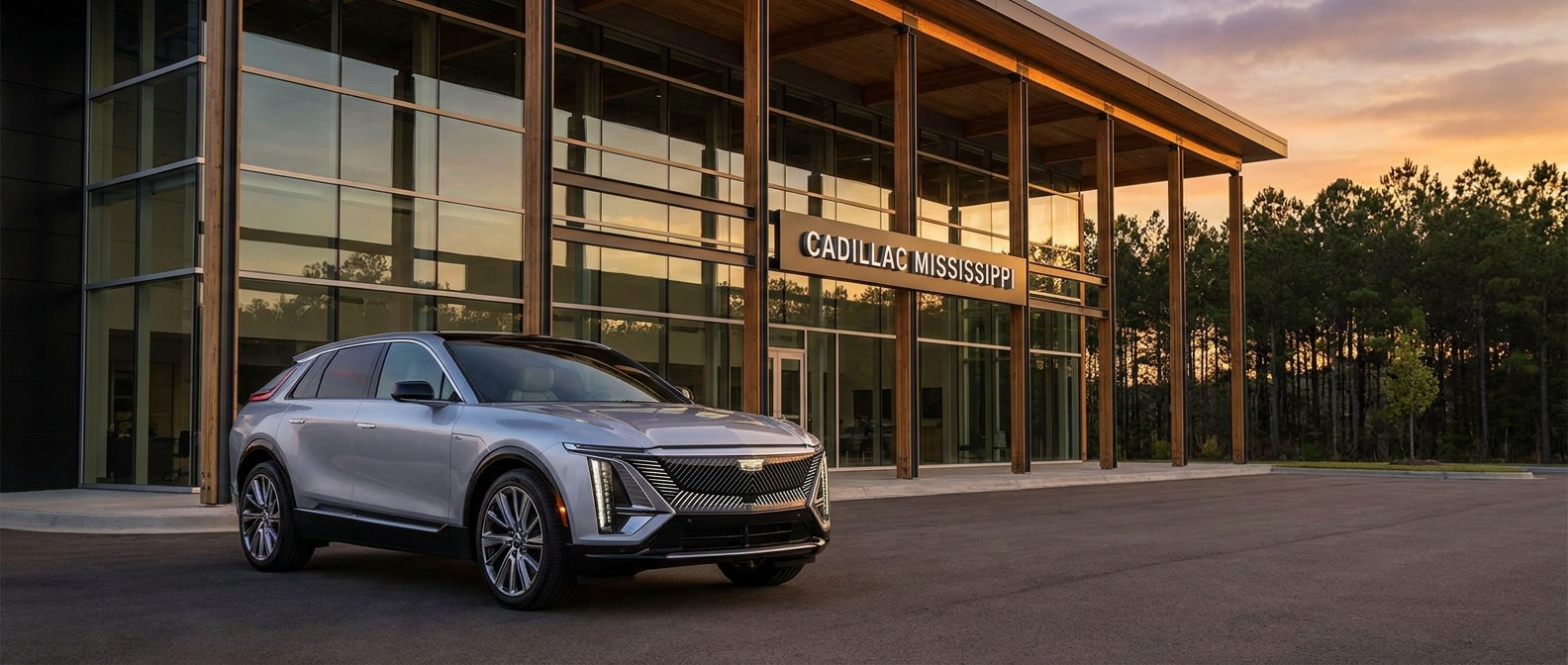
2026 Cadillac LYRIQ outside Cadillac of Jackson dealership in Ridgeland MS with pine treeline in background

Cadillac Test Drive Myths Debunked at Cadillac of Jackson

Plenty of buyers walk into a luxury dealership carrying the same quiet concern, that they'll be steered toward a decision before they've had a fair shot at evaluating anything. Maybe they sat through a pressured loop somewhere else. Maybe they just heard the stories. Either way, they show up guarded. That's a reasonable response to a bad experience. It isn't what a visit here looks like. The short version Myth: You need to know exactly which model you want before you walk in. Reality: We expect you to have questions, and we build the visit around answering them. Myth: A test drive is a short supervised loop around the block. Reality: We route you onto real roads, including the I-55 corridor, so the vehicle's highway composure, cabin quiet, and technology reveal themselves under conditions that actually matter here. Myth: EV range numbers are optimistic and won't hold in Mississippi heat. Reality: The 2026 LYRIQ's 326-mile range is an EPA estimate, not a manufacturer projection, and the drive is designed to show you how the system behaves in real conditions. Myth: A test drive creates an obligation to buy. Reality: It doesn't. The drive is information. You leave with more clarity than you arrived with, and the decision stays yours. Myth: Super Cruise is a gimmick real drivers ignore. Reality: It's a hands-free driver assistance system built on LiDAR-mapped roads, and I-55 north of Jackson is exactly the kind of highway it was engineered for. The 2026 Cadillac LYRIQ is one of those models that changes its argument the second it starts moving. The same holds across the lineup. Start with the myths, because they're what keep buyers from ever reaching that moment. Are These Cadillac Test Drive Assumptions Actually True? Mostly, no, though every one of these assumptions grows out of a real frustration a buyer carried in from somewhere else. The useful thing is to set each myth beside what actually happens here, on our lot and on the roads around Ridgeland, so the comparison does the arguing instead of us. The Myth What's Actually True "You need to arrive knowing exactly which model you want." We expect you to be deciding. We help you narrow the field, not confirm a conclusion you've already reached. "The drive will be a scripted lot loop with a salesperson narrating specs." We put you on real roads. The I-55 corridor through Ridgeland and into Madison replicates the highway quiet, ride compliance, and technology questions that matter for a north-metro commute. (Source: MDOT confirms I-55 runs directly through Ridgeland.) "EV range figures are inflated. Mississippi heat will destroy the numbers." The 2026 LYRIQ carries an EPA-estimated 326-mile range in rear-wheel-drive configuration. EPA estimates are not manufacturer projections. Heat and climate use affect real-world range, the drive shows you how the system manages that honestly. "Super Cruise is a novelty." Per Cadillac, Super Cruise uses LiDAR-scanned map data, cameras, GPS, and radar to maintain lane position on compatible highways. I-55 qualifies. The system earns a different kind of attention from someone commuting it daily. "Driving the car creates a buying obligation." It doesn't. The drive is an evaluation. Bring your trade-in questions, your range questions, your three-row seating questions. Leave with data. "The EV lineup is thin." The 2026 Cadillac electric lineup spans the LYRIQ, OPTIQ, VISTIQ, ESCALADE IQ, and ESCALADE IQL. From compact crossover to full-size three-row. There's a meaningful range to evaluate. What the Drive Reveals That the Spec Sheet Cannot On the road, the myths give way to something you can measure with your own senses, because a configurator reports the numbers without ever conveying what those numbers feel like at speed. A few things about these cars just don't transmit through a spec sheet, and the drive is where they land. The 2026 Cadillac VISTIQ carries an EPA-estimated range of 300 to 305 miles depending on trim and 615 horsepower from its dual-motor all-wheel-drive system, per Cadillac. Road noise cancellation is built into the cabin, too. Those numbers read clearly on a page. What they don't convey is the character of the silence. Put the VISTIQ on a stretch of I-55, with the concrete expansion joints and patched asphalt that mark this section of highway, and the noise management becomes something you feel rather than something you tally. The standard chassis damping control is part of that equation, and the drive makes the case more efficiently than any written description. Super Cruise earns the same recalibration once you're moving. Activating it takes a single button press on compatible highway sections. What the test drive surfaces is the quality of the handoff, how the system reads lane markings, manages following distance, and returns control to the driver through clear, progressive alerts. Per Cadillac's published technical documentation, it uses LiDAR-scanned map data combined with camera and GPS inputs. That description is accurate. What it leaves out is the smoothness of the transition, or what the system feels like across a 20-minute commute between Ridgeland and downtown Jackson rather than in a feature overview. The 2026 CT5 in Sport trim pairs a 3.0L twin-turbocharged V6 with 335 horsepower, per Cadillac. The base configuration runs a 2.0L turbocharged four-cylinder. At highway speed, the acoustic gap between the two is audible (more than the trim sheet would lead you to expect). Acoustic glass and active noise control do specific, measurable work here, and the test drive is where that registers rather than the trim comparison table. For this market specifically, Mississippi summers run long, and cabin-cooling speed, ventilated seat response, and the way interior materials behave under sustained heat are legitimate evaluation points. For a Jackson-metro buyer these count as practical questions about a car that will sit in full sun from May through October. Even an October drive carries enough residual heat to keep those systems relevant. Explore Your Financing Options The 2026 LYRIQ's 33-inch Horizon Display, standard Super Cruise, and EPA-estimated 326-mile range (RWD) are not features you evaluate accurately from a photograph. The drive is the argument. Insider note from our team: Come in with your actual commute in mind, not a generic checklist. Think of the Ridgeland-to-Jackson run on I-55, or the stretch toward Madison or Brandon. Those are the conditions worth replicating. Tell us your daily mileage, your garage situation if you're weighing an EV, and which models you're genuinely torn between. That shapes a drive built to answer your questions rather than a demonstration of the car at its best. So What Should You Do Before You Come In? Less preparation than you'd think, though there's a genuine tradeoff at work. The more context you bring about your commute, your charging, and the vehicles you're weighing, the more the drive gives back, and the thinner your prep, the more generic the demonstration tends to be. A little groundwork changes what the hour is worth. The 2026 XT5, the VISTIQ, the LYRIQ, and the Escalade serve different buyers and different daily patterns. A physician commuting five days a week with the occasional longer run to Memphis or New Orleans asks different questions of range and cabin composure than a household swapping a three-row for school runs and weekend travel. Neither is a wrong answer. They just shape different evaluations, and knowing which set of questions you're carrying makes the visit more productive. Three things worth having in mind: Your daily mileage and charging access. If you're considering the LYRIQ or VISTIQ, knowing whether your home or office supports Level 2 charging changes what the drive is demonstrating. Per Cadillac, the 2026 LYRIQ supports DC fast charging at up to 190 kW, which can add approximately 86 miles of range in about 10 minutes at a compatible public fast-charger. Worth testing that figure against your actual routine, not against an abstract range number. What you're replacing and why. When the current vehicle has a specific limitation, cabin heat, highway noise, insufficient third-row space on longer drives, the test drive reads more clearly against a known baseline. Which questions you haven't been able to answer online. The specs are available everywhere. We can often add something the build-and-price tool doesn't surface, like how the third row of the VISTIQ accommodates adult passengers on a two-hour run, what the Escalade's wide-format infotainment feels like to operate while stopped, or how the CT5's rear-wheel-drive character distinguishes itself once the car is at temperature and the metro opens up on I-55. No appointment is required to look. For a drive across multiple models, or for any of the electric vehicles, where we like to walk through the charging conversation first, a call ahead to (601) 948-5183 means the right vehicles are ready. It's a small step, and it removes a common source of friction on busy days. FAQ: Do I need to know which Cadillac model I want before scheduling a test drive? No, and we'd actually make the case that it's better if you don't. Arriving with a fixed conclusion limits what the visit can do for you. Our team works through the lineup based on your real driving conditions, your daily distances, and the specific questions you want to answer, whether those are about EV range, highway cabin quiet, three-row seating for adults, or hands-free technology on your commute. Plenty of people come in planning to evaluate one model and leave having driven two or three. That is the process doing its job, not a detour from it. Will Mississippi heat affect the EV range I see during a test drive? Honestly, yes. Sustained heat and heavy climate use draw on the battery, and that's true of every electric vehicle on the road, ours included. What matters is understanding how much, and under what conditions. The 2026 LYRIQ's EPA-estimated 326-mile range (RWD) is an EPA figure, tested across a range of conditions. During the drive, the real-time range estimate adjusts based on climate load, speed, and terrain, and watching that system respond to actual October conditions in Ridgeland is more informative than any static number. If you're considering an EV purchase, the drive and the charging conversation together give you a realistic picture. Get Your Trade-In Value Cadillac of Jackson 700 Adcock St, Ridgeland, MS 39157 (601) 948-5183

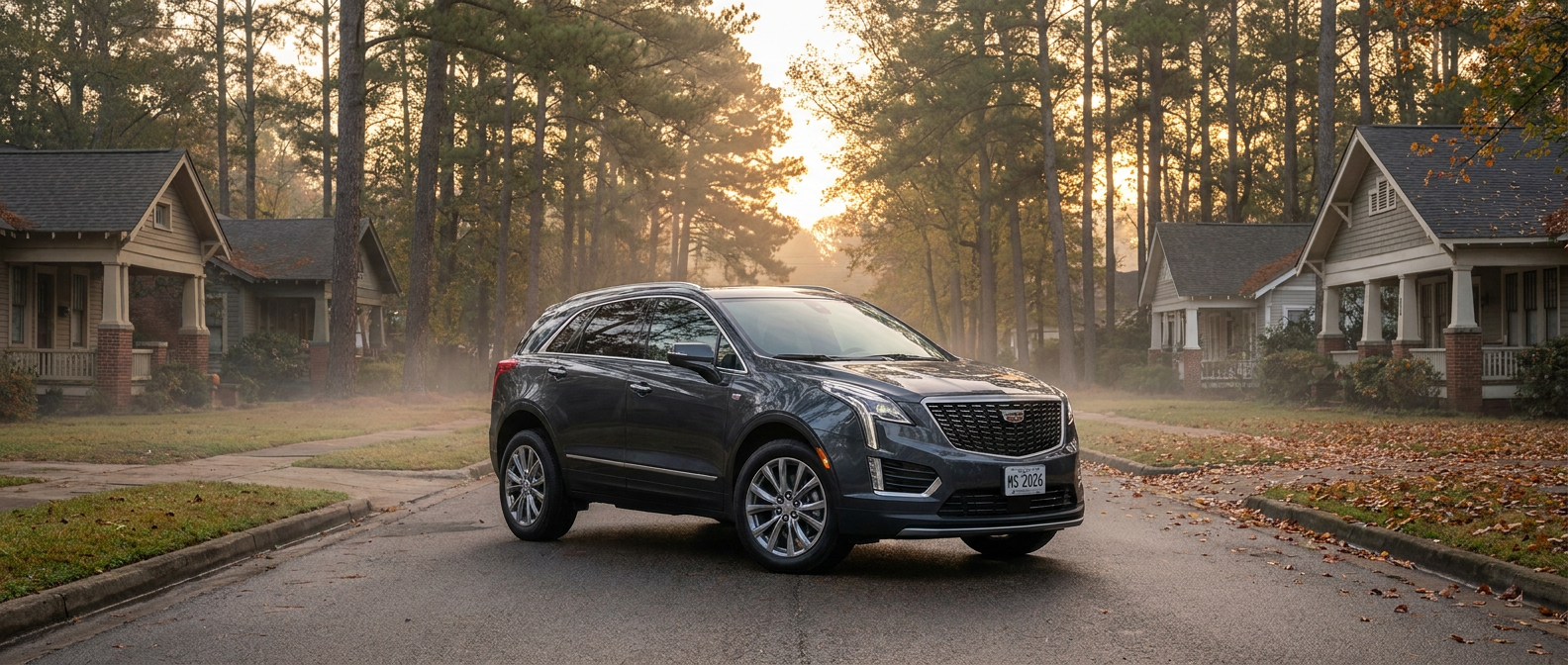
2026 Cadillac XT5 parked in Ridgeland MS on a cool fall morning with pine trees and soft amber light

How to Manage Cadillac Tire Pressure in Mississippi's Fall Mornings

In this article What Actually Determines Whether You Need Air? Your Cadillac's Door Jamb Is the Authoritative Number Matching the Season to How You Actually Drive When to See the Service Team Rather Than the Air Pump October mornings in Ridgeland work on your tires before you feel a thing. Near Ross Barnett Reservoir the temperature sits in the mid-to-upper 40s before sunrise, then climbs into the low 80s by early afternoon. That 35-degree swing shows up inside your tires as roughly 3 to 4 PSI of change, every single day. So the TPMS warning that lit your dash this morning and vanished on its own by lunch isn't a sensor glitch. The cause is physics. The fix is simple. Our team at Cadillac of Jackson watches this pattern roll in with October, cold front after cold front. Your specific model shapes the right response, and the rest of this guide walks through how to read it. The short version Every 10 degrees Fahrenheit of temperature drop pulls roughly 1 PSI out of your tires. Cadillac confirms this directly. Ridgeland's October morning-to-afternoon swing of about 35 degrees equals 3 to 4 PSI of daily pressure oscillation. The TPMS light activates when pressure falls 25% below your door-placard spec. A morning low can cross that threshold even when pressure was correct the evening before. Always check and set pressure with cold, undriven tires. A warm tire reads 4 to 6 PSI high and will mislead you. Each Cadillac model carries a different placard spec. Use your door jamb, not a general number. What Actually Determines Whether You Need Air? What decides it isn't the dashboard light at all but the gap between your current cold reading and the door-placard target, and until you measure that gap on a tire that's sat overnight, you're only guessing, no matter how certain the morning warning looked. The number on your gauge settles it, nothing else. Cadillac's own tire guidance states the rule plainly, that for every 10 degrees Fahrenheit of temperature change, tire pressure shifts by approximately 1 PSI. Call it gas physics, the air inside contracting as it cools, not a design flaw. The morning-to-afternoon temperature range in central Mississippi during October averages roughly 30 to 35 degrees of swing, per AccuWeather data for Ridgeland this month. Run the math. A tire set correctly at 82 degrees on a Tuesday afternoon can read 3 PSI low by Wednesday morning at 47 degrees. That matters because federal law requires Cadillac's TPMS to illuminate when pressure drops 25% below the placard recommendation. For a model spec'd at 36 PSI, the light triggers around 27 PSI. A 3 or 4 PSI overnight drop won't reach that threshold from a well-inflated tire, but it will if the tire was already 1 or 2 PSI low heading into the cool night. That last part is the actual trouble our service team keeps meeting in the lane. Not a dramatic blowout. A tire that drifted 2 PSI under all summer, then got shoved past the warning threshold by the first real fall morning. Small cause, loud light. Factor What It Tells You What to Do TPMS light at startup, gone by 10 a.m. Pressure was borderline cold; warmed to threshold Check cold pressure the next morning before driving TPMS light stays on past noon Pressure is genuinely low regardless of temperature Add air immediately; match door-placard spec Pressure reads correctly in the afternoon Cannot confirm cold-state accuracy Recheck the following morning before the vehicle moves Morning reading 1-2 PSI below spec Sub-threshold but trending low Top off; don't wait for the light Our service team can check cold pressure and reset the TPMS during any routine visit. Your Cadillac's Door Jamb Is the Authoritative Number The authoritative number lives inside your driver's door frame, never in an app and never in a generic "35 PSI" figure from a search result, because the placard there carries the exact cold-inflation pressure Cadillac's engineers set for your vehicle's weight, suspension geometry, and OEM tire size. No app can know your fitment. The frame does. Across the models on our lot, those specs vary in ways that matter. Model Typical Cold-Inflation Spec Notes CT5 (sedan trims) 30-38 PSI Varies by trim and tire size; check your specific placard XT5 35-36 PSI 35 PSI on 18-inch fitment; 36 PSI on 20-inch Escalade / Escalade ESV ~39 PSI Higher spec supports the vehicle's substantial curb weight LYRIQ (electric) 38 PSI front / 42 PSI rear Front-rear split spec; EV weight distribution drives the difference On the LYRIQ and other electric models, a 3 PSI drop from the rear spec of 42 PSI affects estimated range measurably. Underinflation increases rolling resistance, and rolling resistance costs kilowatt-hours. The CT5 range spans for a reason. Performance trims ride on lower-profile tires, wider wheels, and higher pressures than the standard trims carry. Check the placard on your own vehicle rather than the model family's average. The average is a starting guess, and your door frame is the final word. Why EVs carry higher specs: Electric vehicles weigh more than comparable internal-combustion vehicles because of the battery pack. That extra curb weight pushes more load onto the tire contact patch, which is why Cadillac engineers call for higher cold-inflation pressures on the LYRIQ and ESCALADE IQ lineup to hold the same handling precision and wear pattern you'd expect. Matching the Season to How You Actually Drive Matching your routine to the season means accepting that Mississippi's fall only half-commits, swinging from 82-degree afternoons to 47-degree mornings and back, so the sane cadence is a check tied to the first real cold front rather than a textbook daily ritual that nobody keeps anyway. Some days the gap is wide. Some days it barely moves. Fall here doesn't settle in until late October, and even then it hedges. You'll get the warm week and the cool dawn in the same stretch, and the daily spread wanders from one morning to the next. The honest tradeoff is plain. Checking pressure daily is the technically correct answer, and it's also the answer nobody follows. A more realistic plan for this climate (and for anyone who isn't going to crouch by a valve stem every dawn) is a monthly check plus one more when the first genuine cold front arrives. In the Jackson metro, that front usually drops morning lows below 50 degrees, the point where a tire set to spec all summer can start reading low enough to wake the TPMS. The list below fits this climate. Work through it and the morning warning mostly stays dark. Check cold pressure monthly, before the first drive of the day, after the car's sat at least three hours Set to your door-placard spec at the lowest temperature you expect for the coming month After a warm-afternoon check, toss that reading out and wait for the next cold morning Never bleed air off a post-drive reading; the heat of driving inflates it 4 to 6 PSI above the true cold state On the LYRIQ and other electric models, check front and rear separately; the specs differ Browse current Cadillac inventory if you're evaluating whether your model's tire spec is still the right setup for your driving profile. When to See the Service Team Rather Than the Air Pump Most of what we've covered stays owner-manageable with a decent digital gauge, a cold morning, and your door placard, yet a few situations belong in the service lane instead of at the gas-station air pump, and telling them apart saves you a pointless top-off on a tire that's actually fine. A gauge handles the routine. The rest we'll look at. If the TPMS light comes on and stays on no matter the outdoor temperature, the loss isn't the seasonal swing. Have the team look for a slow nail, a valve stem leak, or, less often, a sensor that needs replacing. A flashing TPMS light, as opposed to the steady glow, signals a system malfunction instead of low pressure. Any vehicle that spent a Mississippi summer on repeatedly soft tires also earns a tread-wear inspection. Chronic underinflation loads the outer shoulders harder than the center of the tread, so they wear first, and that uneven pattern hides from a quick glance. Frequently Asked Questions Why does my Cadillac's tire pressure light come on every morning and then turn off by itself? That behavior reflects the gap between your overnight cold temperature and your afternoon temperature. Cadillac states that tire pressure changes approximately 1 PSI for every 10 degrees Fahrenheit of temperature change. In Ridgeland during October, mornings in the mid-to-upper 40s followed by afternoon highs near 80 degrees produce a swing of 30 to 35 degrees, or roughly 3 PSI of pressure oscillation. The TPMS light activates when pressure drops 25% below your door-placard recommendation. If your tires are already 1 or 2 PSI below spec, a cool morning can push them across that threshold. The light extinguishes by midday because warmer air expands the pressure back above the warning point. The fix is to add air in the morning with cold tires until you reach your placard spec, not to wait for the light to self-resolve. Is the Cadillac LYRIQ's tire pressure maintenance different from a gas model? Yes, in two ways. First, the LYRIQ carries a front-rear split specification (approximately 38 PSI front, 42 PSI rear on most configurations) rather than a uniform spec, which means you need to check and adjust each axle separately. Second, tire pressure on an electric vehicle directly affects range. Underinflation increases rolling resistance, and rolling resistance consumes battery energy. A tire that's 3 PSI low on the rear axle of the LYRIQ doesn't just wear unevenly; it reduces the EPA-estimated range you'd otherwise expect from a full charge. The same 1-PSI-per-10-degree rule applies, but because the rear spec is already higher at 42 PSI, Ridgeland's morning temperature drops are proportionally less dramatic, and the TPMS trigger threshold (25% below 42 PSI) sits lower in absolute terms. Still worth a monthly cold check. Schedule a Tire Pressure Check Cadillac of Jackson 700 Adcock St, Ridgeland, MS 39157 (601) 948-5183