
Blog

Cadillac EV Holiday Trip Charging Guide | Ridgeland, MS

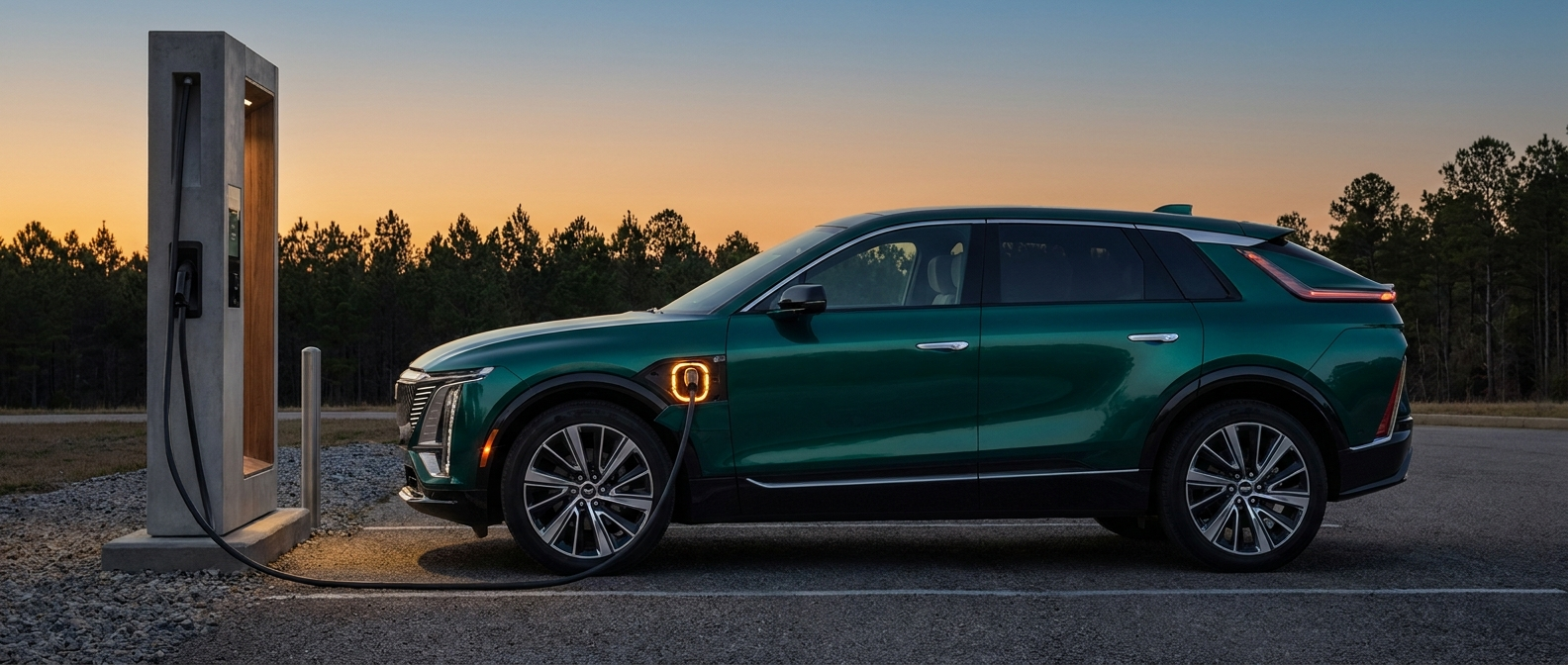
2026 Cadillac LYRIQ plugged into a DC fast charger in Mississippi at dusk, ready for a holiday road trip from Ridgeland

The range anxiety question has a real answer, and it isn't "just trust the window sticker." Every Cadillac EV in our lineup carries enough EPA-estimated range to cover either major holiday corridor out of Ridgeland on a single charge, but a plan built around verified fast-charge stops is what turns a capable vehicle into a confident trip. Before customers leave our lot at 700 Adcock St for Thanksgiving or Christmas, we give them the same short list. Know the two or three stops on your route before you go, charge the night before to around 90 percent, and treat destination-city charging as a bonus rather than a necessity.

The 2026 Cadillac LYRIQ comes up first in almost every one of these conversations. The OPTIQ, VISTIQ, and ESCALADE IQ each carry their own range profile and their own DC fast-charging ceiling, though, so the plan you build should fit the specific vehicle you own.

How Far Will a Cadillac EV Really Go from Here?

Both primary holiday corridors sit well inside the rated range of every model on our lot, so neither Memphis nor New Orleans demands a charging stop, though sustained highway speed draws harder on the battery than the window sticker suggests. I-55 north to Memphis runs about 200 miles from Ridgeland. I-55 south to New Orleans covers about 185 miles. Sustained interstate pace at 70 to 75 mph draws more from the battery than the EPA's mixed-cycle test assumes, so we plan on real-world range landing around 10 to 15 percent below the EPA figure at highway speed.

Cold mornings are where this shows up first. A Cadillac EV that's sat out overnight in a Mississippi cold snap will flash a lower range estimate until the pack and cabin heater settle, which is normal and recovers as you drive.

The lineup stacks up like this for those two runs.

ModelEPA-Estimated RangeDC Fast ChargingRange in 10 MinMemphis (200 mi)New Orleans (185 mi)
LYRIQ RWD326 mi190 kW~86 miSingle charge, strong marginSingle charge, strong margin
LYRIQ AWD319 mi190 kW~86 miSingle chargeSingle charge
OPTIQ RWD317 mi150 kW~71-81 miSingle chargeSingle charge
OPTIQ AWD303 mi150 kW~71-81 miSingle charge, modest marginSingle charge
VISTIQ305 mi190 kW~79 miSingle charge, plan a top-offSingle charge
ESCALADE IQ465 mi (Cadillac est.*)350 kW~117 miWell within rangeWell within range

*A note on the ESCALADE IQ figure. Cadillac estimates 465 miles because the vehicle's weight exempts it from the EPA's standard fuel-economy certification process. The number comes from Cadillac's own testing methodology, not the EPA's cycle. The figure is credible, and it's held up well in independent testing. What it isn't is a stamped EPA estimate. Plan with that distinction in mind.

Both routes above are single-charge runs in every model shown. Ignoring the charging network still isn't the move, because a stop, if you take one, buys margin and comfort instead of covering a shortfall. Plan the stop for comfort and nothing more.

Where Do You Actually Charge on These Routes?

Fast charging along I-55 and across the Jackson metro is more built-out than many drivers expect, so both corridors stay comfortable even for the smaller-battery models, and the stops worth knowing cluster near the start of either run out of Ridgeland. Top off right here before you roll. We've got an EV Connect fast charger on our lot in Ridgeland, so departing with a full charge is straightforward if you're picking up a vehicle or coming through before a trip. Ridgeland has 12 public charging locations overall; 7 of them deliver DC fast charging.

The stop that matters most for route planning is the Electrify America hub on Highway 18 W in Jackson, about six minutes from our dealership. Six 350 kW CCS stalls, open 24 hours a day, add well over 100 miles to any ESCALADE IQ or LYRIQ in roughly the time it takes to find a coffee. Treat it as your primary fast-charge anchor on either corridor before you leave the metro.

For the Memphis run, an EVgo 350 kW station sits on the I-55 corridor in Winona, Mississippi, about 90 miles north of Jackson. The LYRIQ's 326-mile range never needs it, but VISTIQ or OPTIQ AWD drivers who like to arrive with 20 percent or more in reserve (a comfortable cushion on a holiday weekend) will find a 15-minute stop in Winona handles it without drama.

For the New Orleans run, a Tesla Supercharger in Vicksburg at 4116 Washington Street offers 12 stalls at up to 250 kW. The 2026 LYRIQ, OPTIQ, and VISTIQ all use a native NACS charge port and connect there without an adapter. The ESCALADE IQ uses a CCS1 port with an available NACS adapter. Vicksburg also sits on I-20 to the west, so it serves drivers whose route dips toward Louisiana via I-20 rather than straight south on I-55.

Charging caution for holiday weekends: Thanksgiving and Christmas Day concentrate EV traffic at the same roadside stops across every network. Check live stall availability in the Cadillac navigation or the Electrify America app before you depend on a specific location. Having a backup identified on the same exit or the next one costs nothing, and it heads off the one scenario that actually causes range anxiety: a planned stop that isn't available when you arrive.
The 2026 LYRIQ RWD carries an EPA-estimated 326 miles of range; at sustained highway pace of 70 to 75 mph with a loaded cabin, planning for 275 to 290 usable miles gives you an honest margin for a holiday trip rather than a crossed-fingers hope.

Schedule a Pre-Trip Service Check

Plan It This Way Before You Leave Ridgeland

A little structure before you leave saves a lot of roadside frustration, so we walk departing customers through four checkpoints covering the night before, the morning of, the drive itself, and the destination, and together they turn a long holiday run into a predictable one.

Night before: Charge to 90 percent, not 100. Cadillac recommends avoiding sustained full-charge storage for daily use, and 90 percent gives you full practical range the next morning without the minor battery chemistry tradeoffs of sitting at 100 overnight.

Morning of: Confirm station availability. Holiday travel concentrates drivers at the same stops, so two minutes in the app before you leave is worth it.

En route: Use the in-vehicle energy routing on any trip over 180 miles. Set a 20 percent arrival buffer at your destination. That buffer keeps an unexpected detour or a late departure from turning into a stressful roadside situation.

At your destination: A 240V outlet in a host's garage adds roughly 15 miles of range per hour. On a 48-hour stay with no other public charging nearby, that recovers enough for a full departure buffer. Worth asking about.

One tradeoff is worth saying plainly. If your destination is a rural property more than 150 miles from the metro with no public fast charging within 30 miles and no 240V outlet, the ESCALADE IQ's larger buffer gives you far more comfort than the OPTIQ AWD on that specific round trip. Neither vehicle's wrong for the job. The buffer is just the planning consideration that decides which model fits your holiday geography best.

A pre-trip service appointment to verify tire pressure and confirm the charge port is seating cleanly is worth booking before any trip over 200 miles. Underinflation trims range measurably, and a quick check takes less time than a roadside inconvenience.

Frequently Asked Questions

Can a 2026 Cadillac LYRIQ make it from Ridgeland to New Orleans on one charge?

The 2026 LYRIQ RWD carries an EPA-estimated 326 miles of range, and the drive from Ridgeland to New Orleans covers roughly 185 miles. At highway pace you'll arrive with well over 100 EPA-estimated miles in reserve, which is a comfortable margin for a loaded holiday vehicle. The AWD configuration at an EPA-estimated 319 miles delivers the same result. Depart with 90 percent charge, and both drivetrains handle that run without a required charging stop.

How long does a fast-charging stop actually take on a holiday road trip?

It depends on the model and the charger speed. At a DC fast charger, the 2026 LYRIQ accepts up to 190 kW and adds approximately 86 miles of range in about 10 minutes. The OPTIQ charges at up to 150 kW and adds 71 to 81 miles in that window. The ESCALADE IQ, connected to a 350 kW station like the Electrify America hub on Highway 18 W in Jackson, can recover approximately 117 miles in about 10 minutes. A full 10 to 80 percent charge rather than a quick top-off runs between roughly 27 and 40 minutes depending on the model, which pairs naturally with a restroom stop.

Does the ESCALADE IQ's range number work the same way as the LYRIQ's EPA estimate?

It doesn't, and the distinction matters for planning. The 2026 LYRIQ's 326-mile range is an EPA-estimated figure generated through the EPA's standard test cycle. The ESCALADE IQ's 465-mile figure is a Cadillac estimate based on Cadillac's own methodology; the vehicle's weight exempts it from EPA certification. Both are credible figures, and independent testing of the ESCALADE IQ has validated the estimate. The practical planning difference is small because the range is large in either case. Knowing the distinction means you understand what standard generated the number you're counting on. ---


Cadillac of Jackson

700 Adcock St, Ridgeland, MS 39157

(601) 948-5183


Recommended Posts

2026 Cadillac OPTIQ and 2026 Cadillac LYRIQ side by side at dusk, Ridgeland MS pine treeline in background

Cadillac OPTIQ vs. LYRIQ: Which EV Fits Your Ridgeland Daily Routine?

In this article What's the Real Difference Between These Two? Which One Handles the Real Jackson Metro Commute? Cargo, Passengers, and the Things You Haul So Which Should You Choose? Both are good cars, and we mean that without hedging. Which one fits you comes down to the shape of your life around the Jackson metro, and to two questions above the rest. What your weekends look like, and how far you roam past Ridgeland. The short version Both the 2026 OPTIQ and the 2026 LYRIQ come standard with Super Cruise hands-free driver assistance and Cadillac's 33-inch Horizon Display, the technology gap between them is essentially zero. The OPTIQ's EPA-estimated 317 miles of range (RWD) handles the Jackson metro commute with authority; the LYRIQ's EPA-estimated 326 miles (RWD) and faster 190-kW DC charging make it the choice for frequent long highway runs. The LYRIQ tows up to 3,500 lbs when properly equipped; the OPTIQ tops out at 1,500 lbs, a decisive number if weekends involve a boat ramp or a cargo trailer. The OPTIQ is notably more efficient: the EPA rates it at 117 MPGe city versus 95 MPGe city for the LYRIQ. Meaningful in a Mississippi summer when the cabin cooling never really stops. If you drive solo or as a couple and your life is centered on Ridgeland, Madison, and I-55 to Jackson, the OPTIQ earns its keep. If you need passenger room, towing muscle, or the confidence of a larger range buffer on longer runs, choose the LYRIQ. What's the Real Difference Between These Two? They share far more than they split, riding the same GM Ultium platform, wearing the same 33-inch diagonal Horizon Display, coming standard with Super Cruise active hands-free driver assistance on compatible mapped roads, and seating five in a cabin that reads instantly as Cadillac. The differences here are proportional, not philosophical. Specification 2026 OPTIQ (RWD) 2026 LYRIQ (RWD) EPA-est. Range 317 mi 326 mi Battery 85 kWh 102 kWh Horsepower (RWD) 315 hp 365 hp City Efficiency 117 MPGe 95 MPGe DC Fast Charge Rate 150 kW 190 kW Cargo (seats up) 26 cu. ft. 28 cu. ft. Max Cargo (folded) 57 cu. ft. 60.8 cu. ft. Max Towing (equipped) 1,500 lbs 3,500 lbs Front Legroom 41.6 in 44.3 in Super Cruise Standard Standard 33-in Horizon Display Standard Standard The LYRIQ is the longer car (196.7 inches versus 189.8 inches), and those seven inches carry straight through the cabin. The EPA rates it at 105.1 cubic feet of interior volume against the OPTIQ's 101.0. You'll feel it most in the rear legroom, 39.6 inches versus 37.8, on a drive to Memphis with passengers who didn't sign up to fold themselves in. The single most important number in this comparison is the towing rating: 3,500 lbs for the LYRIQ versus 1,500 lbs for the OPTIQ. If a boat, trailer, or anything approaching two tons is part of your life, that number closes the conversation. Which One Handles the Real Jackson Metro Commute? The OPTIQ makes the stronger case for straight commuting, and we'll say why without ceremony, because for the physician at Baptist Medical Center, the attorney running to the Capitol, or the executive working the Ridgeland-to-Flowood-to-Madison triangle every day, the EPA-estimated 317-mile range of the 2026 OPTIQ is more than a full workweek of driving will ever ask for. Efficiency is the number worth sitting with. The EPA rates the OPTIQ RWD at 117 MPGe in the city against 95 MPGe for the LYRIQ RWD. In a Mississippi summer, and ours runs April into October rather than June through August, the air conditioning almost never switches off. EV efficiency falls when the cabin cooling works hard, and the thriftier car gives up less range to that load. So the OPTIQ's higher city MPGe rating buys a quieter cushion on hot days than the bare numbers let on. What about charging away from home? The 2026 OPTIQ ships with a native NACS (North American Charging Standard) port, which hands it built-in access to the Tesla Supercharger network without an adapter, while the 2026 LYRIQ uses a CCS1 port that stays capable and fast but needs a NACS adapter to reach a Supercharger. On a run up I-55 toward Memphis or down toward the Coast, where charging infrastructure is still filling in, that distinction is worth knowing before you choose. Charging note: The OPTIQ peaks at 150 kW on a DC fast charger, adding up to 81 miles of range in about 10 minutes per Cadillac's figures. The LYRIQ peaks at 190 kW and adds up to 86 miles in that same window. Charge at home overnight for a daily commute and neither figure will change your week. On a road trip it does, since the LYRIQ claws range back faster between stops. Explore Financing Options Cargo, Passengers, and the Things You Haul The LYRIQ holds a cargo edge here, though a bounded one, and with every seat in place it carries 28 cubic feet behind the rear row against the OPTIQ's 26, a margin of two cubic feet you won't register on a grocery run or a weekend bag. It starts to matter when you load for a family trip. Golf bags, luggage, the cooler, and the LYRIQ's 60.8-cubic-foot maximum (versus the OPTIQ's 57 cubic feet with the rear seats folded) gives you a more composed load floor. Rear legroom is the other separator. The LYRIQ offers 39.6 inches to the OPTIQ's 37.8 inches. That gap reads small on paper. It stops reading small when the people back there are adults on a two-hour drive. If you regularly carry clients, colleagues, or family who deserve to arrive comfortable, the LYRIQ's cabin makes an argument the spec sheet can't fully carry. Towing is where the gap turns decisive. Equipped for it, the LYRIQ AWD is rated to tow up to 3,500 pounds by Cadillac, while the OPTIQ, equipped the same way, is rated at 1,500 pounds. Those two numbers separate a fishing boat on a trailer from a loaded utility trailer you'd drag to a job site. The OPTIQ won't tow a boat, full stop. So Which Should You Choose? Here's our verdict, and we won't stage it as a tie, because the OPTIQ is the right car for a large share of the professional households we see around Ridgeland and Madison, compact enough for the parking structures downtown and in the medical district, efficient enough that a Mississippi summer barely dents its daily range, and luxurious without asking you to wrestle a big vehicle through tight quarters. The LYRIQ earns the step up under a handful of conditions. You frequently carry three or four adult passengers. You pull a boat, camper, or trailer of any kind. You make regular long-distance runs to Memphis, New Orleans, or the Gulf Coast and want both the range buffer and the faster DC charging rate to keep stops short. Or you simply want the larger vehicle and the composed ride that comes with it. Our team's watched buyers make this call both ways, and neither choice is wrong. The mistake is treating one as the compromise and the other as the upgrade. They're different tools, not different tiers. Browse our current EV inventory Let's talk through the ownership structure that makes sense for your situation. By the Cadillac of Jackson Team | November 2026 Frequently Asked Questions Does the 2026 Cadillac OPTIQ have Super Cruise? Yes. Super Cruise hands-free driver assistance is standard on the 2026 OPTIQ across its full trim range. It operates on the same compatible mapped road network as the LYRIQ, and the technology suite, including the 33-inch Horizon Display, is essentially identical between the two models. Can the 2026 Cadillac LYRIQ tow a boat? When properly equipped with the AWD powertrain, the 2026 LYRIQ is rated by Cadillac to tow up to 3,500 pounds. That covers most recreational boats and personal watercraft on a standard trailer. The OPTIQ's rated at 1,500 pounds maximum when properly equipped, which handles light utility loads but is not suited for a typical boat and trailer combination common in this region. talk to our finance team Cadillac of Jackson 700 Adcock St, Ridgeland, MS 39157 (601) 948-5183

2026 Cadillac VISTIQ three-row electric SUV on a Mississippi highway, rear door open, holiday travel configuration

Cadillac VISTIQ Passenger Space for Holiday Travel in Ridgeland, MS

The I-55 run north out of Ridgeland fills up fast in November. Madison, Grenada, Memphis. Families across the metro are working out right now who rides where, and whether the vehicle they're weighing can actually carry everyone in comfort instead of just technically wedging seven people into three rows. The two are not the same problem. The 2026 Cadillac VISTIQ answers the second one, though not with a simple yes. The answer is geometry, and once you understand the geometry, the configuration decision gets straightforward. The VISTIQ's second row offers 40.16 inches of legroom. Genuinely adult-grade space. The third row delivers 30.63 inches, which works well for teens and younger adults on the Ridgeland-to-Grenada run, and you should configure the vehicle around your actual passenger count before you buy. The 2026 Cadillac VISTIQ is the first three-row all-electric SUV Cadillac has built, and it slots between the two-row LYRIQ and the full-size ESCALADE IQ. It seats six or seven, depending on whether you take second-row captain's chairs or the standard bench. That one choice shapes how the vehicle lives on a holiday drive, so it's worth working through deliberately. Why Does the VISTIQ Fit the Jackson Metro's Holiday Drive? The VISTIQ fits this corridor because November here mixes fronts and rain through Madison County with a drive that starts stop-and-go on I-55 from County Line Road to the I-220 interchange, then opens into a sustained highway pace once you clear Madison and head north toward Grenada. An electric powertrain handles that split well. Regenerative braking recovers energy through the slow segments before you settle into cruise speed on the open stretch. The chart maps each local condition to the VISTIQ feature that handles it, and why it matters here. Local condition or use The VISTIQ feature that handles it Why it matters here Stop-and-go on I-55 between County Line Rd and I-220 Dual-motor AWD with regenerative braking, 102-kWh battery Recovers charge through the slow urban segment before the open highway run north Sustained highway pace Ridgeland to Grenada (and beyond) Super Cruise hands-free driver assistance, standard on all trims Reduces fatigue on a 70-to-100-mile open stretch; engages on compatible highway miles Six or seven passengers for Thanksgiving travel 6-seat captain's chair config or 7-seat bench config, selectable at purchase Match the configuration to your actual passenger count before you order Adults in row two (spouses, in-laws, colleagues) Cadillac-listed 40.16-inch second-row legroom, 59.69-inch shoulder room Genuinely adult-grade space; row-two seats also slide and recline Teens or younger adults in row three Cadillac-listed 30.63-inch third-row legroom, 39.56-inch headroom Comfortable for shorter adults and teenagers; a real seat, not a penalty box Luggage for four to seven passengers 15.2 cu ft behind row three, 43 cu ft with row three folded A family of four keeps row three folded and gains a genuinely large cargo bay November rain and low-light driving Standard Night Vision on Premium Luxury/Platinum trims; standard adaptive lighting Useful through the unlit stretches north of Madison in wet conditions Long-haul cabin comfort Standard front seat heat, ventilation, and massage; tri-zone climate Front occupants arrive composed; row two has dedicated HVAC vents The Second Row Is Where the VISTIQ Earns Its Argument The second row is the strongest case for this vehicle in our market, and we want to be precise about it: Cadillac lists second-row shoulder room at 59.69 inches, which is wider than a lot of three-row vehicles in this segment put in their front rows. The seats slide on rails and recline. On the captain's chair configuration, they give each second-row passenger a dedicated pass-through to the third row without anyone in front having to move. For a family with two adults in row two and children in row three, the captain's chairs are the right call. For a family that genuinely needs seven seats, the bench keeps the third row accessible but asks the second-row outboard passenger to tip forward for entry. The second-row outboard seats are heated on all trims. Captain's chairs add ventilation on higher trims. The Cadillac LYRIQ is the right answer for buyers who want two-row luxury with the longest possible EV range (the LYRIQ AWD carries an EPA estimate of 319 miles). But if your holiday travel involves more than four people on a consistent basis, the VISTIQ's second-row geometry is a compelling reason to step up. Local detail: The I-55 and I-220 interchange in Ridgeland is roughly four miles from our showroom on Adcock Street. For buyers who want to understand how Super Cruise engages on a compatible highway before committing, the on-ramp to I-55 northbound puts you on a Super Cruise-mapped road within minutes. We encourage that drive before any decision. "Every VISTIQ comes with dual-motor AWD and 615 horsepower, giving it an EPA range of up to 305 miles and a 0-60 sprint of under four seconds.". Cadillac VISTIQ specifications, GM product documentation The constraint on the third row is worth naming plainly. Cadillac's listed legroom there is 30.63 inches. Put a six-foot adult back there for the two-hour run from Ridgeland to Memphis and he'll be cramped. The Cadillac Escalade ESV is the vehicle for a family that needs three rows of full adult space on a long drive. The platform is built for exactly that, and the geometry shows it. The VISTIQ's third row is well-finished (Cadillac equips it with padded armrests, cupholders, and USB-C chargers), so it stays comfortable for teens or adults on shorter segments. It just isn't the same seat as row two. Explore Financing Options Configuring the VISTIQ Around Your Passenger Count Before the Holidays Configuring the VISTIQ is a decision made at purchase and effectively locked after, so it rewards a little planning, and the trade is simple enough once you see it, with captain's chairs standard on Premium Luxury and Platinum and available on Luxury and Sport, while the bench comes standard on Luxury and Sport. If your household regularly travels with five or six people (two in front, two in row two, one or two in row three), the captain's chair configuration is the cleaner arrangement, and the pass-through it creates makes third-row boarding significantly easier than with a bench. Need seven seats for real? Then the bench is the correct configuration, and the VISTIQ delivers it. The bench third-row seat is a genuine, finished seat with a 50/40 split fold. Cargo with all three rows up measures 15.2 cubic feet, enough for carry-ons and overnight bags, though a full family's checked-luggage-equivalent belongs in a vehicle with the third row folded. For four or five travelers, fold row three and the cargo bay opens to 43 cubic feet, which handles a Thanksgiving weekend's worth of luggage without negotiation. The EPA-estimated 305-mile range on the 2026 VISTIQ is the same across all four trims. On a Ridgeland-to-Memphis run of roughly 200 miles, that's a single-charge drive with range to spare, even accounting for November temperatures and highway speeds. DC fast charging can add approximately 80 miles in 10 minutes if you stop, which puts the Starbucks stop in Grenada or the rest areas north of there in a different frame. They become charging windows, not just breaks. What we see on the lot is that buyers coming from a three-row gas SUV are often surprised the configuration question (bench versus captain's chairs) needs an answer before the vehicle is ordered, not after. Our current VISTIQ inventory shows what's in stock in each configuration so you can see what's available without waiting on a build. Value Your Current Vehicle Cadillac of Jackson 700 Adcock St, Ridgeland, MS 39157 (601) 948-5183

2026 Cadillac Escalade on the Natchez Trace Parkway in Mississippi during autumn travel

Cadillac Battery Testing Before Cooler-Weather Travel | Ridgeland

In this article What's Actually Going On With Your Battery? The Mississippi Heat Mechanism: Why Summer Builds the Problem The EV Lineup Has Its Own 12V Battery Story DIY Checks vs. What the Service Team Does A certain symptom turns up around this time every year. The vehicle ran fine through September and October. Then a cold front drops overnight lows into the mid-30s, and the morning hands you either a sluggish crank, a cluster of warning lights you've never seen, or, in an EV, a "Reducing Features" alert that wasn't there a week ago. The cause is almost never the temperature itself. Cold is just the moment of reckoning. What actually happened was July. A Jackson metro summer runs three solid months of afternoons above 90 degrees F, with humidity that holds heat under the hood long after sundown. That sustained thermal stress speeds up plate corrosion and electrolyte degradation inside an AGM battery, quietly trimming its capacity. The battery keeps starting the car through the warm months because warm months ask less of it. Then November arrives, the electrochemical reactions slow, and a battery sitting at 70% of its original capacity turns out to have needed more. Our service team at Cadillac of Jackson can run a full battery load test before that moment finds you, and before Thanksgiving travel or a business run to Nashville puts a marginal battery under real stress. What's Actually Going On With Your Battery? Symptom Likely Cause What to Do Sluggish or slow crank, especially on the first cold morning AGM battery below serviceable CCA threshold; cold reduced available current Load test immediately; a single cold-failure event often precedes rapid decline Random warning lights (traction control, parking assist, infotainment resets) Voltage sag during starting drops below 9.6V, triggering module brownouts Load test and charging-system check; ghost codes that clear themselves are a battery signal "Reducing Features" or "Propulsion Power Reduced" on LYRIQ, ESCALADE IQ, OPTIQ, VISTIQ 12V auxiliary battery low or parasitic draw keeping it from topping off Have the 12V checked separately from the high-voltage pack; it's a different system Battery that tested fine last spring now struggling Summer heat accelerated internal degradation between tests Test again now; heat damage accumulates silently and shows up in cold Visible corrosion on terminals, or battery case that looks swollen Advanced deterioration; heat buckled the case or vented the electrolyte Replace promptly; a compromised case is not a borderline call The Mississippi Heat Mechanism: Why Summer Builds the Problem The XT5 and the full ICE lineup carry factory-spec AGM batteries, which handle both heat and cold better than conventional flooded batteries, and that resilience is genuine. That resilience has limits, though, and heat is the AGM's tougher adversary, not cold. Inside any lead-acid AGM battery, current comes from an electrochemical reaction between lead plates and a glass-mat electrolyte. High ambient temperatures push that reaction past its design pace, gradually corroding the plate surfaces and shrinking the battery's usable surface area. By the time the battery is two or three years old, after three Jackson summers, the heat-driven degradation can leave it well below its rated cold cranking amp output, even while it still rests at a reasonable open-circuit voltage. Our service team sees a specific pattern. A battery that reads 12.5 or 12.6 volts at rest looks plausible on a quick check. Only under load, when the starter pulls a surge of current and system voltage has to stay above 9.6 volts, does the hidden capacity loss turn into a failure. A battery testing at 65% of its rated CCA on a 50-degree November morning is marginal. At 35 degrees, it's a problem. Important: A cold battery can produce a falsely low CCA reading in testing. Per GM's published service guidance, an AGM battery should be warmed to above 40 degrees F (4 degrees C) before any load test is conducted. A battery tested in a cold garage may appear to fail when it would actually pass at room temperature. This matters if you're trying to decide whether to replace or not. The EV Lineup Has Its Own 12V Battery Story Every Cadillac EV carries two batteries, and the smaller of the two is where the surprises hide, because the LYRIQ, the ESCALADE IQ, the OPTIQ, and the VISTIQ all run a separate 12-volt AGM auxiliary battery alongside the high-voltage Ultium pack, a system most online guides skip entirely. They're two entirely different systems, and the distinction matters more than it sounds. The high-voltage Ultium battery powers the drive motors and handles range. The 12V auxiliary battery powers the locks, the infotainment system, the instrument cluster, the charging control modules, and the systems that let the vehicle boot up at all. Drop the 12V below threshold and the high-voltage system can't wake. The car won't start. The range on the display doesn't matter. A Cadillac EV has no alternator. The 12V battery is maintained by a DC-to-DC converter that draws from the main high-voltage pack and recharges the 12V at set intervals as the car sits unused. Let the vehicle sit for long stretches without a charge, or let a module keep the system from going fully to sleep, and the 12V can drain. That particular issue (a parasitic draw from an infotainment or gateway module that doesn't fully sleep) has been documented on LYRIQ models and addressed by GM through software updates. For owners, the takeaway is simple. The 12V auxiliary battery in a Cadillac EV deserves its own inspection, and you shouldn't assume the high-voltage pack's health covers everything. Next step: If your Cadillac EV has shown a "Reducing Features" alert, a "Propulsion Power Reduced" message, or unusual warning clusters after a cold night, contact our service team before your next long trip. Those symptoms often resolve once the 12V is addressed, but they don't resolve on their own. Schedule a Pre-Travel Battery Inspection DIY Checks vs. What the Service Team Does You can run a sensible first check at home with a digital multimeter, and it's worth doing, but a multimeter only tells you part of the story, and the part it leaves out, the battery's behavior under real starting load, is exactly the part that strands you on a cold morning. A healthy, fully charged 12V AGM battery at rest reads approximately 12.6 to 12.8 volts. A reading below 12.4 volts at rest, after the vehicle has sat for several hours, suggests the battery isn't holding a full charge and warrants a proper load test. Treat that as an early warning and nothing more. A home multimeter can't measure true cold cranking amp delivery under load, can't assess the alternator's charging output on gas models or the DC-to-DC converter health on EVs, can't detect parasitic draws quietly draining the system, and can't catch a battery that holds voltage at rest but collapses under the starting load. That last scenario, a battery with strong resting voltage and severely reduced CCA output, is exactly the failure pattern that surprises drivers who thought they'd already checked. A professional load test applies a controlled current draw and measures voltage stability at the same time, so it tells you whether the battery can actually sustain the surge the starter demands, charge level aside. Pair that test with an alternator output check on ICE models, or a DC-to-DC converter voltage check on the EV lineup, and you can see the charging system as a whole instead of guessing from one component. Skip the temptation to read a battery's health from its age alone. A battery under four years old that passes a load test confidently probably just needed a full charge cycle. Past five years and testing at 70% of rated CCA or below, replacement before winter travel is the straightforward call. AGM batteries in modern vehicles typically serve four to seven years, and a marginal one at the edge of that range doesn't get better by waiting. Frequently Asked Questions Does cold weather actually damage my Cadillac's battery, or just slow it down temporarily? Cold doesn't damage a healthy AGM battery. What it does is reveal damage that heat already caused. At 32 degrees F, a battery delivers roughly 65% of its rated capacity. At 0 degrees F, that figure drops to around 50%. If the battery's internal structure was already compromised by Mississippi's summer heat, those cold-weather reductions push it past the starting threshold. A battery with strong capacity comes through the first cold front without issue. A marginal one doesn't, and the cold gets the blame for a problem that formed in July and August. Why is my Cadillac showing warning lights and infotainment resets in cooler weather, even though it starts? A weak AGM battery can allow system voltage to sag below 9.6 volts during the cranking surge, which is enough to trigger a brief brownout in the vehicle's electronic modules. Those modules may reboot or log fault codes, producing warning lights on the instrument cluster, infotainment restarts, or error messages from the driver assist systems. The vehicle starts because the battery still has just enough capacity to turn the engine over, but the voltage drop during that effort disturbs the sensitive electronics. Load-testing the battery and checking the charging system will typically identify the cause. These are not random software glitches; they're a battery signal. Book Your Battery Check Cadillac of Jackson 700 Adcock St, Ridgeland, MS 39157 (601) 948-5183