


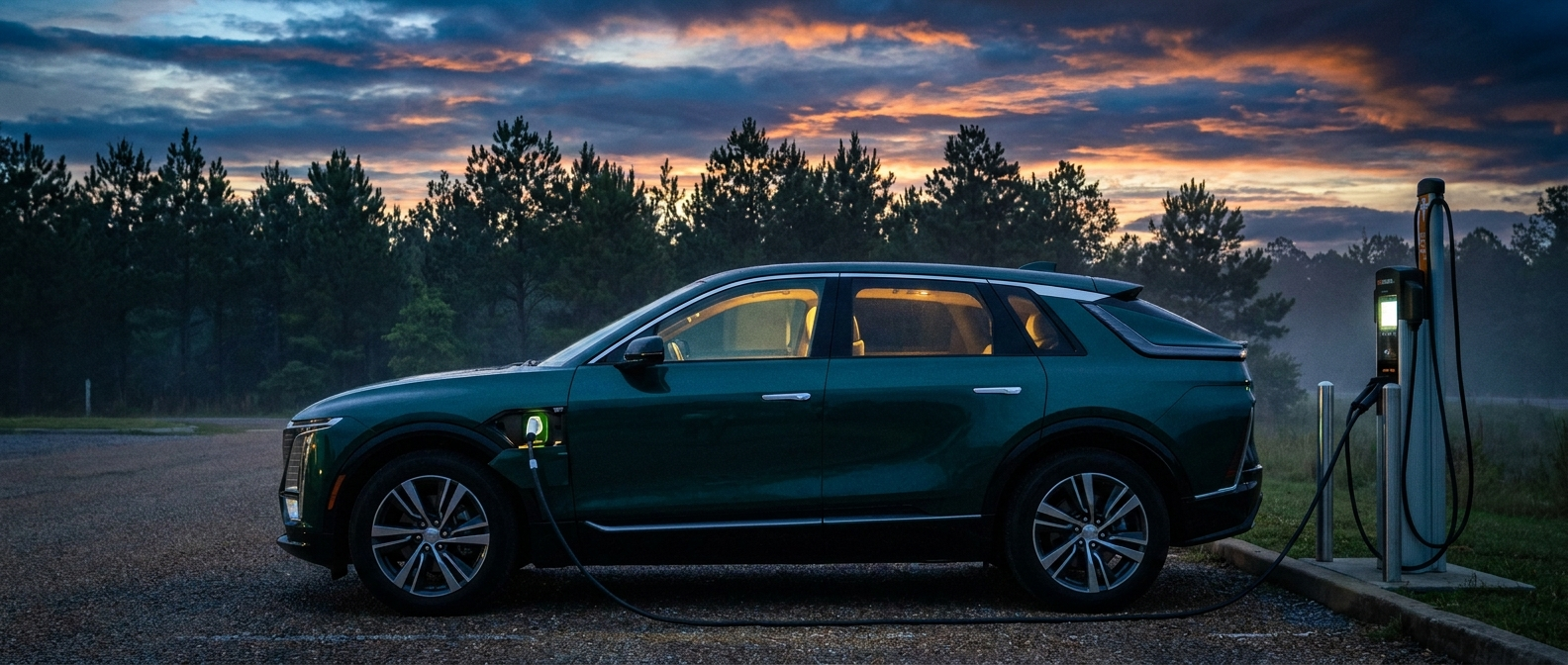
The Cadillac LYRIQ carries an EPA-estimated 326 miles of range in rear-wheel drive, and that's a substantial number by any measure. Drive it through the Jackson metro in July, though, with the climate system working hard and no Level 2 charger installed at home yet, and your daily reality will sit a fair bit below that EPA figure. We wrote this for the questions buyers in Ridgeland, Madison, and Brandon actually bring to us, covering what range is realistic here, where you charge, and how you build a routine that makes ownership easy.
How Far Will a Cadillac EV Really Go in Mississippi?
The EPA range figures are accurate, measured under standardized conditions, and they hold up as a baseline, but what moves them in the real world here is the continuous load of air conditioning through a Mississippi summer, which runs off the same pack that turns the wheels. Count on that draw being constant.
| Model | Drivetrain | EPA-Estimated Range | DC Fast Charge Rate | Level 2 (19.2 kW) |
|---|---|---|---|---|
| 2027 LYRIQ RWD | Single motor | 326 mi | 190 kW (up to 86 mi in 10 min) | Up to 50 mi/hr |
| 2027 LYRIQ AWD | Dual motor | 319 mi | 190 kW (up to 86 mi in 10 min) | Up to 50 mi/hr |
| 2027 OPTIQ RWD | Single motor | 317 mi | 150 kW (up to 79 mi in 10 min) | Up to 50 mi/hr |
| 2027 OPTIQ AWD | Dual motor | 303 mi | 150 kW | Up to 50 mi/hr |
| 2027 VISTIQ AWD | Dual motor | 305 mi | 190 kW (up to 80 mi in 10 min) | Up to 47 mi/hr |
| 2027 ESCALADE IQ AWD | Dual motor | 465 mi (Cadillac-est.) | 350 kW (up to 117 mi in 10 min) | Up to 36 mi/hr (std.) |
*All range figures are EPA-estimated except the ESCALADE IQ, which carries a Cadillac-estimated range. The ESCALADE IQ is over the weight threshold for mandatory EPA fuel-economy labeling.*
Air conditioning pulls continuous power from the same battery that moves the car, and in sustained summer heat that draw never lets up. A reasonable planning figure for warm-weather mixed driving is roughly 10 to 15 percent below the EPA estimate. So a 326-mile vehicle becomes a practical 275-to-290-mile vehicle on a hot August day, cabin pre-cooled from home and the AC holding comfort on the road. Still, that's plenty for any commute in this market, and it's the honest starting point for planning a run to Memphis, New Orleans, or the Gulf Coast.
One thing that barely registers on range here is cold-weather battery conditioning. Mississippi winters rarely challenge lithium-ion chemistry the way northern climates do. In this state the thermal concern runs the other way, toward keeping the pack cool during long DC fast-charge sessions in August. On a car that's sat baking on our Ridgeland lot all afternoon, the first few minutes of a fast-charge session can go toward cooling the pack before acceptance climbs, and the LYRIQ and VISTIQ thermal management systems are built to handle exactly that.
Where Do You Charge in the Ridgeland and Jackson Area?
The charging network across the Ridgeland and Jackson area is smaller than what you'd know from a major metro, so if you've owned an EV in Atlanta or Dallas, you'll notice fewer public stations than you're used to, though planning around that reality turns it into a non-issue. Most of the work happens at home anyway.
Our service team at 700 Adcock Street in Ridgeland keeps a 50 kW CCS2 charger on-site, handy for a top-up while you're in for service. For quicker public charging, Renaissance at Colony Park on Highland Colony Parkway in Ridgeland runs DC fast chargers rated to 125 kW output, two ports, open to the public. Pearl's Bass Pro Drive Tesla Supercharger (150 kW, public) sits well for drivers heading east or coming back from the coast, and it's the cleanest stop if you've got the OPTIQ or VISTIQ out on a longer run, since both carry native NACS ports and connect to Tesla Superchargers without an adapter.
LYRIQ and ESCALADE IQ use a CCS1 charge port instead. A GM-approved NACS adapter opens the Tesla Supercharger network to them, though it's a separate item you'll want to confirm and keep in the vehicle before a long trip. That's the practical split in the lineup right now, and it's worth knowing before you route a Memphis weekend.
Where should charging start? At home, and it's where we steer almost every buyer first. A professionally installed 19.2 kW Level 2 wall charger recovers up to 50 miles of range per hour on the LYRIQ. Plug in when you get home and by morning the battery is full, no public charger in your week at all. ESCALADE IQ owners get about 22 miles per hour from the standard 11.5 kW onboard charger; the available 19.2 kW unit raises that to about 36 miles per hour.
The OPTIQ's native NACS port and 150 kW DC fast-charge capability make it the most plug-and-go choice in the lineup for drivers who travel often and want the simplest access to the broadest charging network in the state.
- Home Level 2 charging eliminates most public-charger dependence for daily driving
- Native NACS port (OPTIQ, VISTIQ) connects to Tesla Superchargers without an adapter
- LYRIQ and ESCALADE IQ use CCS1; a GM-approved NACS adapter unlocks Supercharger access
- Renaissance at Colony Park in Ridgeland offers 125 kW public DC fast charging
- The Pearl Supercharger (Bass Pro Drive) is the practical fast stop for eastbound and southbound routes
Plan Your Cadillac EV Ownership This Way
The owners who make EV life feel effortless around here tend to follow one simple pattern, installing a home charger, setting the charge limit to 80 percent for everyday use (the battery's preferred long-term operating range), and saving 100 percent charges for the days they know they'll need the full distance. That rhythm, paired with the LYRIQ and VISTIQ range figures, covers nearly every commute and most regional travel here without a second thought.
For the ESCALADE IQ, the calculus gets even more relaxed. Cadillac estimates up to 465 miles on a full charge, and the 350 kW peak DC fast-charge capability means that on the rare stop you do make, it's roughly 117 miles of range in about 10 minutes at a compatible high-power charger. Here's the honest tradeoff. Finding a 350 kW charger in Mississippi today takes planning, and the infrastructure will expand, but right now that figure matters more for Interstate travel than for a daily Ridgeland-to-downtown loop.
The VISTIQ sits in a different spot. It's the three-row family hauler in the electric lineup, EPA-estimated at 305 miles with the standard 11.5 kW onboard charger, and it takes up to 190 kW at a public DC fast charger, good for about 80 miles in 10 minutes. For a family in Madison or Brandon juggling school, practice, and weekend travel, the home-charge routine handles the week. A regional trip to the Gulf Coast works fine with one planned stop.
We'll say this plainly. If you're not ready to install a home charger, you'll work harder to live with a Cadillac EV in this market than an owner who has one. The public network here is functional and growing, though it still isn't as dense as what you'd find in Atlanta or Dallas. For buyers willing to make the one-time home installation, and the professional class in Ridgeland and Madison usually has what it takes to do it, the daily routine gets genuinely low-friction. Plug in, sleep, drive.
Frequently Asked Questions
Does Mississippi heat reduce my Cadillac EV's range?
Yes, and the mechanism is worth understanding. Air conditioning draws power from the traction battery, not a separate system, so in sustained summer driving that continuous climate load trims real-world range by about 10 to 15 percent against the EPA estimate. The EPA cycle is standardized and doesn't replicate a 98-degree commute on I-55 with the cabin cooled to 68 degrees. A practical planning range for the 2027 LYRIQ RWD in warm-weather mixed driving lands around 275 to 290 miles. You can claw back some of that margin by pre-conditioning the cabin while still plugged in at home. The car cools before it disconnects from grid power, so you start the drive full and already comfortable.
Should I charge my Cadillac EV to 100 percent every night?
For routine daily driving, an 80 percent charge limit serves most owners well. Cadillac's battery management system recommends it for long-term capacity preservation, since lithium-ion chemistry operates most efficiently when it isn't held at full charge for long stretches. Every Cadillac EV lets you set that limit straight from the vehicle's settings menu or the myCadillac app. Reserve 100 percent charges for days when your route genuinely needs the full range. Around the Jackson metro, a partial charge covers most commutes.
What connector does my Cadillac EV use, and does it work at Tesla Superchargers?
The 2027 OPTIQ and 2027 VISTIQ come with a native NACS (North American Charging Standard) port that connects directly to Tesla Superchargers and the growing network of NACS-compatible public stations without an adapter. The 2027 LYRIQ and 2027 ESCALADE IQ use a CCS1 port instead, and a GM-approved NACS adapter opens Supercharger access for them. Confirm you've got it in the car before a longer trip. All four models also support Level 1 and Level 2 AC charging at home. *By the Cadillac of Jackson Team | October 2026*